Thank you for visiting SNEWPapers!
Sign up free
Story
March 27, 1883
Semi Weekly Interior Journal
Stanford, Lincoln County, Kentucky
What is this article about?
Article discusses the nutritional superiority of fish over meat, explaining why meat feels more satisfying despite fish being easier to digest and more nourishing. It distinguishes two types of fish based on fat distribution and advises against wasting edible parts like cod liver when preparing fish.
Clipping
OCR Quality
98%
Excellent
Full Text
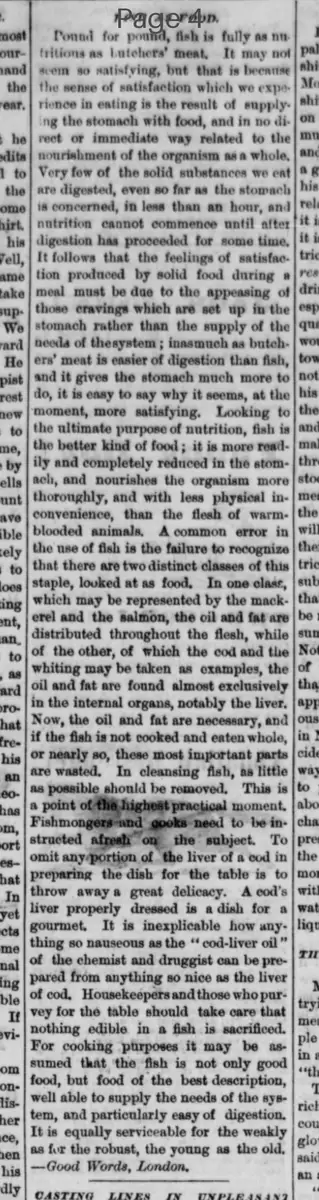
Pound for pound, fish is fully as nutritious as butchers' meat. It may not seem so satisfying, but that is because the sense of satisfaction which we experience in eating is the result of supplying the stomach with food, and in no direct or immediate way related to the nourishment of the organism as a whole.
Very few of the solid substances we eat are digested, even so far as the stomach is concerned, in less than an hour, and nutrition cannot commence until after digestion has proceeded for some time. It follows that the feelings of satisfaction produced by solid food during a meal must be due to the appeasing of those cravings which are set up in the stomach rather than the supply of the needs of the system; inasmuch as butchers' meat is easier of digestion than fish, and it gives the stomach much more to do, it is easy to say why it seems, at the moment, more satisfying.
Looking to the ultimate purpose of nutrition, fish is the better kind of food: it is more readily and completely reduced in the stomach, and nourishes the organism more thoroughly, and with less physical inconvenience, than the flesh of warm-blooded animals.
A common error in the use of fish is the failure to recognize that there are two distinct classes of this staple, looked at as food. In one class, which may be represented by the mackerel and the salmon, the oil and fat are distributed throughout the flesh, while of the other, of which the cod and the whiting may be taken as examples, the oil and fat are found almost exclusively in the internal organs, notably the liver.
Now, the oil and fat are necessary, and if the fish is not cooked and eaten whole or nearly so, these most important parts are wasted. In cleansing fish, as little as possible should be removed. This is a point of the highest practical moment. Fishmongers and cooks need to be instructed afresh on the subject.
To omit any portion of the liver of a cod in preparing the dish for the table is to throw away a great delicacy. A cod's liver properly dressed is a dish for a gourmet. It is inexplicable how anything so nauseous as the "cod-liver oil" of the chemist and druggist can be prepared from anything so nice as the liver of cod.
Housekeepers and those who purvey for the table should take care that nothing edible in a fish is sacrificed. For cooking purposes it may be assumed that the fish is not only good food, but food of the best description, well able to supply the needs of the system, and particularly easy of digestion. It is equally serviceable for the weakly as for the robust, the young as the old.-Good Words, London.
Very few of the solid substances we eat are digested, even so far as the stomach is concerned, in less than an hour, and nutrition cannot commence until after digestion has proceeded for some time. It follows that the feelings of satisfaction produced by solid food during a meal must be due to the appeasing of those cravings which are set up in the stomach rather than the supply of the needs of the system; inasmuch as butchers' meat is easier of digestion than fish, and it gives the stomach much more to do, it is easy to say why it seems, at the moment, more satisfying.
Looking to the ultimate purpose of nutrition, fish is the better kind of food: it is more readily and completely reduced in the stomach, and nourishes the organism more thoroughly, and with less physical inconvenience, than the flesh of warm-blooded animals.
A common error in the use of fish is the failure to recognize that there are two distinct classes of this staple, looked at as food. In one class, which may be represented by the mackerel and the salmon, the oil and fat are distributed throughout the flesh, while of the other, of which the cod and the whiting may be taken as examples, the oil and fat are found almost exclusively in the internal organs, notably the liver.
Now, the oil and fat are necessary, and if the fish is not cooked and eaten whole or nearly so, these most important parts are wasted. In cleansing fish, as little as possible should be removed. This is a point of the highest practical moment. Fishmongers and cooks need to be instructed afresh on the subject.
To omit any portion of the liver of a cod in preparing the dish for the table is to throw away a great delicacy. A cod's liver properly dressed is a dish for a gourmet. It is inexplicable how anything so nauseous as the "cod-liver oil" of the chemist and druggist can be prepared from anything so nice as the liver of cod.
Housekeepers and those who purvey for the table should take care that nothing edible in a fish is sacrificed. For cooking purposes it may be assumed that the fish is not only good food, but food of the best description, well able to supply the needs of the system, and particularly easy of digestion. It is equally serviceable for the weakly as for the robust, the young as the old.-Good Words, London.
What sub-type of article is it?
Curiosity
Medical Curiosity
What themes does it cover?
Moral Virtue
What keywords are associated?
Fish Nutrition
Digestion
Cod Liver
Food Preparation
Health Benefits
Story Details
Story Details
Fish is as nutritious as meat but more easily digested and nourishing overall, despite feeling less satisfying. Two classes of fish differ in fat distribution; advises minimal waste in preparation, especially cod liver as a delicacy, suitable for all ages and healths.