Thank you for visiting SNEWPapers!
Sign up free
Literary
December 7, 1739
The Virginia Gazette
Richmond, Williamsburg, Richmond County, Virginia
What is this article about?
This essay debates whether human life's miseries outweigh its felicities, surveying arguments from Homer, Pliny, and others, and invokes Christian providence to reconcile evils with divine goodness.
Merged-components note: This is a single philosophical essay continued across pages 2 and 3. Relabeled from 'editorial' to 'literary' as it fits a serialized essay rather than an opinion piece.
Clippings
1 of 2
OCR Quality
95%
Excellent
Full Text
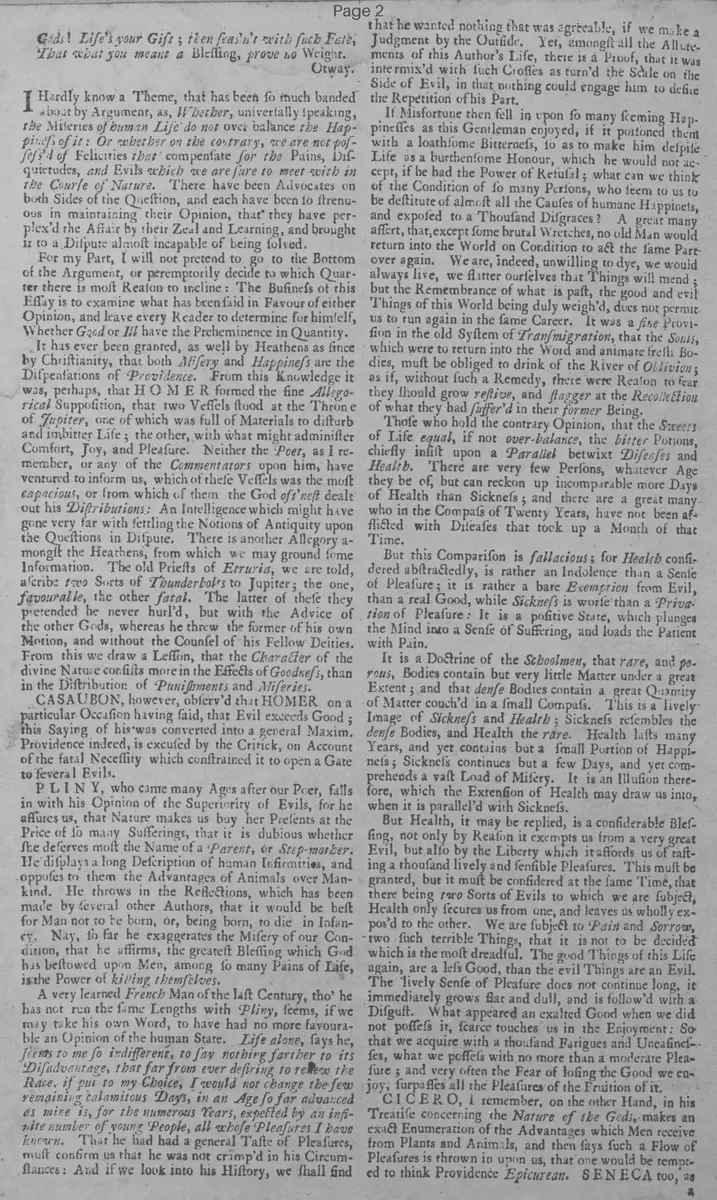
Gods! Life's your Gift; taken easily with such Task;
That what you meant a Blessing, prove no Weight.
Otway.
Hardly know a Theme, that has been so much bandied
about by Argument, as, I believe, universally speaking,
the Miseries of human Life do not over balance the Happiness of it: Or whether on the contrary, we are not possessed of Felicities that compensate for the Pains, Disquietudes, and Evils which we are sure to meet with in
the Course of Nature. There have been Advocates on
both Sides of the Question, and each have been so strenuous
in maintaining their Opinion, that they have perplexed
the Affair by their Zeal and Learning, and brought
it to a Dispute almost incapable of being solved.
For my Part, I will not pretend to go to the Bottom
of the Argument, or peremptorily decide to which Quarter
there is most Reason to incline: The Business of this
Essay is to examine what has been said in Favour of either
Opinion, and leave every Reader to determine for himself,
Whether Good or Ill have the Preheminence in Quantity.
It has ever been granted, as well by Heathens as since
by Christianity, that both Misery and Happiness are the
Dispensations of Providence. From this Knowledge it
was, perhaps, that HOMER formed the fine Allegorical
Supposition, that two Vessels stood at the Throne
of Jupiter, one of which was full of Materials to disturb
and imbitter Life; the other, with what might administer
Comfort, Joy, and Pleasure. Neither the Poet, as I remember, or any of the Commentators upon him, have
ventured to inform us, which of these Vessels was the most
capacious, or from which of them the God oft'nest dealt
out his Distributions: An Intelligence which might have
gone very far with settling the Notions of Antiquity upon
the Questions in Dispute. There is another Allegory amongst the Heathens, from which we may ground some
Information. The old Priests of Etruria, we are told,
ascribe two Sorts of Thunderbolts to Jupiter; the one,
favourable, the other fatal. The latter of these they
pretended he never hurled, but with the Advice of
the other Gods, whereas he threw the former of his own
Motion, and without the Counsel of his Fellow Deities.
From this we draw a Lesson, that the Character of the
divine Nature consists more in the Effects of Goodness, than
in the Distribution of Punishments and Miseries.
CASAUBON, however, observed that HOMER on a
particular Occasion having said, that Evil exceeds Good;
this Saying of his was converted into a general Maxim.
Providence indeed, is excused by the Critic, on Account
of the fatal Necessity which constrained it to open a Gate
to several Evils.
PLINY, who came many Ages after our Poet, falls
in with his Opinion of the Superiority of Evils, for he
assures us, that Nature makes us buy her Presents at the
Price of so many Sufferings, that it is dubious whether
She deserves most the Name of a Parent, or Step-mother.
He displays a long Description of human Infirmities, and
opposes to them the Advantages of Animals over Mankind. He throws in the Reflections, which has been
made by several other Authors, that it would be best
for Man not to be born, or, being born, to die in Infancy. Nay, so far he exaggerates the Misery of our Condition, that he affirms, the greatest Blessing which God
has bestowed upon Men, among so many Pains of Life,
is the Power of killing themselves.
A very learned French Man of the last Century, tho' he
has not run the same Lengths with Pliny, seems, if we
may take his own Word, to have had no more favourable
an Opinion of the human State. Life alone, says he,
seems to me so indifferent, to say nothing farther to its
Disadvantage, that far from ever desiring to renew the
Race, if put to my Choice, I would not change the few
remaining calamitous Days, in an Age so far advanced
as mine is, for the numerous Years, expected by an infinite
number of young People, all whose Pleasures I have
known. That he had had a general Taste of Pleasures,
must confirm us that he was not cramped in his Circumstances: And if we look into his History, we shall find
A wise Man, and as great a Philosopher, does not scruple to say, that considering the Multitude of good Things which Nature has imparted, and the inexhaustible Industry with which the Wit of Man diversifies Pleasures, and discovers the Sources of them; Heaven has not been contented to provide barely for our Necessities, but has besides furnished us with Superfluities enough to live deliciously.
In Spight however, of these fine Ideas, every living Man finds his State of Bliss severely chequer'd with Misfortunes: The Question is, whether these be owing to our own Fault, and incorrect Conduct, or to the Inflictions of Providence. The Mind of Man, being too narrow to comprehend clearly, how the Miseries and Crimes which cover the whole Earth, can be consistent with an infinitely good Being, has had Resort to many Shifts and chimerical Arguments: But Christianity only can set us right upon this Topick. We are to consider the Almighty as a Father and a Judge: As a Father, he has been indulgent to us in an Excess of good Things; as a Judge, he has rebated the Fruition of them with less Severity, than our Demerits could reasonably have expected from him.
That what you meant a Blessing, prove no Weight.
Otway.
Hardly know a Theme, that has been so much bandied
about by Argument, as, I believe, universally speaking,
the Miseries of human Life do not over balance the Happiness of it: Or whether on the contrary, we are not possessed of Felicities that compensate for the Pains, Disquietudes, and Evils which we are sure to meet with in
the Course of Nature. There have been Advocates on
both Sides of the Question, and each have been so strenuous
in maintaining their Opinion, that they have perplexed
the Affair by their Zeal and Learning, and brought
it to a Dispute almost incapable of being solved.
For my Part, I will not pretend to go to the Bottom
of the Argument, or peremptorily decide to which Quarter
there is most Reason to incline: The Business of this
Essay is to examine what has been said in Favour of either
Opinion, and leave every Reader to determine for himself,
Whether Good or Ill have the Preheminence in Quantity.
It has ever been granted, as well by Heathens as since
by Christianity, that both Misery and Happiness are the
Dispensations of Providence. From this Knowledge it
was, perhaps, that HOMER formed the fine Allegorical
Supposition, that two Vessels stood at the Throne
of Jupiter, one of which was full of Materials to disturb
and imbitter Life; the other, with what might administer
Comfort, Joy, and Pleasure. Neither the Poet, as I remember, or any of the Commentators upon him, have
ventured to inform us, which of these Vessels was the most
capacious, or from which of them the God oft'nest dealt
out his Distributions: An Intelligence which might have
gone very far with settling the Notions of Antiquity upon
the Questions in Dispute. There is another Allegory amongst the Heathens, from which we may ground some
Information. The old Priests of Etruria, we are told,
ascribe two Sorts of Thunderbolts to Jupiter; the one,
favourable, the other fatal. The latter of these they
pretended he never hurled, but with the Advice of
the other Gods, whereas he threw the former of his own
Motion, and without the Counsel of his Fellow Deities.
From this we draw a Lesson, that the Character of the
divine Nature consists more in the Effects of Goodness, than
in the Distribution of Punishments and Miseries.
CASAUBON, however, observed that HOMER on a
particular Occasion having said, that Evil exceeds Good;
this Saying of his was converted into a general Maxim.
Providence indeed, is excused by the Critic, on Account
of the fatal Necessity which constrained it to open a Gate
to several Evils.
PLINY, who came many Ages after our Poet, falls
in with his Opinion of the Superiority of Evils, for he
assures us, that Nature makes us buy her Presents at the
Price of so many Sufferings, that it is dubious whether
She deserves most the Name of a Parent, or Step-mother.
He displays a long Description of human Infirmities, and
opposes to them the Advantages of Animals over Mankind. He throws in the Reflections, which has been
made by several other Authors, that it would be best
for Man not to be born, or, being born, to die in Infancy. Nay, so far he exaggerates the Misery of our Condition, that he affirms, the greatest Blessing which God
has bestowed upon Men, among so many Pains of Life,
is the Power of killing themselves.
A very learned French Man of the last Century, tho' he
has not run the same Lengths with Pliny, seems, if we
may take his own Word, to have had no more favourable
an Opinion of the human State. Life alone, says he,
seems to me so indifferent, to say nothing farther to its
Disadvantage, that far from ever desiring to renew the
Race, if put to my Choice, I would not change the few
remaining calamitous Days, in an Age so far advanced
as mine is, for the numerous Years, expected by an infinite
number of young People, all whose Pleasures I have
known. That he had had a general Taste of Pleasures,
must confirm us that he was not cramped in his Circumstances: And if we look into his History, we shall find
A wise Man, and as great a Philosopher, does not scruple to say, that considering the Multitude of good Things which Nature has imparted, and the inexhaustible Industry with which the Wit of Man diversifies Pleasures, and discovers the Sources of them; Heaven has not been contented to provide barely for our Necessities, but has besides furnished us with Superfluities enough to live deliciously.
In Spight however, of these fine Ideas, every living Man finds his State of Bliss severely chequer'd with Misfortunes: The Question is, whether these be owing to our own Fault, and incorrect Conduct, or to the Inflictions of Providence. The Mind of Man, being too narrow to comprehend clearly, how the Miseries and Crimes which cover the whole Earth, can be consistent with an infinitely good Being, has had Resort to many Shifts and chimerical Arguments: But Christianity only can set us right upon this Topick. We are to consider the Almighty as a Father and a Judge: As a Father, he has been indulgent to us in an Excess of good Things; as a Judge, he has rebated the Fruition of them with less Severity, than our Demerits could reasonably have expected from him.
What sub-type of article is it?
Essay
What themes does it cover?
Moral Virtue
Religious
Death Mortality
What keywords are associated?
Human Miseries
Life Happiness
Providence
Philosophical Debate
Christian Perspective
Literary Details
Subject
The Balance Of Miseries And Happiness In Human Life
Key Lines
Gods! Life's Your Gift; Taken Easily With Such Task;
That What You Meant A Blessing, Prove No Weight.
Otway.
It Would Be Best For Man Not To Be Born, Or, Being Born, To Die In Infancy.
The Greatest Blessing Which God Has Bestowed Upon Men, Among So Many Pains Of Life, Is The Power Of Killing Themselves.