Thank you for visiting SNEWPapers!
Sign up free
The Representative
Saint Paul, Minneapolis, Ramsey County, Hennepin County, Minnesota
What is this article about?
After serving over six years in prison for embezzling from his bank, Lucius McKnight returns to Red Willow, confronts his past, starts a humble chair-reseating business, earns community respect through craftsmanship, partners with Phoebe Dillingham to build a prosperous firm, completes financial restitution, and marries schoolteacher Mary Lester.
Clipping
OCR Quality
Full Text
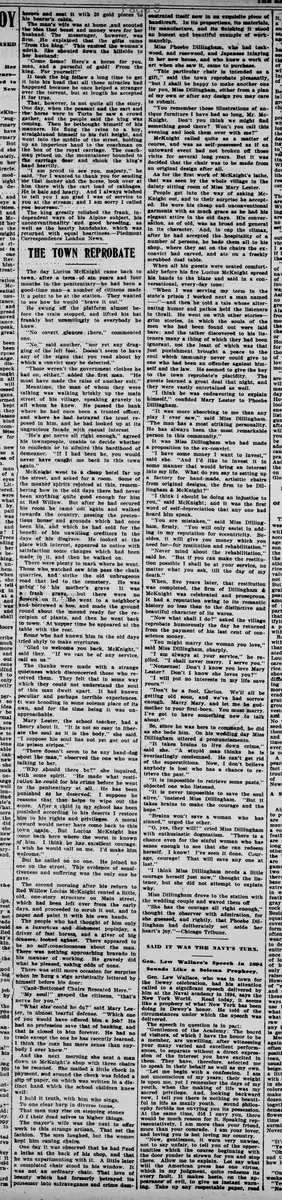
The day Lucius McKnight came back to town, after a term of six years and four months in the penitentiary—he had been a good-time man—a number of citizens made it a point to be at the station. They wanted to see how he would "brave it out."
He swung off the platform almost before the train stopped, and lifted his hat frankly but unsmilingly to everybody he knew.
"No covert glances there," commented one.
"No," said another, "nor yet any dragging of the left foot. Doesn't seem to have any of the signs that you read about by which a convict may be detected."
"Those weren't the government clothes he had on, either," added the first man. "He must have made the raise of another suit."
Meantime, the man of whom they were talking was walking briskly up the main street of his village, speaking gravely to all whom he knew. He passed the bank where he had once been a trusted officer, and where he had betrayed the trust reposed in him, and he had looked up at its ungracious facade with casual interest.
"He's got nerve all right enough," agreed his townspeople, unable to decide whether to condemn or to admire this hardihood of demeanor. "If I had been he, you would never have caught me back in this town again."
McKnight went to a cheap hotel far up the street, and asked for a room. Some of the meaner spirits rejoiced at this, remembering how in the old days there had never been anything quite good enough for him at Red Willow. But after he had secured his room he came out again and walked towards the country, passing the pretentious house and grounds which had once been his, and which he had sold for the benefit of his unwilling creditors in the days of his disgrace. He looked at the place with interest, appeared to notice with satisfaction some changes which had been made in it, and then he walked on.
There were plenty to mark where he went. Those who watched saw him pass the chalk quarries, and strike the old umbrageous road that led to the cemetery.
He was going to his mother's grave. It was a fresh grave, but there were no flowers on it. He went to a neighbor's and borrowed a hoe, and made the ground round about the mound ready for the reception of plants, and then he went back to town. At supper time he appeared at the table with the rest.
Some who had known him in the old days tried shyly to make overtures.
"Glad to welcome you back, McKnight," said they. "If we can be of any service, call on us."
The thanks were made with a strange quietness which disconcerted those who received them. They felt that in some way which they could not understand the soul of this man dwelt apart. It had known peculiar and perhaps terrible experiences. It was brooding in some solemn place of its own, and for the time being it was unapproachable.
Mary Lester, the school teacher, had a theory about it. "It is not so easy to liberate the soul as it is the body," she said. "I suppose his soul has not yet got out of its prison stripes."
"There doesn't seem to be any hand-dog about the man," observed the one who was talking to her.
"Why, should there be?" she inquired, with some spirit. "He made what restitution he could for his crime before he went to the penitentiary at all. He has been punished as he deserved. I suppose he reasons that that helps to wipe out the score. After a child in my school has been punished according to his deserts I restore him to his rights and privileges. A moral coward would never have come back to this town again. But Lucius McKnight has come back here where the worst is known of him. I think he has excellent courage. I wish he would call on me. I'd make him welcome."
But he called on no one. He joined no one on the street. This evidence of sensitiveness and suffering was the only one he gave.
The second morning after his return to Red Willow Lucius McKnight rented a little, old, one-story structure on Main street, which had been left over from the early days, and proceeded to scrub it out, and to paper and paint it with his own hands.
The people who had thought of him only as a luxurious and dishonest popinjay, a driver of fast horses, and a giver of big dinners, looked aghast. There appeared to be no self-consciousness about the man. There was nothing approaching bravado in his manner of working. He gravely did what he pleased; asking odds of none.
There was still more occasion for surprise when he hung a sign artistically lettered by himself before his door:
"Cane-Bottomed Chairs Reseated Here."
"My soul!" gasped the citizens, "that's nerve for you."
"What else could he do?" said Mary Lester, in almost tearful defense. "Which one of you would have offered him a job? He had no profession save that of banking, and that is closed to him forever. He had no trade except the one he has recently learned. I think the man has more sense than anybody I ever knew."
And the next morning she sent a man down to McKnight's shop with three chairs to be recaned. She mailed a little check in payment, and around the check was folded a slip of paper, on which was written in a distinct hand, which the school children knew well:
I hold it truth, with him who sings,
To one clear harp in diverse tones,
That men may rise on stepping stones
Of their dead selves to higher things.
The mayor's wife was the next to offer work to this strange artisan. That set the fashion. The men laughed, but the women kept him caning chairs.
One day it was observed that he had fixed a lathe at the back of his shop, and that he was experimenting with it. A little later a completed chair stood in his window. It was not an ordinary chair. That love of beauty which had formerly betrayed its possessor into extravagance and crime demonstrated itself now in an exquisite piece of handicraft. In its proportions, its materials, its manufacture, and its finishing it stood an honest and beautiful example of workmanship.
Miss Phoebe Dillingham, who had teakwood, and rosewood, and Japanese inlaying in her new house, and who knew a work of art when she saw it, came to purchase.
"This particular chair is intended as a gift," said the town reprobate pleasantly, "but I shall be happy to make another one for you, Miss Dillingham, either from a plan of my own or after any design you may care to submit.
"You remember those illustrations of antique furniture I have had so long, Mr. McKnight. Don't you think we might find something good there? Won't you call this evening and look them over with me?"
McKnight called quite as a matter of course, and was as self-possessed as if an untoward event had not broken off those visits for several long years. But it was decided that the chair was to be made from an original design after all.
As for the first work of McKnight's lathe, that was seen by the whole village in the dainty sitting room of Miss Mary Lester. People got into the way of asking McKnight out, and to their surprise he accepted. He wore his cheap and unconventional garments with as much grace as he had his elegant attire in the old days. His conversation, as of old, was as broad and general in its character. And, to cap the climax, after he had accepted the hospitality of a number of persons, he bade them all to his shop, where they sat on the chairs the ex-convict had carved, and ate on a freshly scrubbed deal table.
When all his guests were seated comfortably before his fire Lucius McKnight spread his hands to the blaze and said in a conversational, every-day tone:
"When I was serving my term in the state's prison I worked next a man named "—and then he told a tale whose alternating humor and pathos held the listeners in thrall. He went on with other stories—grim stories, in which the souls of the men who had been found out were laid bare; and the talker discovered to his listeners many a thing of which they had been ignorant, not the least of which was that just punishment brought a peace to the soul which immunity never could give to one who had been an offender against himself and the law. He seemed to give the key to the town reprobate's placidity.
The guests learned a great deal that night, and they were vastly entertained as well.
"I think he was endeavoring to explain himself," confided Mary Lester to Phoebe Dillingham.
"It was more absorbing to me than any play I ever saw," said Miss Dillingham.
"The man has a most striking personality. He has always been the most remarkable person in this community."
It was Miss Dillingham who had made a proposition to the ex-convict.
"I have some money I want to invest," said she. "And I'd like to invest it in some manner that would bring an interest into my life. What do you say to setting up a factory for hand-made artistic chairs from original designs, the firm to be Dillingham & McKnight?"
"I think I should be doing an injustice to you," said McKnight; and it was the first word of self-depreciation that any one had heard him speak.
"You are mistaken," said Miss Dillingham, firmly. "You will only assist in adding to my reputation for eccentricity. Besides, it will give you money which you need for—for restitution and rehabilitation."
"Never mind about the rehabilitation," said he. "But if you can make the restitution possible I shall be at your service, no matter what you ask, till the day of my death."
When, five years later, that restitution was completed, the firm of Dillingham & McKnight was celebrated and prosperous. It had a reputation owing to its romantic history no less than to the distinctive and beautiful character of its wares.
"Now what shall I do?" asked the village reprobate humorously the day he returned from the payment of his last cent of conscience money.
"You might marry the woman you love," said Miss Dillingham, sharply.
"I am always at your service," he replied. "I shall never marry. I serve you."
"Nonsense! Don't I know you love Mary Lester? Don't I know she loves you?"
"I will put no interests in my life save yours."
"Don't be a fool, Lucius. We'll all be getting old soon, and we've had sorrow enough. Marry Mary, and let me be godmother to your first-born. You must marry. I've got to have something new to talk about."
So, since he was hers to command, he did as she bade him. On his wedding day Miss Dillingham uttered a pronunciamento.
"It takes brains to live down crime," said she. "A stupid man thinks he is everlastingly condemned. He can't get rid of the superstitions. Now, I don't believe anybody is lost who has a chance to retrieve the past."
"It is impossible to retrieve some pasts," objected one who listened.
"It is never impossible to save the soul alive," insisted Miss Dillingham. "But it takes brains to make the courage and the hope."
"Brains won't save a woman who has sinned," urged the other.
"O, yes, they will!" cried Miss Dillingham with enthusiastic dogmatism. "There is a chance even for the sinful woman who has sense enough to see that she can redeem herself. I know! I've seen it done. Courage, courage! That will save any one at last."
"I think Miss Dillingham needs a little courage herself just now," thought the listener, but she did not attempt to explain why.
Miss Dillingham drove to the station with the wedding couple and waved them off.
"She has the courage all right enough," thought the observer with admiration, for she guessed, and rightly, that Phoebe Dillingham had deliberately set aside her heart's joy.—Chicago Tribune.
What sub-type of article is it?
What themes does it cover?
What keywords are associated?
What entities or persons were involved?
Where did it happen?
Story Details
Key Persons
Location
Red Willow
Story Details
Lucius McKnight returns to Red Willow after prison for embezzlement, faces townsfolk's scrutiny, tends his mother's grave, starts reseating cane-bottomed chairs, gains work from women, creates artistic furniture, partners with Phoebe Dillingham for a factory, completes restitution, and marries Mary Lester after Dillingham's encouragement.