Thank you for visiting SNEWPapers!
Sign up free
Republican Herald
Providence, Providence County, Rhode Island
What is this article about?
Biography of Jacques Lafitte, from humble origins in Bayonne to becoming a prominent banker and French deputy, highlighting his rise, defense of the Bank of France against Napoleon and allies, political contributions, and philanthropy.
Merged-components note: Continuation of the biographical article on Jacques Lafitte across pages 1 and 2, with seamless text flow.
Clippings
1 of 2
OCR Quality
Full Text
MONS. JACQUES LAFITTE,
Member of the French Chambers of Deputies.
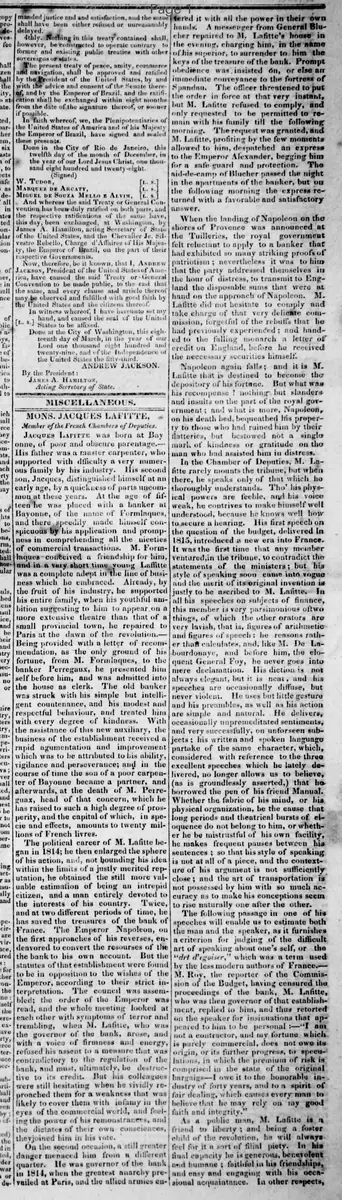
JACQUES LAFITTE was born at Bayonne, of poor and obscure parentage. His father was a master carpenter, who supported with difficulty a very numerous family by his industry. His second son, Jacques, distinguished himself at an early age, by a quickness of parts uncommon at these years. At the age of fifteen he was placed with a banker at Bayonne, of the name of Formilagues, and there speedily made himself conspicuous by his application and promptness in comprehending all the niceties of commercial transactions. M. Formilagues conceived a friendship for him, and in a very short time young Lafitte was a complete adept in the line of business which he embraced. Already, by the fruit of his industry, he supported his entire family, when his youthful ambition suggesting to him to appear on a more extensive theatre than that of a small provincial town, he repaired to Paris at the dawn of the revolution. Being provided with a letter of recommendation, as the only ground of his fortune, from M. Formilagues, to the banker Perregaux, he presented himself before him, and was admitted into the house as clerk. The old banker was struck with his simple but intelligent countenance, and his modest and respectful behaviour, and treated him with every degree of kindness. With the assistance of this new auxiliary, the business of the establishment received a rapid augmentation and improvement which was to be attributed to his ability, vigilance and perseverance; and in the course of time the son of a poor carpenter of Bayonne became a partner, and afterwards, at the death of M. Perregaux, head of that concern, which he has raised to such a high degree of prosperity, and the capital of which, in specie and effects, amounts to twenty millions of French livres.
The political career of M. Lafitte began in 1814; he then enlarged the sphere of his action, and, not bounding his ideas within the limits of a justly merited reputation, he obtained the still more valuable estimation of being an intrepid citizen, and a man entirely devoted to the interests of his country. Twice, and at two different periods of time, he has saved the treasures of the bank of France. The Emperor Napoleon, on the first approaches of his reverses, endeavored to convert the resources of the bank to his own account. But the statutes of that establishment were found to be in opposition to the wishes of the Emperor, according to their strict interpretation. The council was assembled; the order of the Emperor was read, and the whole meeting looked at each other with symptoms of terror and trembling, when M. Lafitte, who was the governor of the bank, arose, and with a voice of firmness and energy, refused his assent to a measure that was contradictory to the regulation of the bank, and must, ultimately, be destructive to its credit. But his colleagues were still hesitating when he vividly reproached them for a weakness that was likely to cover them with infamy in the eyes of the commercial world, and feeling the power of his remonstrances, and the dictates of their own consciences, they joined him in his vote.
On the second occasion, a still greater danger menaced him from a different quarter. He was governor of the bank in 1814, when the greatest anarchy prevailed at Paris, and the allied armies entered it with all the power in their own hands. A messenger from General Blucher repaired to M. Lafitte's house in the evening, charging him, in the name of his superior, to surrender to him the keys of the treasure of the bank. Prompt obedience was insisted on, or else an immediate conveyance to the fortress of Spandau. The officer threatened to put the order in force at that very instant, but M. Lafitte refused to comply, and only requested to be permitted to remain with his family till the following morning. The request was granted, and M. Lafitte, profiting by the few moments allowed to him, despatched an express to the Emperor Alexander, begging him for a safe-guard and protection. The aid-de-camp of Blucher passed the night in the apartments of the banker, but on the following morning the express returned with a favorable and satisfactory answer.
When the landing of Napoleon on the shores of Provence was announced at the Tuilleries, the royal government felt reluctant to apply to a banker that had exhibited so many striking proofs of patriotism; nevertheless it was to him that the party addressed themselves in the hour of distress, to transmit to England the disposable sums that were at hand on the approach of Napoleon. M. Lafitte did not hesitate to comply and take charge of that very delicate commission, forgetful of the rebuffs that he had previously experienced; and handed to the falling monarch a letter of credit on England, before he received the necessary securities himself.
Napoleon again falls; and it is M. Lafitte that is destined to become the depository of his fortune. But what was his recompense ? nothing but slanders and insults on the part of the royal government; and what is more, Napoleon, on his death bed, bequeathed his property to those who had ruined him by their flatteries, but bestowed not a single mark of kindness or gratitude on the man who had assisted him in distress.
In the Chamber of Deputies, M. Lafitte rarely mounts the tribune, but when there, he speaks only of that which he thoroughly understands. Tho' his physical powers are feeble, and his voice weak, he contrives to make himself well understood, because he knows well how to secure a hearing. His first speech on the question of the budget, delivered in 1815, introduced a new era into France. It was the first time that any member ventured, in the tribune, to contradict the statements of the ministers; but his style of speaking soon came into vogue and the merit of its original invention is justly to be ascribed to M. Lafitte. In all his speeches on subjects of finance, this member is very parsimonious of two things, of which the other orators are very lavish, that is, figures of arithmetic and figures of speech: he reasons rather than calculates, and, like M. De Labourdonnaye, and before him, the eloquent General Foy, he never goes into mere declamation. His diction is not always elegant, but it is neat, and his speeches are occasionally diffuse, but never violent. He uses but little gesture and his preambles, as well as his action are simple and natural. He delivers, occasionally unpremeditated sentiments, and very successfully, on unforeseen subjects; his written and spoken language partake of the same character, which, considered with reference to the three excellent speeches which he lately delivered, no longer allows us to believe, (as is groundlessly asserted,) that he borrowed the pen of his friend Manuel.
Whether the fabric of his mind, or his physical organization, be the cause that long periods and theatrical bursts of eloquence do not belong to him, or whether he be mistrustful of his own facility, he makes frequent pauses between his sentences ; so that his style of speaking is not at all of a piece, and the texture of his argument is not sufficiently close; and the art of transportation is not possessed by him with so much accuracy as to make his conceptions seem to rise naturally one after the other.
The following passage in one of his speeches will enable us to estimate both the man and the speaker, as it furnishes a criterion for judging of the difficult art of speaking about one's self, or the "art d'egoiser," which was a term used by the less modern authors of France. M. Roy, the reporter of the Commission of the Budget, having censured the proceedings of the bank, M. Lafitte, who was then governor of that establishment, replied to him, and thus retorted on the speaker for insinuations that appeared to him to be personal :-"I am not a contractor, and my fortune which is purely commercial, does not owe its origin, or its further progress, to speculations, in which the premium of risk is comprised in the state of the original bargains--I owe it to the honorable industry of forty years, and to a spirit of fair dealing, which causes every man to believe that he may rely on my good faith and integrity."
As a public man, M. Lafitte is a friend to liberty ; and being a foster child of the revolution, he will always feel for it a sort of filial piety. In his social capacity he is generous, benevolent and humane ; faithful in his friendships. and easy and engaging with his occasional acquaintance. In other respects, His vanity is excessive, and he carries it to the extreme; so that flattery, however gross it may be, is eagerly swallowed by him on every occasion. Behold him, any evening at one of his grand balls, where the most select society of Paris is collected around him, of those most distinguished for rank, talents, importance, and property, to the number of two or three thousand. He there resembles a king receiving the homage of his subjects, rather than the master of a house that seems eager to give a kind and hospitable reception to his guests. This degree of stiffness is rather inexplicable, because the habits of M. Lafitte are simple, and amidst the gorgeous glare that surrounds him, he frequently betrays symptoms of his originally humble condition, and narrow economy and thrift. Thus, on these evenings of parade, he frequently takes a sponge in his hand to wipe off the water that flows down the panes of glass, so that it may not spoil his fine mouldings, and the elegant gilding of his windows. But what are these weaknesses compared with the many valuable qualities with which they are attended? As he possesses an immense fortune, it may be asserted that no man knows better than M. Lafitte how to make a good use of it. His purse is always open to the wretched and unfortunate. He has relieved the indigence of the family of Ney, by giving his only daughter in marriage to the eldest son of that Marshal. He has also relieved his proscribed countrymen; and those especially who have taken refuge at London, have received ten thousand livres as gratuities of his bounty. In short, he is the natural protector of all industrious enterprises, of all useful talents, and all sufferings under unmerited misfortune; and there is scarcely a single useful enterprise, or benevolent society in France, to which M. Lafitte has not contributed either by his influence, his counsels, or his purse.
What sub-type of article is it?
What themes does it cover?
What keywords are associated?
What entities or persons were involved?
Where did it happen?
Story Details
Key Persons
Location
Bayonne, Paris, France
Event Date
Born Late 18th Century; Active 1814 1815
Story Details
Jacques Lafitte rises from poverty in Bayonne to head a major Paris bank, defends Bank of France against Napoleon and Prussian demands in 1814, aids royal government and Napoleon in crises, serves as deputy with influential financial speeches, and uses fortune for philanthropy despite personal flaws.