Thank you for visiting SNEWPapers!
Sign up free
Letter to Editor
June 16, 1832
Southern Planter
Woodville, Wilkinson County, Mississippi
What is this article about?
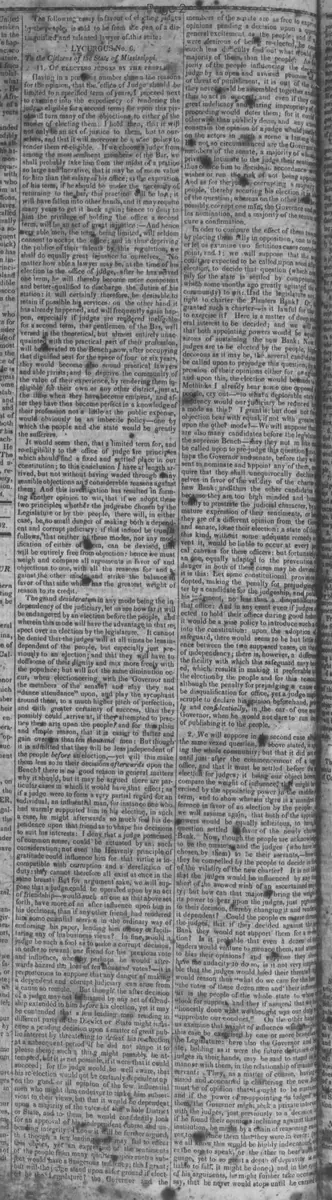
A letter argues for electing judges by the people over appointment by the governor and senate to ensure judicial independence, using the controversial Planters Bank charter as an example and proposing constitutional safeguards against prejudging cases.
Clipping
OCR Quality
72%
Good
Full Text
members of the senate are as free to express opinions pending a decision upon general excitement as the people; and if
were desirous of being
re-elected, he
CO
much less difficulty find out what would
majority of them, than the people:
An
jority of the people influencing
the
dec
judge by an open and avowed
promise of
or threat of punishment, it is
out of the
bxu
they never old be assembled together and
thus to act in concert; and
even if they
he
great indelicacy and daring
impropriety of
proceeding would deter them; for it
otherwise than publicly
done, and
any atle
could
constrain the opinion of a judge
would justly
on the actors in such a scene
not so circumstanced are the Governor
a
lasting
dr
members of the senate, a majority of whom
privat
intimate to the judge their sentiments
thus coerce him to decide in accordance
wishes or run the risk of not being appoint
And as or the judge corrupting a majority
people, thereby securing his election it is
possibly corrupt one man, the Governor and
his nomination, and a majority of the senate
cure a confirmation.
of the question; whereas on the other
CO
In order to compare the effect of these two
by placing them fully in opposition, one to
cr let us examine two fictitious cases complete
point, and 1: we will suppose that the
court are expected to be called upon soon after
election, to decide that question (which no
pity for the state is settled by compromise
which some months ago greatly agitated the
community) to wit: Had the legislature any
right to charter the Planters Bank? Or,
granted such a charter--is it lawful for that
to exercise it? Here is a matter of deep an
eral interest to be decided; and we will
that both appointing powers would be equal
desirous of sustaining the new Bank: Now
judges are to be elected by the people, high
decorous as it may be, the several candidates
be called upon to prejudge this question, by
profession of their opinions either for or agoi
and upon this, the election would be made to
Methinks I already hear some one opposed
people, cry out--to what a deplorable state
perfdoncy would our judiciary be reduced by
a mode as this!' - I grant it: but does not th
objection bear with equal, if not with greater:
upon the other mode?--We will suppose the:
are also many candidates before the legislatip
the supreme Bench--they not in like a
be called upon to pre-judge this question n4
haps the Governor and senate, before they vm
sent to nominate and appoint any of them, m
quire that they shall unequivocally declare the
selves in favor of the validity- of the charte
new Bank: and thus the other candidates
because-they are too high minded and honest:
to feignly to prostrate the judicial character, byi-
mature expression of their sentiments, or because
they are of a different opinion from, the Gore.
and senate, lose their election: a state of things
this kind, without some adequate remedy to
vent it, would be liable to occur at every political
cal canvass of these officers: but fortunately there
is an one, equally adapted to the prevention dj
danger in both of these cases may be derived
it in this:'Let some constitutional provision
adopted, making the penalty of, prejudging
1er by a candidate for the judgeship, and put,
hin judgment, : no less than a disqualification
that office: And in any event even if judges
ected to hold- their offices during good beba
it would be a wise policy to introduce such ad:
into the constitution: upon the adoption of
such a safeguard, there would seem to be but little difference between the two supposed cases, on that
of independence; there is, however, a difference
the facility with which this safeguard may be!
ed; which results in making it preferable pi
the election by the people and for this reason.
although the penalty for prejudging a cause
be disqualification for office, yet a judge might
acruple to declare his opinion beforehand, m
ly and confidentially, in the ear of one i
Bi
Governor, when he would not dare to run
of publishing it to the people,'
2. We will suppose in
second case al
the same vexed question, above stated, is agitating the whole community; but that it did not
until just after the commencement of a term
of office, and that it must be settled before the
election for judges; it being our object here to
compare the weight of influence, the might be
exercised by the appointing power in the middle
term, and to show wherein there is a manifest
difference in favor of an election by the people:,
we will assume again, that both of the appoi
powers would be equally solicitous, to have
question settled in favor of the newly chartered
Bank. Now, though the people are acknowledged
to be the masters and the judges (who have been
chosen by them) to be their servants,--howe
can they be compelled by the people to decide in f
of the validity of the new charter? It is not li
that the judges would be influenced by any
short of the avowed wish of an ascertained ma
jority; but how can that majority bring the weight
of its power to bear upon the judges, just previous
to their decision, thereby changing it and rendering
it dependent? Could the people en masse threaten
the judges, that if they decided against the
Bank they would not support them for a re
election? Is it probable that even a dozen of the
leaders would venture to menace them, and attempt
to bias their opinions? and suppose they should
have the audacity to do so, is it not very improbable
that the judges would heed their threats!
would reason thus "what do we care for these
"the votes of these dozen men and their influence
it is the people of the whole state to whom
"look for support, and they if assured that we
"honestly done what we thought was our duty
"approbate our conduct."
On the other hand
let us examine that weight of influence which might
this case be exercised by one or more branches
the Legislature: here also the
Governor and
ate, holding as it were the future
destinies of
judges in their hands, may be said to stand
In
manor
with
them
in
the
relationship
of master
servant: They, as a matter of course, having
sisted and concurred in chartering the new Bank
must be of opinion that it ought to be sustained
and if the power of re-appointing is lodged
with them, the Governor might seek a private interview
with the judges, just previously to a decision
if he found their opinions inclining against the
institution, he might by a chain of reasoning endeavor
to convince them that they were in error:
we all know this would be highly indecorous
either the one to speak, or the other to hear such
language, yet to so great a depth of depravity
men are liable to fall; it might be done;) and in the course
of his arguments, he might further take occasion
to say, that he never would stop until he carried
were desirous of being
re-elected, he
CO
much less difficulty find out what would
majority of them, than the people:
An
jority of the people influencing
the
dec
judge by an open and avowed
promise of
or threat of punishment, it is
out of the
bxu
they never old be assembled together and
thus to act in concert; and
even if they
he
great indelicacy and daring
impropriety of
proceeding would deter them; for it
otherwise than publicly
done, and
any atle
could
constrain the opinion of a judge
would justly
on the actors in such a scene
not so circumstanced are the Governor
a
lasting
dr
members of the senate, a majority of whom
privat
intimate to the judge their sentiments
thus coerce him to decide in accordance
wishes or run the risk of not being appoint
And as or the judge corrupting a majority
people, thereby securing his election it is
possibly corrupt one man, the Governor and
his nomination, and a majority of the senate
cure a confirmation.
of the question; whereas on the other
CO
In order to compare the effect of these two
by placing them fully in opposition, one to
cr let us examine two fictitious cases complete
point, and 1: we will suppose that the
court are expected to be called upon soon after
election, to decide that question (which no
pity for the state is settled by compromise
which some months ago greatly agitated the
community) to wit: Had the legislature any
right to charter the Planters Bank? Or,
granted such a charter--is it lawful for that
to exercise it? Here is a matter of deep an
eral interest to be decided; and we will
that both appointing powers would be equal
desirous of sustaining the new Bank: Now
judges are to be elected by the people, high
decorous as it may be, the several candidates
be called upon to prejudge this question, by
profession of their opinions either for or agoi
and upon this, the election would be made to
Methinks I already hear some one opposed
people, cry out--to what a deplorable state
perfdoncy would our judiciary be reduced by
a mode as this!' - I grant it: but does not th
objection bear with equal, if not with greater:
upon the other mode?--We will suppose the:
are also many candidates before the legislatip
the supreme Bench--they not in like a
be called upon to pre-judge this question n4
haps the Governor and senate, before they vm
sent to nominate and appoint any of them, m
quire that they shall unequivocally declare the
selves in favor of the validity- of the charte
new Bank: and thus the other candidates
because-they are too high minded and honest:
to feignly to prostrate the judicial character, byi-
mature expression of their sentiments, or because
they are of a different opinion from, the Gore.
and senate, lose their election: a state of things
this kind, without some adequate remedy to
vent it, would be liable to occur at every political
cal canvass of these officers: but fortunately there
is an one, equally adapted to the prevention dj
danger in both of these cases may be derived
it in this:'Let some constitutional provision
adopted, making the penalty of, prejudging
1er by a candidate for the judgeship, and put,
hin judgment, : no less than a disqualification
that office: And in any event even if judges
ected to hold- their offices during good beba
it would be a wise policy to introduce such ad:
into the constitution: upon the adoption of
such a safeguard, there would seem to be but little difference between the two supposed cases, on that
of independence; there is, however, a difference
the facility with which this safeguard may be!
ed; which results in making it preferable pi
the election by the people and for this reason.
although the penalty for prejudging a cause
be disqualification for office, yet a judge might
acruple to declare his opinion beforehand, m
ly and confidentially, in the ear of one i
Bi
Governor, when he would not dare to run
of publishing it to the people,'
2. We will suppose in
second case al
the same vexed question, above stated, is agitating the whole community; but that it did not
until just after the commencement of a term
of office, and that it must be settled before the
election for judges; it being our object here to
compare the weight of influence, the might be
exercised by the appointing power in the middle
term, and to show wherein there is a manifest
difference in favor of an election by the people:,
we will assume again, that both of the appoi
powers would be equally solicitous, to have
question settled in favor of the newly chartered
Bank. Now, though the people are acknowledged
to be the masters and the judges (who have been
chosen by them) to be their servants,--howe
can they be compelled by the people to decide in f
of the validity of the new charter? It is not li
that the judges would be influenced by any
short of the avowed wish of an ascertained ma
jority; but how can that majority bring the weight
of its power to bear upon the judges, just previous
to their decision, thereby changing it and rendering
it dependent? Could the people en masse threaten
the judges, that if they decided against the
Bank they would not support them for a re
election? Is it probable that even a dozen of the
leaders would venture to menace them, and attempt
to bias their opinions? and suppose they should
have the audacity to do so, is it not very improbable
that the judges would heed their threats!
would reason thus "what do we care for these
"the votes of these dozen men and their influence
it is the people of the whole state to whom
"look for support, and they if assured that we
"honestly done what we thought was our duty
"approbate our conduct."
On the other hand
let us examine that weight of influence which might
this case be exercised by one or more branches
the Legislature: here also the
Governor and
ate, holding as it were the future
destinies of
judges in their hands, may be said to stand
In
manor
with
them
in
the
relationship
of master
servant: They, as a matter of course, having
sisted and concurred in chartering the new Bank
must be of opinion that it ought to be sustained
and if the power of re-appointing is lodged
with them, the Governor might seek a private interview
with the judges, just previously to a decision
if he found their opinions inclining against the
institution, he might by a chain of reasoning endeavor
to convince them that they were in error:
we all know this would be highly indecorous
either the one to speak, or the other to hear such
language, yet to so great a depth of depravity
men are liable to fall; it might be done;) and in the course
of his arguments, he might further take occasion
to say, that he never would stop until he carried
What sub-type of article is it?
Persuasive
Political
What themes does it cover?
Politics
Constitutional Rights
What keywords are associated?
Judicial Independence
Election Of Judges
Planters Bank
Constitutional Provision
Judicial Appointment
What entities or persons were involved?
The Printer
Letter to Editor Details
Recipient
The Printer
Main Argument
electing judges by the people ensures greater judicial independence than appointment by the governor and senate, as the latter allows easier coercion through private influence, illustrated by fictitious cases involving the planters bank charter; proposes constitutional disqualification for candidates who prejudge cases.
Notable Details
Fictitious Cases Comparing Election Vs. Appointment
Planters Bank Charter Controversy
Private Interviews By Governor To Influence Judges