Thank you for visiting SNEWPapers!
Sign up free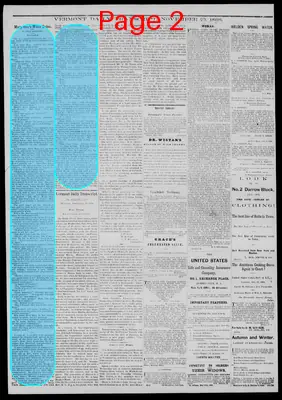
Literary
November 23, 1868
Vermont Daily Transcript
Saint Albans, Franklin County, Vermont
What is this article about?
In this moral tale, young Mary Starr forgoes buying a white dress for a party to purchase a bonnet for her hardworking mother, embracing inner 'goodness' as true white robes. At the party, she receives a dress gift, forgives friend Bessie, and learns about spiritual purity over outward appearances.
Clipping
OCR Quality
95%
Excellent
Full Text
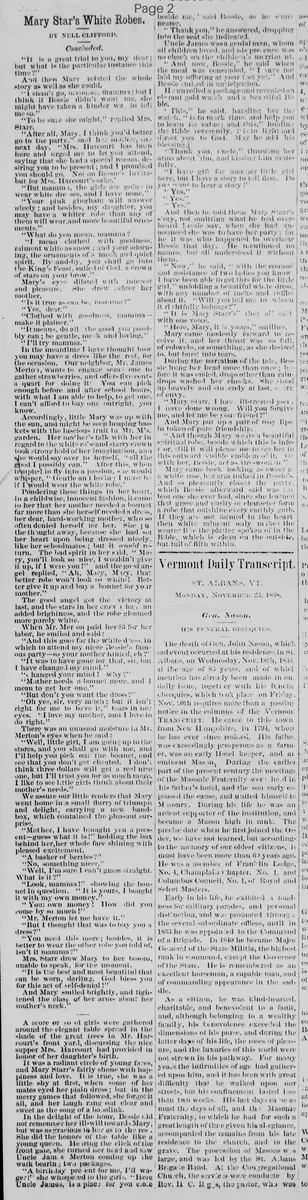
Mary Star's White Robes.
BY NELL CLIFFORD.
Concluded.
"It is a great trial to you, my dear; but what is the particular instance this time?"
And then Mary related the whole story as well as she could.
"I shan't go, of course, mammi; but I think if Bessie didn't want me, she might have taken a kinder way to tell me so."
"To be sure she might," replied Mrs. Starr.
"After all, Mary, I think you'd better go to the party," said her mother the next day. "Mrs. Harcourt has been here and urged me to let you attend, saying that she had a special reason, desiring you to be present; and I promised you should go. Not on Bessie's invitation, but for Mrs. Harcourt's sake."
"But mammi, the girls are going to wear white dresses, and I have none."
"Your pink gingham will answer nicely; and besides, my daughter, you may have a whiter robe than any of them will wear, and more beautiful ornaments."
"What do you mean, mamma?"
"I mean clothed with goodness, raiment white as snow; and your adorning, the ornaments of a meek and quiet spirit. By-and-by, you shall go into the King's Feast, called of God, a crown of stars on your brow."
Mary's eyes dilated with interest and pleasure. She drew nearer her mother.
"Is it true as can be, mammi?"
"Yes, dear."
"Clothed with goodness, mamma—make it plainer."
"It means, do all the good you possibly can; be gentle, meek and loving."
"I'll try, mamma. In the meantime I have thought how you may have a dress like the rest, for the occasion. Our neighbor, Mr. James Merton, wants to engage some one to gather strawberries, and offers five cents a quart for doing it. You can pick enough before and after school hours, with what I am able to help, to get one. I can't afford to buy one outright, you know."
Accordingly, little Mary was up with the sun, and might be seen heaping baskets with the luscious fruit in Mr. M's garden. Her mother's talk with her in regard to the white robe and starry crown took strong hold of her imagination, and she would say over to herself, "all the good I possibly can." After this, when tempted to fly into a passion, she would whisper, "Gentle and loving; I must be, if I would wear the white robe."
Pondering these things in her heart, in a childlike, innocent fashion, it came to her that her mother needed a bonnet far more than she herself needed a dress, her dear, hard-working mother, who so often denied herself for her. She put the thought away, because she had set her heart upon being dressed nicely like her schoolmates; but it would return. The bad spirit in her said, "Mary, you'll look so nice, I wouldn't give it up, if I were you!" and the good angel replied, "Ah, Mary, Mary, that better robe won't look so white! Better give it up and buy a bonnet for your mother."
The good angel got the victory at last, and the stars in her crown had an added brightness, and the robe gleamed more purely white.
When Mr. Merton paid her $3 for her labor, he smiled and said:
"And this goes for the white dress, in which to attend my niece Bessie's famous party—so your mother hinted, eh?"
"It was to have gone for that, sir, but I have changed my mind."
"Changed your mind! why?"
"Mother needs a bonnet more, and I mean to get her one."
"But don't you want the dress?"
"Oh yes, sir, very much; but it isn't right for me to have it," tears in her eyes. "I love my mother, and I love to do right."
There was an unusual moisture in Mr. Merton's eyes when he said:
"Well, little girl, I am going up to the stores, and you shall go with me, and I'll help you pick out the bonnet, and see that you don't get cheated. I don't think three dollars will get a real nice one, but I'll trust you for as much more. I like to see little girls think about their mother's needs."
We assure our little readers that Mary went home in a small flurry of triumph and delight, carrying a new bandbox, which contained the pleasant surprise.
"Mother, I have brought you a present—guess what it is!" holding the box behind her, her whole face shining with pleased excitement.
"A basket of berries?"
"No, something nicer."
"Well, I'm sure I can't guess straight. What is it?"
"Look, mamma!" showing the bonnet in question. "It is yours. I bought it with my own money."
"Your own money! How did you come by so much!"
"Mr. Merton let me have it."
"But I thought that was to buy you a dress?"
"You need this more; besides, it is better to wear the other robe you told of, isn't it, mamma?"
Mrs. Starr drew Mary to her bosom, unable to speak, for the moment.
"It is the best and most beautiful that can be worn, darling. God bless you for this act of self-denial!"
And Mary smiled brightly, and tightened the clasp of her arms about her mother's neck.
A score or so of girls were gathered around the elegant table spread in the shade of the great trees in Mr. Harcourt's front yard, discussing the nice supper Mrs. Harcourt had provided in honor of her daughter's birth.
It was a radiant circle of young faces, and Mary Starr's fairly shone with happiness and love. It is true, she was a little shy at first, when some of her mates eyed her plain dress; but in the merry games that followed, she forgot it all, and her laugh rang out clear and sweet as the song of a bobolink.
In the delight of the hour, Bessie did not remember her ill-will towards Mary, but was as gracious to her as to the rest. She did the honors of the table like a young queen. Hearing the click of the front gate, she turned her head and saw Uncle James Merton coming up the walk bearing two packages.
"A birthday present for me, I'll wager!" she whispered to the girls. "Here, Uncle James, is a place for you beside me," said Bessie, as he came nearer.
"Thank you," he answered, dropping into the seat she indicated.
Uncle James was a genial man, whom all children loved, and his presence was no check on the children's merriment.
"And now, Bessie," he said when the meal was concluded, "I have not laid my offering at your feet yet." And Bessie smiled in anticipation.
He unrolled a package and revealed an elegant gold watch and a beautiful Bible.
"This," he said, handing her the watch, "is to mark time, and help you to learn its value; and this," holding the Bible reverently, "is to light and direct you to God. May he add his blessing."
"Thank you, uncle," throwing her arms about him, and kissing him gratefully.
"I have a gift for another little girl here, but I have a story to tell first. Do you want to hear a story?"
"Yes."
And then he told them Mary Starr's story, not omitting what he had overheard Bessie say, when she had announced she was to have her party; for he it was who happened to overhear Bessie that day. He mentioned no names, but all understood it without them.
"Now," he said, "with the counsel and assistance of two ladies you know, I have been able to get this for the little girl," unfolding a beautiful white dress, with any number of tucks and ruffles about it. "Will you tell me to whom it rightfully belongs?"
"It is Mary Starr's," they all said with one voice.
"Here, Mary, it is yours," smiling.
Mary came modestly forward to receive it, and her throat was so full of cobwebs, or something, as she desired to, but burst into tears.
During the narration of the tale, Bessie hung her head more than once; before it was ended, drops other than rain drops washed her cheeks. She stood up bravely and sincerely at last, free of envy.
"Mary Starr, I have ill-treated you. I have done wrong. Will you forgive me, and let me be your friend?"
And Mary put up a pair of rosy lips in token of pure friendship.
"And though Mary wears a beautiful spiritual robe, beside which this is inferior, still it will please me to see her in this outward visible emblem of it. Go with her, Bessie, act as tire-woman."
Mary came back looking as sweet as a white rose, her arm linked in Bessie's.
And so pleasantly closed the party which Bessie afterward said was the best one she ever had, since she learned that grace and purity of character form a robe that outshines every earthly garb. If they are not formed in the heart, then white raiment only makes the wearer like the platter spoken of in the Bible, which is clean on the outside, but full of filth within.
BY NELL CLIFFORD.
Concluded.
"It is a great trial to you, my dear; but what is the particular instance this time?"
And then Mary related the whole story as well as she could.
"I shan't go, of course, mammi; but I think if Bessie didn't want me, she might have taken a kinder way to tell me so."
"To be sure she might," replied Mrs. Starr.
"After all, Mary, I think you'd better go to the party," said her mother the next day. "Mrs. Harcourt has been here and urged me to let you attend, saying that she had a special reason, desiring you to be present; and I promised you should go. Not on Bessie's invitation, but for Mrs. Harcourt's sake."
"But mammi, the girls are going to wear white dresses, and I have none."
"Your pink gingham will answer nicely; and besides, my daughter, you may have a whiter robe than any of them will wear, and more beautiful ornaments."
"What do you mean, mamma?"
"I mean clothed with goodness, raiment white as snow; and your adorning, the ornaments of a meek and quiet spirit. By-and-by, you shall go into the King's Feast, called of God, a crown of stars on your brow."
Mary's eyes dilated with interest and pleasure. She drew nearer her mother.
"Is it true as can be, mammi?"
"Yes, dear."
"Clothed with goodness, mamma—make it plainer."
"It means, do all the good you possibly can; be gentle, meek and loving."
"I'll try, mamma. In the meantime I have thought how you may have a dress like the rest, for the occasion. Our neighbor, Mr. James Merton, wants to engage some one to gather strawberries, and offers five cents a quart for doing it. You can pick enough before and after school hours, with what I am able to help, to get one. I can't afford to buy one outright, you know."
Accordingly, little Mary was up with the sun, and might be seen heaping baskets with the luscious fruit in Mr. M's garden. Her mother's talk with her in regard to the white robe and starry crown took strong hold of her imagination, and she would say over to herself, "all the good I possibly can." After this, when tempted to fly into a passion, she would whisper, "Gentle and loving; I must be, if I would wear the white robe."
Pondering these things in her heart, in a childlike, innocent fashion, it came to her that her mother needed a bonnet far more than she herself needed a dress, her dear, hard-working mother, who so often denied herself for her. She put the thought away, because she had set her heart upon being dressed nicely like her schoolmates; but it would return. The bad spirit in her said, "Mary, you'll look so nice, I wouldn't give it up, if I were you!" and the good angel replied, "Ah, Mary, Mary, that better robe won't look so white! Better give it up and buy a bonnet for your mother."
The good angel got the victory at last, and the stars in her crown had an added brightness, and the robe gleamed more purely white.
When Mr. Merton paid her $3 for her labor, he smiled and said:
"And this goes for the white dress, in which to attend my niece Bessie's famous party—so your mother hinted, eh?"
"It was to have gone for that, sir, but I have changed my mind."
"Changed your mind! why?"
"Mother needs a bonnet more, and I mean to get her one."
"But don't you want the dress?"
"Oh yes, sir, very much; but it isn't right for me to have it," tears in her eyes. "I love my mother, and I love to do right."
There was an unusual moisture in Mr. Merton's eyes when he said:
"Well, little girl, I am going up to the stores, and you shall go with me, and I'll help you pick out the bonnet, and see that you don't get cheated. I don't think three dollars will get a real nice one, but I'll trust you for as much more. I like to see little girls think about their mother's needs."
We assure our little readers that Mary went home in a small flurry of triumph and delight, carrying a new bandbox, which contained the pleasant surprise.
"Mother, I have brought you a present—guess what it is!" holding the box behind her, her whole face shining with pleased excitement.
"A basket of berries?"
"No, something nicer."
"Well, I'm sure I can't guess straight. What is it?"
"Look, mamma!" showing the bonnet in question. "It is yours. I bought it with my own money."
"Your own money! How did you come by so much!"
"Mr. Merton let me have it."
"But I thought that was to buy you a dress?"
"You need this more; besides, it is better to wear the other robe you told of, isn't it, mamma?"
Mrs. Starr drew Mary to her bosom, unable to speak, for the moment.
"It is the best and most beautiful that can be worn, darling. God bless you for this act of self-denial!"
And Mary smiled brightly, and tightened the clasp of her arms about her mother's neck.
A score or so of girls were gathered around the elegant table spread in the shade of the great trees in Mr. Harcourt's front yard, discussing the nice supper Mrs. Harcourt had provided in honor of her daughter's birth.
It was a radiant circle of young faces, and Mary Starr's fairly shone with happiness and love. It is true, she was a little shy at first, when some of her mates eyed her plain dress; but in the merry games that followed, she forgot it all, and her laugh rang out clear and sweet as the song of a bobolink.
In the delight of the hour, Bessie did not remember her ill-will towards Mary, but was as gracious to her as to the rest. She did the honors of the table like a young queen. Hearing the click of the front gate, she turned her head and saw Uncle James Merton coming up the walk bearing two packages.
"A birthday present for me, I'll wager!" she whispered to the girls. "Here, Uncle James, is a place for you beside me," said Bessie, as he came nearer.
"Thank you," he answered, dropping into the seat she indicated.
Uncle James was a genial man, whom all children loved, and his presence was no check on the children's merriment.
"And now, Bessie," he said when the meal was concluded, "I have not laid my offering at your feet yet." And Bessie smiled in anticipation.
He unrolled a package and revealed an elegant gold watch and a beautiful Bible.
"This," he said, handing her the watch, "is to mark time, and help you to learn its value; and this," holding the Bible reverently, "is to light and direct you to God. May he add his blessing."
"Thank you, uncle," throwing her arms about him, and kissing him gratefully.
"I have a gift for another little girl here, but I have a story to tell first. Do you want to hear a story?"
"Yes."
And then he told them Mary Starr's story, not omitting what he had overheard Bessie say, when she had announced she was to have her party; for he it was who happened to overhear Bessie that day. He mentioned no names, but all understood it without them.
"Now," he said, "with the counsel and assistance of two ladies you know, I have been able to get this for the little girl," unfolding a beautiful white dress, with any number of tucks and ruffles about it. "Will you tell me to whom it rightfully belongs?"
"It is Mary Starr's," they all said with one voice.
"Here, Mary, it is yours," smiling.
Mary came modestly forward to receive it, and her throat was so full of cobwebs, or something, as she desired to, but burst into tears.
During the narration of the tale, Bessie hung her head more than once; before it was ended, drops other than rain drops washed her cheeks. She stood up bravely and sincerely at last, free of envy.
"Mary Starr, I have ill-treated you. I have done wrong. Will you forgive me, and let me be your friend?"
And Mary put up a pair of rosy lips in token of pure friendship.
"And though Mary wears a beautiful spiritual robe, beside which this is inferior, still it will please me to see her in this outward visible emblem of it. Go with her, Bessie, act as tire-woman."
Mary came back looking as sweet as a white rose, her arm linked in Bessie's.
And so pleasantly closed the party which Bessie afterward said was the best one she ever had, since she learned that grace and purity of character form a robe that outshines every earthly garb. If they are not formed in the heart, then white raiment only makes the wearer like the platter spoken of in the Bible, which is clean on the outside, but full of filth within.
What sub-type of article is it?
Prose Fiction
What themes does it cover?
Moral Virtue
Religious
What keywords are associated?
Moral Tale
Self Denial
White Robe
Forgiveness
Spiritual Purity
Children's Story
What entities or persons were involved?
By Nell Clifford.
Literary Details
Title
Mary Star's White Robes.
Author
By Nell Clifford.
Form / Style
Moral Short Story In Prose
Key Lines
"I Mean Clothed With Goodness, Raiment White As Snow; And Your Adorning, The Ornaments Of A Meek And Quiet Spirit."
"It Is The Best And Most Beautiful That Can Be Worn, Darling. God Bless You For This Act Of Self Denial!"
"And Though Mary Wears A Beautiful Spiritual Robe, Beside Which This Is Inferior, Still It Will Please Me To See Her In This Outward Visible Emblem Of It."