Thank you for visiting SNEWPapers!
Sign up free
Alexandria Gazette, Commercial And Political
Alexandria, Virginia
What is this article about?
In the U.S. House of Representatives on June 16, debate ensues over resolutions by Mr. Webster requesting details from the President on the receipt of France's April 28, 1811, decree repealing the Berlin and Milan decrees. Objections from Mr. Calhoun and others cite the resolution's novel form implying suspicion of executive concealment, amid concerns over the War of 1812's origins.
Merged-components note: This is a single article reporting on the congressional debate in the House of Representatives, continued across pages 2 and 3.
Clippings
1 of 2
OCR Quality
Full Text
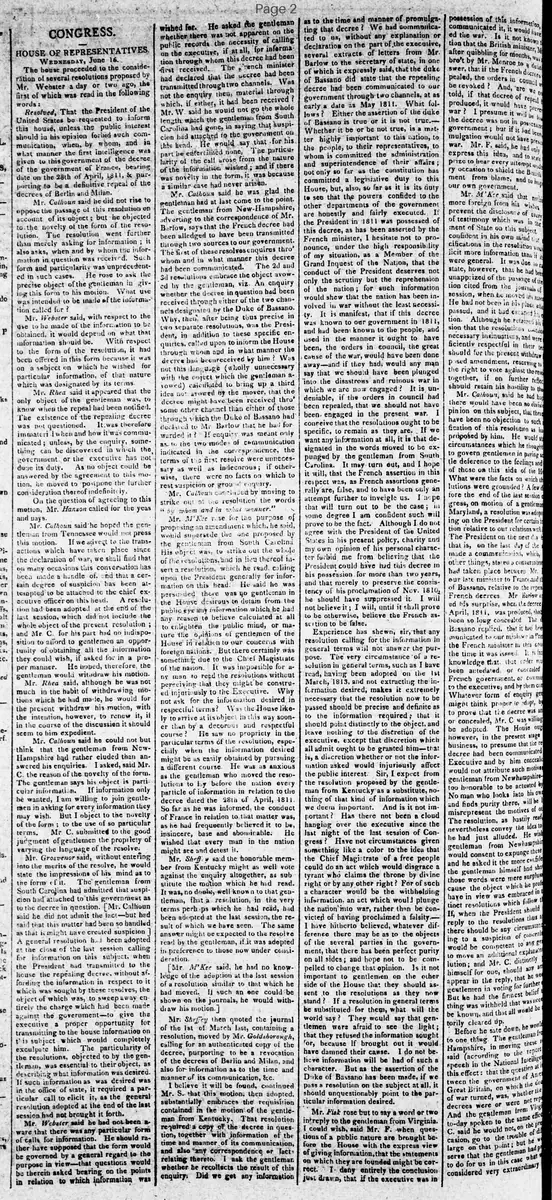
HOUSE OF REPRESENTATIVES
Wednesday, June 16.
The house proceeded to the consideration of several resolutions proposed by Mr. Webster a day or two ago, the first of which was—read in the following words:
Resolved, That the President of the United States be requested to inform this house, unless the public interest should in his opinion forbid such communication, when, by whom, and in what manner the first intelligence was given to this government of the decree of the government of France, bearing date on the 28th of April, 1811, & purporting to be a definitive repeal of the decrees of Berlin and Milan.
Mr. Calhoun said he did not rise to oppose the passage of this resolution on account of its object; but he objected to the novelty of the form of the resolution. The resolution went further than merely asking for information; it also asks, when and by whom the information in question was received. Such form and particularity was unprecedented in such cases. He rose to ask the precise object of the gentleman in giving this form to his motion. What use was intended to be made of the information called for?
Mr. Webster said, with respect to the use to be made of the information to be obtained, it would depend on what that information should be. With respect to the form of the resolution, it had been offered in this form because it was on a subject on which he wished for particular information, of that nature which was designated by its terms.
Mr. Rhea said it appeared that the only object of the gentleman was, to know when the repeal had been notified. The existence of the repealing decree was not questioned. It was therefore immaterial when and how it was communicated; unless, by the enquiry, something can be discovered in which the government or the executive has not done its duty. As no object could be answered by the agreement to this motion, he moved to postpone the further consideration thereof indefinitely.
On the question of agreeing to this motion, Mr. Hanson called for the yeas and nays.
Mr. Calhoun said he hoped the gentleman from Tennessee would not press this motion. If we advert to the transactions which have taken place since the declaration of war, we shall find that on many occasions this conversation has been made a handle of, and that a certain degree of suspicion has been attempted to be attached to the chief executive officer on this head. A resolution had been adopted at the end of the last session, which did not include the whole object of the present resolution; and Mr. C. for his part had no indisposition to afford to gentlemen an opportunity of obtaining all the information they could wish, if asked for in a proper manner. He hoped, therefore, the gentleman would withdraw his motion.
Mr. Rhea said, although he was not much in the habit of withdrawing motions which he had made, he would for the present withdraw his motion, with the intention, however, to renew it, if in the course of the discussion it should seem to him expedient.
Mr. Calhoun said he could not but think that the gentleman from New-Hampshire had rather eluded than answered his enquiries. I asked, said Mr. C. the reason of the novelty of the form. The gentleman says his object is particular information. If information only be wanted, I am willing to join gentlemen in asking for every information they may wish. But I object to the novelty of the form; to the use of so particular terms.
Mr. C. submitted to the good judgment of gentlemen the propriety of varying the language of the resolve.
Mr. Grosvenor said, without entering into the merits of the resolve, he would state the impressions of his mind as to the form of it. The gentleman from South Carolina had admitted that suspicion had attached to this government as to the decree in question. Mr. Calhoun said he did not admit the fact—but had said that this matter had been so handled as that it might have created suspicion. A general resolution had been adopted at the close of the last session calling for information on this subject, when the President had transmitted to the house the repealing decree, without affording the information in respect to it which was sought by these resolves, the object of which was, to sweep away entirely the charge which had been made against the government—to give the executive a proper opportunity for transmitting to the house information on this subject which would completely exculpate him. The particularity of the resolutions, objected to by the gentleman, was essential to their object, as describing what information was desired. If such information as was desired was in the office of state, it required a particular call to elicit it, as the general resolution adopted at the end of the last session had not brought it forth.
Mr. Webster said he had not been aware that there was any particular form of calls for information. He should rather have supposed that the form would be governed by a general regard to the purpose in view—that questions would be therein asked bearing on the points in relation to which information was wished for. He asked the gentleman from South Carolina whether there was yet apparent on the public records the necessity of calling for the first intelligence first received. The French minister had declared that the decree had been transmitted through two channels. Was not the enquiry then, material through which, if either, it had been received?
Mr. W. said he would not go the whole length which the gentleman from South Carolina had gone, in saying that suspicion had attached to the government on this head. He would say that for his part he entertained none. The particularity of the call arose from the nature of the information wished; and if there was novelty in the form, it was because a similar case had never arisen.
Mr. Calhoun said he was glad the gentleman had at last come to the point. The gentleman from New-Hampshire, adverting to the correspondence of Mr. Barlow, says that the French decree had been alleged to have been transmitted through two sources to our government. The first of these resolutions enquires through whom this decree had been communicated. The 2d and 3d resolutions embrace the object avowed by the gentleman, viz. An enquiry whether the decree in question had been received through either of the two channels designated by the Duke of Bassano. Why, then, after being thus precise in two separate resolutions, was the President, in addition to these specific enquiries, called upon to inform the House through whom and in what manner the decree had been received by him? Was not this language (wholly unnecessary with the object which the gentleman avowed) calculated to bring up a third idea not avowed by the mover, that the decree might have been received through some other channel than either of those through which the Duke of Bassano had declared to Mr. Barlow that he had forwarded it? If enquiry was meant only as to the two modes of communication indicated in the correspondence, the terms of the first resolve were unnecessary as well as indecorous; if otherwise, there were no facts on which to rest suspicion or ground enquiry.
Mr. Calhoun concluded by moving to strike out of the resolution the words "by whom and in what manner."
Mr. M'Kee rose for the purpose of proposing an amendment which, he said, would supersede the one proposed by the gentleman from South Carolina. His object was, to strike out the whole of the resolutions, and in lieu thereof insert a resolution, which he read, calling upon the President generally for information on this head. He said he was persuaded there was no gentleman in the House desirous to detain from the public eye any information which he had any reason to believe calculated at all to enlighten the public mind, or mature the opinions of gentlemen of the House in relation to our concerns with foreign nations. But there certainly was something due to the Chief Magistrate of the nation. It was impossible for any man to read the resolutions without perceiving that they might be construed injuriously to the Executive. Why not ask for the information desired in respectful terms? Was the House likely to arrive at its object in this way sooner than by a decorous and respectful course? He saw no propriety in the particular terms of the resolution, especially when the information desired might be as easily obtained by pursuing a different course. He was as anxious as the gentleman who moved the resolutions to lay before the nation every particle of information in relation to the decree dated the 28th of April, 1811. So far as he was informed, the conduct of France in relation to that matter was, as he had frequently believed it to be, insincere, base and abominable: He wished that every man in the nation might see and detest it.
Mr. Sheffey said the honorable member from Kentucky might as well vote against the enquiry altogether, as substitute the motion which he had read. It was, no doubt well known to that gentleman, that a resolution, in the very terms perhaps which he had read, had been adopted at the last session, the result of which we have seen. The same answer might be expected to the resolve read by the gentleman, if it was adopted in preference to those now under consideration.
Mr. M'Kee said, he had no knowledge of the adoption at the last session of a resolution similar to that which he had moved. If such an one could be shown on the journals, he would withdraw his motion.
Mr. Shefey then quoted the journal of the 1st of March last, containing a resolution, moved by Mr. Goldsborough, calling for an authenticated copy of the decree, purporting to be a revocation of the decrees of Berlin and Milan, and also for information as to the time and manner of its communication, &c. I believe it will be found, continued Mr. S. that this motion, then adopted, substantially embraces the requisition contained in the motion of the gentleman from Kentucky. That resolution required a copy of the decree in question, together with information of the time and manner of its communication, and also any correspondence or facts relating thereto. I ask the gentleman whether he recollects the result of this enquiry? Did we get any information as to the time and manner of promulgating that decree? We had communicated to us, without any explanation or declaration on the part of the executive, several extracts of letters from Mr. Barlow to the secretary of state, in one of which it expressly said, that the duke of Bassano did state that the repealing decree had been communicated to our government through two channels, at as early a date as May 1811. What follows? Either the assertion of the duke of Bassano is true or it is not true. Whether it be or be not true, is a matter highly important to this nation, to the people, to their representatives, to whom is committed the administration and superintendence of their affairs; not only so far as the constitution has committed a legislative duty to this House, but, also, so far as it is its duty to see that the powers confided to the other departments of the government are honestly and fairly executed. If the President in 1811 was possessed of this decree, as has been asserted by the French minister, I hesitate not to pronounce, under the high responsibility of my situation, as a Member of the Grand Inquest of the Nation, that the conduct of the President deserves not only the scrutiny but the reprehension of the nation; for such information would shew that the nation has been involved in war without the least necessity. It is manifest, that if this decree was known to our government in 1811, and had been known to the people, and used in the manner it ought to have been, the orders in council, the great cause of the war, would have been done away—and if they had, would any man say that we should have been plunged into the disastrous and ruinous war in which we are now engaged? It is undeniable, if the orders in council had been repealed, that we should not have been engaged in the present war. I conceive that the resolutions ought to be specific, to remain as they are. If we want any information at all, it is that designated in the words moved to be expunged by the gentleman from South Carolina. It may turn out, and I hope it will, that the French assertion in this respect was, as French assertions generally are, false, and to have been only an attempt further to inveigle us. I hope that will turn out to be the case; in some degree I am confident such will prove to be the fact. Although I do not agree with the President of the United States in his present policy, charity and my own opinion of his personal character forbid me from believing that the President could have had this decree in his possession for more than two years, and that merely to preserve the consistency of his proclamation of Nov. 1810, he should have suppressed it. I will not believe it; I will, until it shall prove to be otherwise, believe the French assertion to be false.
Experience has shewn, sir, that any resolution calling for the information in general terms will not answer the purpose. The very circumstance of a resolution in general terms, such as I have read, having been adopted on the 1st March, 1813, and not extracting the information desired, makes it extremely necessary that the resolution now to be passed should be precise and definite as to the information required; that it should point distinctly to the object, and leave nothing to the discretion of the executive, except that discretion which all admit ought to be granted him—that is, a discretion whether or not the information asked would injuriously affect the public interest. Sir, I expect from the resolution proposed by the gentleman from Kentucky as a substitute, nothing of that kind of information which we deem important. And is it not important? Has there not been a cloud hanging over the executive since the last night of the last session of Congress? Have not circumstances given something like a color to the idea that the Chief Magistrate of a free people could do an act which would disgrace a tyrant who claims the throne by divine right or by any other right? For of such a character would be the withholding information, an act which would plunge the nation into war, rather than be convicted of having proclaimed a falsity. I have hitherto believed, whatever difference there may be as to the objects of the several parties in the government, that there has been perfect purity on all sides; and hope not to be compelled to change that opinion. Is it not important to gentlemen on the other side of the House that they should assent to the resolutions as they now stand? If a resolution in general terms be substituted for them, what will the world say? They would say that gentlemen were afraid to see the light; that they refused the information sought for, because if brought out it would have damned their cause. I do not believe information will be had of such a character. But as the assertion of the Duke of Bassano has been made, if we pass a resolution on the subject at all, it should unquestionably point to the particular information desired.
Mr. Fisk rose but to say a word or two in reply to the gentleman from Virginia. I could wish, said Mr. F. when questions of a public nature are brought before the House with the express view of giving information, that the statements on which they are founded might be correct. I deny entirely the conclusion just drawn, that if the executive was in possession of this information, communicated it, it would have prevented the war. Is it not known to the gentleman that the British minister, Mr. Foster, after quibbling for months, was brought by Mr. Monroe to a definitive answer, that if the French decrees were repealed, the orders in council would be revoked? And, are we not told, if that decree of repeal had been produced, it would have prevented war? I presume it will be told, the decree was not in possession of government; but if it had been, its promulgation would not have prevented war. Mr. F. said, he had only to express this idea, and to state his surprise to hear every attempt made on every occasion to shield the British government from blame, and to impeach our own government.
Mr. M'Kee said that nothing could be more foreign from his wishes than to prevent the disclosure of every species of testimony which was in the Department of State on this subject. He was confident in his own mind that specifications in the resolution would elicit more information than if they were general. It was due to the state, however, that he had been unapprised of the passage of the resolution cited from the journals of the last session, when he moved his amendment. He had not been in his place when it passed, and it had escaped his attention. Although he retained his opinion that the resolutions contain unnecessary insinuations, and were not sufficiently respectful in their terms, he should for the present withdraw his proposed amendment, reserving to himself the right to vote against the resolutions altogether, if on further reflection he should retain his hostility to them.
Mr. Calhoun, said he had not thought there would have been no division of opinion on this subject, that there would have been no objection to such modification of this resolution as he had proposed by him. He would state the circumstances which he thought ought to govern gentlemen in paying so little deference to the feelings and opinions of those on this side of the House. What were the facts on which the resolutions were grounded? A few days before the end of the last session of Congress, on motion of a gentleman from Maryland, a resolution was adopted calling on the President for certain information relative to our relations with France. The President on the next day—that is, on the last day of the session—made a communication, which, among other things, stated a conversation which had taken place between Mr. Barlow, our late minister to France, and the Duke of Bassano, relative to the repeal of the French decrees. Mr. Barlow expressed his surprise, when the decree of April, 1811, was produced, that it had been so long concealed. The Duke of Bassano replied, that it had been communicated to our minister in Paris and to the French minister in this country at the time it was issued. It is fair to take it for knowledge that that order must have been antedated, or concealed by the French government, or communicated to the executive: and by them concealed. Whatever form of enquiry gentlemen might think proper to adopt, he was willing to adopt it to prove that the decree was antedated or concealed, Mr. C was willing it should be adopted. The House ought, however, in the present stage of business, to presume that the repeal decree had been communicated to the Executive and by him concealed. He would not attribute such motive to the gentleman from New Hampshire—he was too honorable to be actuated by it. No man who looks into his own breast and finds purity there, will be apt to misrepresent the motives of others. The resolution, as hastily read by the gentleman from New Hampshire, would nevertheless convey the idea to which he had just alluded. He wished to ask the gentleman from New Hampshire whether he would consent to expunge these words, as those words were mere surplusage, the gentleman himself had shown, as the object which he professed to have in view was embraced in the two resolutions which follow the first.
In reply to the resolutions thus altered, if, when the President should make his communication in answer to the two resolutions which follow the first, there should be any circumstances arising to a suspicion of concealment, he would be ready to move an additional explanatory resolution; and Mr. C. distinctly stated that it would be competent to any gentleman, himself for one, should any answer appear in the reply, that he would then move something to compel the gentlemen in voting for the further resolutions to declare that nothing was withheld that was necessary to a satisfactory explanation. But he had the firmest belief that all would be satisfactorily cleared up.
Mr. Webster said he had alluded to one thing. The gentleman from Virginia, before he sat down, would permit him to say one thing. The gentleman from New Hampshire, in moving these resolutions, had said (according to the report in the National Intelligencer) something between the government of America and Great Britain to this effect: that the question at issue at the time of the declaration of war turned, was, whether the decrees of France were or were not repealed. And the gentleman from Virginia had spoken to-day to the same effect. Mr. C. said he would not, on the present occasion, go to the trouble of discussing that point; but he would observe that the gentleman had professed to do for us in this case what he considered very extraordinary.
attorney at law. He, the doctor, had drawn the declaration, and pointed out to be in a legal contest. This was as unfair in a court of each belligerent night to consider the and always distinctly ground. This had been seen as unworthy a nation, because a different one re been unworthy of an That! said he, shall we dependent on the justice of obtaining redress ed the gentleman into er: different ground. He . for his part, would ristaken the means of re- had, indeed, in its great bjurr to be redressed.- give peace and neutrality, is offensive edicts, in or- get one of the belliger- ent (said Mr. C ) did de- the other to do the same. he way wonid say, pretend. rance did (yry as the gen- pasring the act of 1810, ith France in this repeal. ndit refuse to proceed her decrecs of Berlin and a shall hereafter for ever te this question at rest for cantry, even,if France did otradiction. England did kereesin relation to us she oral her orlers in council. av br the solemn declara. inceRegcnt dated 21st A. hgentleman dare hercafier ena, Engla d would have repraled her decrees, as statement that if France exanpie. Most indubita- aho so bighly appreciate lice Br some unaccount- oni not discredit the evj- bey have hereofore contriv cloud over it. to keep it A further evidence in uy shade of doubt hanging yssertio. is, that when there M. for thirtu-five days after kalatheFrench decraes-- unvauoication to the British of theFiench decree bear- 88th Aj1. 18:1. no reweal ncouni took place Iu.t adgt ese days amostlabo- gour, on in B itain in that y was in progress in the mmons, i. to the effects, be- ahernine, produced ontie e est of'Bitain by her or- hi of18 7 & 18.9; during etheB itish ministrynot on d and sopported them. but ground in relation to them ad ever done before They x the pretended retatia- fer of the orders in council. gound to give it up Men of ase coud no longer have de- n on that ground. The ques- terms. whether or net our that is neutral commerce, made subservient to Bitish And how, finally, were the or. areil repealed? After it bed clear as the light of the sun that they were injurious to omerce. Will therentleman Sinla now sav that England erepeaied her orders in coun- if abe bad been convinced had in the sume mamer re- modifed her decrees? The dare not say it. No, sir. he touse I shall urove hin guil- if be does. His known in- andor are too great to pernit tHe dare not say,then. Frencb decree of repeal had .the British orders would repealed, and the war thus ekton here spoke to order -- ito know whether personal re admissible on thefluor- y gentleman could be per- br that anotber dare not say star thing] Pruker sad ke did not under- gentieman as having used a areal. Goyn continued. He wished wactly understood, that he had dmeaning in what he said.— lad said that the gentleman sa man of veracitv, assert a rise than that fect is. He was gentleman from New-Jersey, e that the genileman from Vir- saell should misundersrand bim. more particular, said Mr. C. I two and two iake four; and emileman dare to contradict it. conviction of the certainty of Sir, aithough warm in my cause, nothing shall ever in- unnecessarilyto wound the lany gentleman in this house, ectally of the gentleman from with whom I hare never been anate as to come in collision. zorm, sir : I have a right to be s one of the advocates of the . I considered the best in- i rights of the nation compro- the question, and I was bound it. I am therefore mortifi- ix placed on ground on which ot o stand. I am mortifed to mistatements which prevail on tt The cavse of my country shose behalf I am now warm, hope to be so. . It is a cause & justice of which I would
stake my all--though on its uitimate success I cannot, for that is yet in the womb of time. I have condescended, sir, to view this question for a mowent on the ground of the relative conduct of France and G. Britain. Not that I believe ths govern- ment ooght to descend, in the pursuit of a mnagnanimous policy, to a scholastie view, wbich oation bas done us the first or the greatest injury. Such consider- ations would never cnter into the view of a statesman.. The question is, how we can best redress the wrongs of the conntry. I-have ever regretted that the injuries of the belligerents should for a moment have been viewed in their re- taliatery charrcter. notwithstanding the excellence of the motive, a love of peace and a desire to maintain it. I would have taken a higher ground, and the go- vernment, finding all their pacific efforts were in vain, were compelled at length to appeal to the last resort. An oppo- site view of this question appears to me ridiculous, if I dare mingle ridicule with a question of such. seriousness. Is it not absurd to contend that we ought to suffer ourscives to be beaten to death, whilst engaged in abstract philosopbic enquiries who gave us the first blow? In the whole of this contest of restric- tions. I shail ever deein the conduct of Frunce to have bcen imoproper. I stand here only as tne assertor of American rights, the vindicator of the American cause. I will not presume that the President had received the decree in question and concealed it-and the only modification I ask of th:ese resolutions, is to divest them of thatimputation which they an pear to convey. T'hus medified, I shall cheerfuily vote for them, to afford to gentlemen in opposition, the most li- beral opportunity of obtaining all the information they can wish. Debaie to be Continued,
What sub-type of article is it?
What themes does it cover?
What keywords are associated?
What entities or persons were involved?
Where did it happen?
Story Details
Key Persons
Location
House Of Representatives
Event Date
Wednesday, June 16
Story Details
Debate on resolutions requesting presidential information about the receipt of France's 1811 decree repealing Berlin and Milan decrees, amid suspicions of executive concealment that could have averted the War of 1812; objections focus on the resolution's form implying distrust, with amendments proposed for respectfulness.