Thank you for visiting SNEWPapers!
Sign up free
Literary
April 17, 1840
Burlington Free Press
Burlington, Chittenden County, Vermont
What is this article about?
Article highlights Elihu Burritt, a 27-year-old Massachusetts blacksmith who self-taught 50 languages amid laborious work, inspiring young laborers. Includes his modest 1839 letter to Dr. Th. Nelson detailing his studies in Hebrew, European, and Oriental languages, and ambition to exemplify using 'odd moments' for self-improvement.
Clipping
OCR Quality
95%
Excellent
Full Text
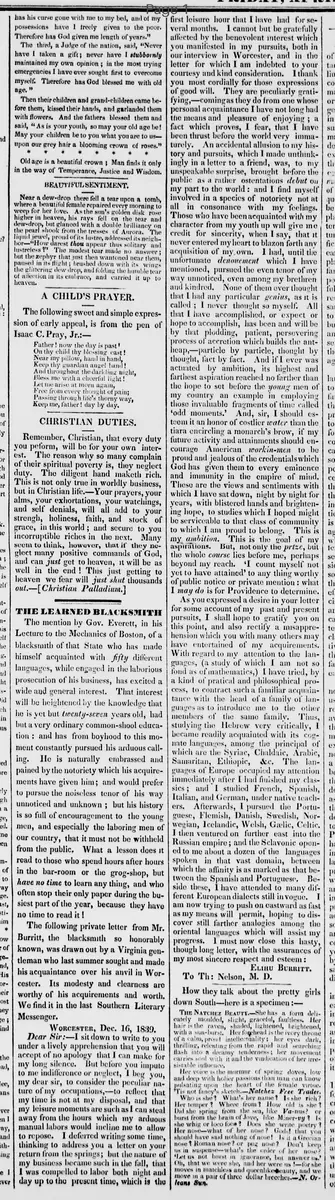
THE LEARNED BLACKSMITH
The mention by Gov. Everett, in his Lecture to the Mechanics of Boston, of a blacksmith of that State who has made himself acquainted with fifty different languages, while engaged in the laborious prosecution of his business, has excited a wide and general interest. That interest will be heightened by the knowledge that he is yet but twenty-seven years old, had but a very ordinary common-school education: and has from boyhood to this moment constantly pursued his arduous calling.
He is naturally embarrassed and pained by the notoriety which his acquirements have given him; and would prefer to pursue the noiseless tenor of his way unnoticed and unknown; but his history is so full of encouragement to the young men, and especially the laboring men of our country, that it must not be withheld from the public. What a lesson does it read to those who spend hours after hours in the bar-room or the grog-shop, but have no time to learn any thing, and who often stop their only paper during the busiest part of the year, because they have no time to read it!
The following private letter from Mr. Burritt, the blacksmith so honorably known, was drawn out by a Virginia gentleman who last summer sought and made his acquaintance over his anvil in Worcester. Its modesty and clearness are worthy of his acquirements and worth. We find it in the last Southern Literary Messenger.
WORCESTER, Dec. 16, 1839.
Dear Sir:—I sit down to write to you under a lively apprehension that you will accept of no apology that I can make for my long silence. But before you impute to me indifference or neglect, I beg you, my dear sir, to consider the peculiar nature of my occupations,—to reflect that my time is not at my disposal, and that my leisure moments are such as I can steal away from the hours which my arduous manual labors would incline me to allow to repose. I deferred writing some time, thinking to address you a letter on your return from the springs; but the nature of my business became such in the fall, that I was compelled to labor both night and day up to the present time, which is the first leisure hour that I have had for several months. I cannot but be gratefully affected by the benevolent interest which you manifested in my pursuits, both in our interview in Worcester, and in the letter for which I am indebted to your courtesy and kind consideration. I thank you most cordially for those expressions of good will. They are peculiarly gratifying,—coming as they do from one whose personal acquaintance I have not long had the means and pleasure of enjoying; a fact which proves, I fear, that I have been thrust before the world very immaturely. An accidental allusion to my history and pursuits, which I made unthinkingly in a letter to a friend, was, to my unspeakable surprise, brought before the public as a rather ostentatious debut on my part to the world: and I find myself involved in a species of notoriety not at all in consonance with my feelings. Those who have been acquainted with my character from my youth up will give me credit for sincerity, when I say, that it never entered my heart to blazon forth any acquisition of my own. I had, until the unfortunate denouement which I have mentioned, pursued the even tenor of my way unnoticed, even among my brethren and kindred. None of them ever thought that I had any particular genius, as it is called; I never thought so myself. All that I have accomplished, or expect or hope to accomplish, has been and will be by that plodding, patient, persevering process of accretion which builds the ant-heap,—particle by particle, thought by thought, fact by fact." And if I ever was actuated by ambition, its highest and farthest aspiration reached no farther than the hope to set before the young men of my country an example in employing those invaluable fragments of time called 'odd moments.' And, sir, I should esteem it an honor of costlier water than the tiara encircling a monarch's brow, if my future activity and attainments should encourage American working-men to be proud and jealous of the credentials which God has given them to every eminence and immunity in the empire of mind. These are the views and sentiments with which I have sat down, night by night for years, with blistered hands and brightening hope, to studies which I hoped might be serviceable to that class of community to which I am proud to belong. This is my ambition. This is the goal of my aspirations. But, not only the prize, but the whole course lies before me, perhaps beyond my reach. I count myself not yet to have attained to any thing worthy of public notice or private mention: what I may do is for Providence to determine.
As you expressed a desire in your letter for some account of my past and present pursuits, I shall hope to gratify you on this point, and also rectify a misapprehension which you with many others may have entertained of my acquirements. With regard to my attention to the languages, (a study of which I am not so fond as of mathematics,) I have tried, by a kind of practical and philosophical process, to contract such a familiar acquaintance with the head of a family of languages as to introduce me to the other members of the same family. Thus, studying the Hebrew very critically, I became readily acquainted with its cognate languages, among the principal of which are the Syriac, Chaldaic, Arabic, Samaritan, Ethiopic, &c. The languages of Europe occupied my attention immediately after I had finished my classics; and I studied French, Spanish, Italian, and German, under native teachers. Afterwards, I pursued the Portuguese, Flemish, Danish, Swedish, Norwegian, Icelandic, Welsh, Galic, Celtic. I then ventured on further east into the Russian empire; and the Sclavonic opened to me about a dozen of the languages spoken in that vast domain, between which the affinity is as marked as that between the Spanish and Portuguese. Besides these, I have attended to many different European dialects still in vogue. I am now trying to push on eastward as fast as my means will permit, hoping to discover still farther analogies among the oriental languages which will assist my progress. I must now close this hasty, though long letter, with the assurances of my most sincere respect and esteem:
Elihu Burritt.
To Th: Nelson, M. D.
The mention by Gov. Everett, in his Lecture to the Mechanics of Boston, of a blacksmith of that State who has made himself acquainted with fifty different languages, while engaged in the laborious prosecution of his business, has excited a wide and general interest. That interest will be heightened by the knowledge that he is yet but twenty-seven years old, had but a very ordinary common-school education: and has from boyhood to this moment constantly pursued his arduous calling.
He is naturally embarrassed and pained by the notoriety which his acquirements have given him; and would prefer to pursue the noiseless tenor of his way unnoticed and unknown; but his history is so full of encouragement to the young men, and especially the laboring men of our country, that it must not be withheld from the public. What a lesson does it read to those who spend hours after hours in the bar-room or the grog-shop, but have no time to learn any thing, and who often stop their only paper during the busiest part of the year, because they have no time to read it!
The following private letter from Mr. Burritt, the blacksmith so honorably known, was drawn out by a Virginia gentleman who last summer sought and made his acquaintance over his anvil in Worcester. Its modesty and clearness are worthy of his acquirements and worth. We find it in the last Southern Literary Messenger.
WORCESTER, Dec. 16, 1839.
Dear Sir:—I sit down to write to you under a lively apprehension that you will accept of no apology that I can make for my long silence. But before you impute to me indifference or neglect, I beg you, my dear sir, to consider the peculiar nature of my occupations,—to reflect that my time is not at my disposal, and that my leisure moments are such as I can steal away from the hours which my arduous manual labors would incline me to allow to repose. I deferred writing some time, thinking to address you a letter on your return from the springs; but the nature of my business became such in the fall, that I was compelled to labor both night and day up to the present time, which is the first leisure hour that I have had for several months. I cannot but be gratefully affected by the benevolent interest which you manifested in my pursuits, both in our interview in Worcester, and in the letter for which I am indebted to your courtesy and kind consideration. I thank you most cordially for those expressions of good will. They are peculiarly gratifying,—coming as they do from one whose personal acquaintance I have not long had the means and pleasure of enjoying; a fact which proves, I fear, that I have been thrust before the world very immaturely. An accidental allusion to my history and pursuits, which I made unthinkingly in a letter to a friend, was, to my unspeakable surprise, brought before the public as a rather ostentatious debut on my part to the world: and I find myself involved in a species of notoriety not at all in consonance with my feelings. Those who have been acquainted with my character from my youth up will give me credit for sincerity, when I say, that it never entered my heart to blazon forth any acquisition of my own. I had, until the unfortunate denouement which I have mentioned, pursued the even tenor of my way unnoticed, even among my brethren and kindred. None of them ever thought that I had any particular genius, as it is called; I never thought so myself. All that I have accomplished, or expect or hope to accomplish, has been and will be by that plodding, patient, persevering process of accretion which builds the ant-heap,—particle by particle, thought by thought, fact by fact." And if I ever was actuated by ambition, its highest and farthest aspiration reached no farther than the hope to set before the young men of my country an example in employing those invaluable fragments of time called 'odd moments.' And, sir, I should esteem it an honor of costlier water than the tiara encircling a monarch's brow, if my future activity and attainments should encourage American working-men to be proud and jealous of the credentials which God has given them to every eminence and immunity in the empire of mind. These are the views and sentiments with which I have sat down, night by night for years, with blistered hands and brightening hope, to studies which I hoped might be serviceable to that class of community to which I am proud to belong. This is my ambition. This is the goal of my aspirations. But, not only the prize, but the whole course lies before me, perhaps beyond my reach. I count myself not yet to have attained to any thing worthy of public notice or private mention: what I may do is for Providence to determine.
As you expressed a desire in your letter for some account of my past and present pursuits, I shall hope to gratify you on this point, and also rectify a misapprehension which you with many others may have entertained of my acquirements. With regard to my attention to the languages, (a study of which I am not so fond as of mathematics,) I have tried, by a kind of practical and philosophical process, to contract such a familiar acquaintance with the head of a family of languages as to introduce me to the other members of the same family. Thus, studying the Hebrew very critically, I became readily acquainted with its cognate languages, among the principal of which are the Syriac, Chaldaic, Arabic, Samaritan, Ethiopic, &c. The languages of Europe occupied my attention immediately after I had finished my classics; and I studied French, Spanish, Italian, and German, under native teachers. Afterwards, I pursued the Portuguese, Flemish, Danish, Swedish, Norwegian, Icelandic, Welsh, Galic, Celtic. I then ventured on further east into the Russian empire; and the Sclavonic opened to me about a dozen of the languages spoken in that vast domain, between which the affinity is as marked as that between the Spanish and Portuguese. Besides these, I have attended to many different European dialects still in vogue. I am now trying to push on eastward as fast as my means will permit, hoping to discover still farther analogies among the oriental languages which will assist my progress. I must now close this hasty, though long letter, with the assurances of my most sincere respect and esteem:
Elihu Burritt.
To Th: Nelson, M. D.
What sub-type of article is it?
Essay
Epistolary
What themes does it cover?
Moral Virtue
Patriotism
What keywords are associated?
Learned Blacksmith
Self Education
Multiple Languages
Eli Hu Burritt
Working Men
Odd Moments
Moral Example
Linguistic Studies
What entities or persons were involved?
Elihu Burritt
Literary Details
Title
The Learned Blacksmith
Author
Elihu Burritt
Subject
Self Education And Linguistic Pursuits Of A Working Man
Form / Style
Biographical Essay With Embedded Personal Letter
Key Lines
All That I Have Accomplished, Or Expect Or Hope To Accomplish, Has Been And Will Be By That Plodding, Patient, Persevering Process Of Accretion Which Builds The Ant Heap,—Particle By Particle, Thought By Thought, Fact By Fact.
And If I Ever Was Actuated By Ambition, Its Highest And Farthest Aspiration Reached No Farther Than The Hope To Set Before The Young Men Of My Country An Example In Employing Those Invaluable Fragments Of Time Called 'Odd Moments.'
I Should Esteem It An Honor Of Costlier Water Than The Tiara Encircling A Monarch's Brow, If My Future Activity And Attainments Should Encourage American Working Men To Be Proud And Jealous Of The Credentials Which God Has Given Them To Every Eminence And Immunity In The Empire Of Mind.
Thus, Studying The Hebrew Very Critically, I Became Readily Acquainted With Its Cognate Languages, Among The Principal Of Which Are The Syriac, Chaldaic, Arabic, Samaritan, Ethiopic, &C.
The Languages Of Europe Occupied My Attention Immediately After I Had Finished My Classics; And I Studied French, Spanish, Italian, And German, Under Native Teachers.