Thank you for visiting SNEWPapers!
Sign up free
Editorial
March 30, 1936
The Daily Alaska Empire
Juneau, Juneau County, Alaska
What is this article about?
Editorial praises the National Organization for Public Health Nursing's work, highlighting 30 million annual home visits by 20,000 nurses across the US, emphasizing their role in home care where hospitals handle only 7% of cases, and support for isolated communities.
Clipping
OCR Quality
95%
Excellent
Full Text
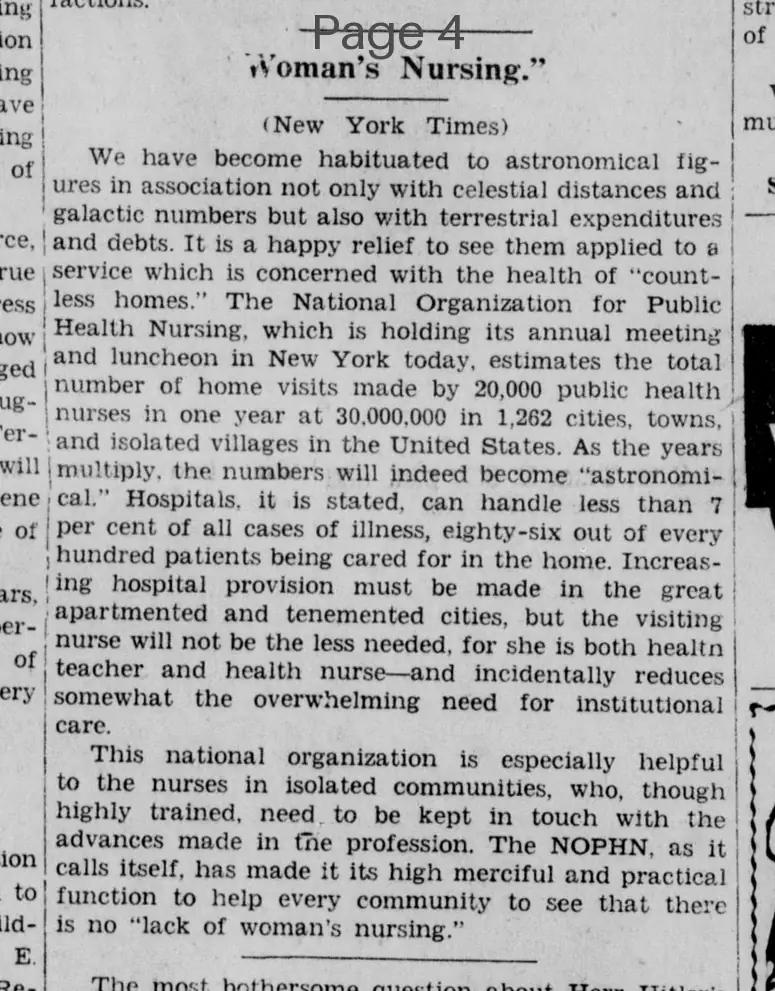
Woman's Nursing.
(New York Times)
We have become habituated to astronomical figures in association not only with celestial distances and galactic numbers but also with terrestrial expenditures and debts. It is a happy relief to see them applied to a service which is concerned with the health of "countless homes." The National Organization for Public Health Nursing, which is holding its annual meeting and luncheon in New York today, estimates the total number of home visits made by 20,000 public health nurses in one year at 30,000,000 in 1,262 cities, towns, and isolated villages in the United States. As the years multiply, the numbers will indeed become "astronomical."
Hospitals, it is stated, can handle less than 7 per cent of all cases of illness, eighty-six out of every hundred patients being cared for in the home. Increasing hospital provision must be made in the great apartmented and tenemented cities, but the visiting nurse will not be the less needed, for she is both health teacher and health nurse-and incidentally reduces somewhat the overwhelming need for institutional care.
This national organization is especially helpful to the nurses in isolated communities, who, though highly trained, need to be kept in touch with the advances made in the profession. The NOPHN, as it calls itself, has made it its high merciful and practical function to help every community to see that there is no "lack of woman's nursing."
(New York Times)
We have become habituated to astronomical figures in association not only with celestial distances and galactic numbers but also with terrestrial expenditures and debts. It is a happy relief to see them applied to a service which is concerned with the health of "countless homes." The National Organization for Public Health Nursing, which is holding its annual meeting and luncheon in New York today, estimates the total number of home visits made by 20,000 public health nurses in one year at 30,000,000 in 1,262 cities, towns, and isolated villages in the United States. As the years multiply, the numbers will indeed become "astronomical."
Hospitals, it is stated, can handle less than 7 per cent of all cases of illness, eighty-six out of every hundred patients being cared for in the home. Increasing hospital provision must be made in the great apartmented and tenemented cities, but the visiting nurse will not be the less needed, for she is both health teacher and health nurse-and incidentally reduces somewhat the overwhelming need for institutional care.
This national organization is especially helpful to the nurses in isolated communities, who, though highly trained, need to be kept in touch with the advances made in the profession. The NOPHN, as it calls itself, has made it its high merciful and practical function to help every community to see that there is no "lack of woman's nursing."
What sub-type of article is it?
Science Or Medicine
Social Reform
Feminism
What keywords are associated?
Public Health Nursing
Home Visits
Visiting Nurses
Nophn
Women's Nursing
Health Care In Homes
What entities or persons were involved?
National Organization For Public Health Nursing
Public Health Nurses
Editorial Details
Primary Topic
Importance Of Public Health Nursing In Homes
Stance / Tone
Supportive Of Public Health Nursing
Key Figures
National Organization For Public Health Nursing
Public Health Nurses
Key Arguments
Public Health Nurses Make 30,000,000 Home Visits Annually In 1,262 Us Locations
Hospitals Handle Less Than 7% Of Illness Cases, With 86% Cared For At Home
Visiting Nurses Serve As Health Teachers And Reduce Need For Institutional Care
Nophn Helps Nurses In Isolated Communities Stay Updated With Professional Advances