Thank you for visiting SNEWPapers!
Sign up free
Editorial
December 20, 1890
The Daily Bulletin
Honolulu, Honolulu County, Hawaii
What is this article about?
An editorial by Ruth Ward advocating for early, comprehensive education of girls, including classics, mathematics, languages, history, literature, music, and sciences, to foster intellectual strength and prepare them for life's duties, criticizing wasted time and emphasizing starting young for better retention and outcomes.
Clipping
OCR Quality
98%
Excellent
Full Text
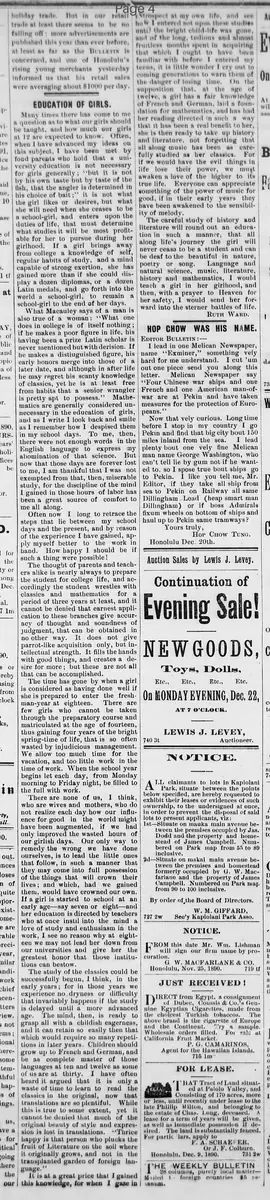
EDUCATION OF GIRLS.
Many times there has come to me a question as to what our girls should be taught, and how much our girls at 12 are expected to know. Often, when I have advanced my ideas on this subject, I have been met by fond parents who hold that a university education is not necessary for girls generally; "but it is not by his own taste but by taste of the fish, that the angler is determined in his choice of bait;" it is not what the girl likes or desires, but what she will need when she ceases to be a school-girl, and enters upon the duties of life, that must determine what studies it will be most profitable for her to pursue during her girlhood. If a girl brings away from college a knowledge of self, regular habits of study, and a mind capable of strong exertion, she has gained more than if she could display a dozen diplomas, or a dozen Latin medals, and go forth into the world a school-girl, to remain a school-girl to the end of her days. What Macaulay says of a man is also true of a woman: "What one does in college is of itself nothing; if he makes a poor figure in life, his having been a prize Latin scholar is never mentioned but with derision. If he makes a distinguished figure, his early honors merge into those of a later date, and although in after life he may regret his scanty knowledge of classics, yet he is at least free from habits that a senior wrangler is pretty apt to possess." Mathematics are generally considered unnecessary in the education of girls, and as I write I look back and smile as I remember how I despised them in my school days. To me, then, there were not enough words in the English language to express my abomination of that science. But now that those days are forever lost to me, I am thankful that I was not exempted from that, then, miserable study, for the discipline of the mind I gained in those hours of labor has been a great source of comfort to me all along. Often now I long to retrace the steps that lie between my school days and the present, and by reason of the experience I have gained, apply myself better to the work in hand. How happy I should be if such a thing were possible! The thought of parents and teachers alike is nearly always to prepare the student for college life, and accordingly the student wrestles with classics and mathematics for a period of three years at least, and it cannot be denied that earnest application to these branches give accuracy of thought and soundness of judgment, that can be obtained in no other way. It does not give parrot-like acquisition only, but intellectual strength. It fills the hands with good things, and creates a desire for more; but these are not all that can be accomplished. The time has gone by when a girl is considered as having done well if she is prepared to enter the freshman-year at eighteen. There are few girls who cannot be taken through the preparatory course and matriculated at the age of fourteen, thus gaining four years of the bright spring-time of life, that is so often wasted by injudicious management. We allow too much time for the vacation, and too little work in the time of work. When the school year begins let each day, from Monday morning to Friday night, be filled to the full with work. There are none of us, I think, who are wives and mothers, who do not realize each day how our influence for good in the world might have been augmented, if we had only improved the wasted hours of our girlish days. Our only way to remedy the wrong we have done ourselves, is to lead the little ones that follow, in such a manner that they may come into full possession of the things that will crown their lives; and which, had we gained them, would have crowned our own. If a girl is started to school at an early age--say seven or eight--and her education is directed by teachers who at once instil into the mind a love of study and enthusiasm in the work, I see no reason why at eighteen we may not lead her down from our universities and give her the greatest honor that those institutions can bestow. The study of the classics could be successfully begun, I think, in the early years; for in those years we experience no dryness or difficulty that invariably happens if the study is delayed until a more advanced age. The mind, then, is ready to grasp all with a childish eagerness, and it can retain so easily then that which would require so many repetitions in later years. Children should grow up to French and German, and be as complete master of those languages at ten and twelve as some of us are at thirty. I have often heard it argued that it is only a waste of time to learn to read the classics in the original, now that translations are so plentiful. While this is true to some extent, yet it cannot be denied that much of the original beauty of style and expression is lost in translations. "Thrice happy is that person who plucks the fruit of Literature on the soil where it originally grows, and not in the transplanted garden of foreign language."
It is at a great price that I gained this knowledge, for when I gaze in retrospection at my own life, and see how I entered not upon these studies until the bright child-life was gone, and of the long, tedious and almost fruitless months spent in acquiring that which I ought to have been familiar with before I entered my teens, it is little wonder I cry out to coming generations to warn them of the danger of losing time. On the supposition that, at the age of twelve, a girl has a fair knowledge of French and German, laid a foundation for mathematics, and has had her reading directed in such a way that it has been a real benefit to her, she is then ready to take up history and literature, not forgetting that all along music has been as carefully studied as her classics. For if we would have the evil things in life lose their power, we must awaken a love of the higher to its true life. Everyone can appreciate something of the power of music for good, if in their early years they have been awakened to the sensibility of melody. The careful study of history and literature will round out an education in such a manner, that all along life's journey the girl will never cease to be a student and can be deaf to the beautiful in nature, poetry or song. Language and natural science, music, literature, history and mathematics, I would teach a girl in her girlhood, and then, with a prayer to Heaven for her safety, I would send her forward into the sterner battles of life.
RUTH WARD.
Many times there has come to me a question as to what our girls should be taught, and how much our girls at 12 are expected to know. Often, when I have advanced my ideas on this subject, I have been met by fond parents who hold that a university education is not necessary for girls generally; "but it is not by his own taste but by taste of the fish, that the angler is determined in his choice of bait;" it is not what the girl likes or desires, but what she will need when she ceases to be a school-girl, and enters upon the duties of life, that must determine what studies it will be most profitable for her to pursue during her girlhood. If a girl brings away from college a knowledge of self, regular habits of study, and a mind capable of strong exertion, she has gained more than if she could display a dozen diplomas, or a dozen Latin medals, and go forth into the world a school-girl, to remain a school-girl to the end of her days. What Macaulay says of a man is also true of a woman: "What one does in college is of itself nothing; if he makes a poor figure in life, his having been a prize Latin scholar is never mentioned but with derision. If he makes a distinguished figure, his early honors merge into those of a later date, and although in after life he may regret his scanty knowledge of classics, yet he is at least free from habits that a senior wrangler is pretty apt to possess." Mathematics are generally considered unnecessary in the education of girls, and as I write I look back and smile as I remember how I despised them in my school days. To me, then, there were not enough words in the English language to express my abomination of that science. But now that those days are forever lost to me, I am thankful that I was not exempted from that, then, miserable study, for the discipline of the mind I gained in those hours of labor has been a great source of comfort to me all along. Often now I long to retrace the steps that lie between my school days and the present, and by reason of the experience I have gained, apply myself better to the work in hand. How happy I should be if such a thing were possible! The thought of parents and teachers alike is nearly always to prepare the student for college life, and accordingly the student wrestles with classics and mathematics for a period of three years at least, and it cannot be denied that earnest application to these branches give accuracy of thought and soundness of judgment, that can be obtained in no other way. It does not give parrot-like acquisition only, but intellectual strength. It fills the hands with good things, and creates a desire for more; but these are not all that can be accomplished. The time has gone by when a girl is considered as having done well if she is prepared to enter the freshman-year at eighteen. There are few girls who cannot be taken through the preparatory course and matriculated at the age of fourteen, thus gaining four years of the bright spring-time of life, that is so often wasted by injudicious management. We allow too much time for the vacation, and too little work in the time of work. When the school year begins let each day, from Monday morning to Friday night, be filled to the full with work. There are none of us, I think, who are wives and mothers, who do not realize each day how our influence for good in the world might have been augmented, if we had only improved the wasted hours of our girlish days. Our only way to remedy the wrong we have done ourselves, is to lead the little ones that follow, in such a manner that they may come into full possession of the things that will crown their lives; and which, had we gained them, would have crowned our own. If a girl is started to school at an early age--say seven or eight--and her education is directed by teachers who at once instil into the mind a love of study and enthusiasm in the work, I see no reason why at eighteen we may not lead her down from our universities and give her the greatest honor that those institutions can bestow. The study of the classics could be successfully begun, I think, in the early years; for in those years we experience no dryness or difficulty that invariably happens if the study is delayed until a more advanced age. The mind, then, is ready to grasp all with a childish eagerness, and it can retain so easily then that which would require so many repetitions in later years. Children should grow up to French and German, and be as complete master of those languages at ten and twelve as some of us are at thirty. I have often heard it argued that it is only a waste of time to learn to read the classics in the original, now that translations are so plentiful. While this is true to some extent, yet it cannot be denied that much of the original beauty of style and expression is lost in translations. "Thrice happy is that person who plucks the fruit of Literature on the soil where it originally grows, and not in the transplanted garden of foreign language."
It is at a great price that I gained this knowledge, for when I gaze in retrospection at my own life, and see how I entered not upon these studies until the bright child-life was gone, and of the long, tedious and almost fruitless months spent in acquiring that which I ought to have been familiar with before I entered my teens, it is little wonder I cry out to coming generations to warn them of the danger of losing time. On the supposition that, at the age of twelve, a girl has a fair knowledge of French and German, laid a foundation for mathematics, and has had her reading directed in such a way that it has been a real benefit to her, she is then ready to take up history and literature, not forgetting that all along music has been as carefully studied as her classics. For if we would have the evil things in life lose their power, we must awaken a love of the higher to its true life. Everyone can appreciate something of the power of music for good, if in their early years they have been awakened to the sensibility of melody. The careful study of history and literature will round out an education in such a manner, that all along life's journey the girl will never cease to be a student and can be deaf to the beautiful in nature, poetry or song. Language and natural science, music, literature, history and mathematics, I would teach a girl in her girlhood, and then, with a prayer to Heaven for her safety, I would send her forward into the sterner battles of life.
RUTH WARD.
What sub-type of article is it?
Education
Feminism
What keywords are associated?
Girls Education
University Preparation
Classics For Women
Early Language Learning
Intellectual Discipline
Music In Curriculum
Historical Literature Study
What entities or persons were involved?
Ruth Ward
Macaulay
Editorial Details
Primary Topic
Comprehensive Education For Girls Including Classics, Mathematics, And Languages
Stance / Tone
Advocacy For Rigorous Early Education To Prepare Girls For Life Duties
Key Figures
Ruth Ward
Macaulay
Key Arguments
Girls Should Be Taught What They Need For Life's Duties, Not Just Preferences
University Education Provides Self Knowledge, Study Habits, And Mental Discipline Over Mere Diplomas
Mathematics And Classics Build Accuracy Of Thought And Intellectual Strength
Start Education Early At 7 8 To Matriculate At 14 And Graduate At 18
Classics And Languages Should Begin Young For Easier Retention
Translations Lose Original Beauty; Study Originals
Include History, Literature, Music, Natural Science For Well Rounded Education