Thank you for visiting SNEWPapers!
Sign up free
Literary
May 4, 1843
The Democratic Whig
Columbus, Lowndes County, Mississippi
What is this article about?
An essay in 'Popular Philosophy' series, No. 1, explains clouds as collections of hollow, transparent globes that absorb water via tails and release it as rain through contraction in cooler temperatures. Includes a pewter cup experiment to illustrate condensation. Authored by Lardner for the Democratic Whig.
Clipping
OCR Quality
95%
Excellent
Full Text
For the Democratic Whig
Sir
The praiseworthy desire of those who have had advantages of education and observation—to benefit their fellow-citizens by "communications" in the public prints, has been so apparent for the last few weeks that the writer has been for a number of reasons deterred from presenting anything for consideration—but if it is true that 'every little helps' it is proper that those who can, should contribute their mite. With this modest exordium we will go on to the subject.
POPULAR PHILOSOPHY.
NO1.
CLOUDS AND RAIN.
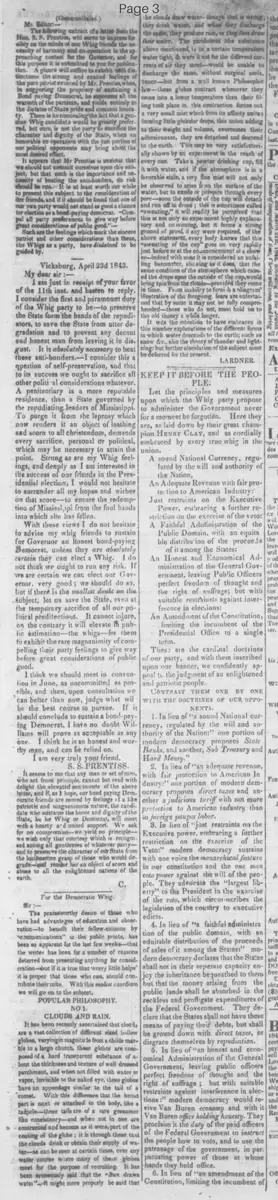
It has been recently ascertained that clouds are vast collections of different sized hollow globes, varying in magnitude from a child's marble to a large church, these globes are composed of a hard transparent substance about the thickness and texture of well dressed parchment, and when not filled with water or vapor, invisible to the naked eye, these globes have an appendage similar to the tail of a comet. With this difference that the broad part is next or attached to the body, like a tadpole—these tails are of a rare gossamer like consistency—and when not in use are contracted and become as it were part of the coating of the globe; it is through these that the clouds drink or obtain their supply of water—as can be seen at certain times, over any water course where many of these globes meet for the purpose of recruiting. It has been erroneously said that the "Sun draws water"—it might more properly be said that the clouds draw water—though that is wrong; they drink water, and when they discharge the same, they produce rain, or they then draw their water. The parchment like substance above mentioned, is in a certain temperature water tight, & were it not for the different currents of air they meet—would be unable to discharge the same, without surgical assistance—but from a well known Philosophic law—these globes contract whenever they come into a lower temperature than their filling took place in, this contraction forces out a very small mist which from its affinity unite forming little globular drops, this union adding to their weight and volume, overcomes their adhesiveness, they are detached and descend to the earth. This may be very satisfactorily shown by an experiment in the reach of every one. Take a pewter drinking cup, fill it with water, and if the atmosphere is in a favorable state, a very fine mist will not only be observed to arise from the surface of the water, but to exude or perspire through every pore—soon the outside of the cup will detach and run off in drops; this is sometimes called "sweating." it will readily be perceived that this is not only an experiment highly explanatory and convincing, but it forms a strong ground of proof, if any were required, of the above statement, every body knows that this "sweating of the cup" goes on very rapidly just before or at the commencement of a shower—indeed with some it is considered an unfailing barometer, showing as it does, that the same condition of the atmosphere which caused the drops upon the outside of the cup, would bring rain from the clouds—provided they come in time. From inability to furnish a diagram illustrative of the foregoing, fears are entertained that by some it may not be fully comprehended—those who do not, must hold on to the old theory a while longer.
It was the intention to have embraced in this number explanations of the different forms in which water descends to the earth; such as snow &c., also the theory of thunder and lightning: but further elucidation of the subject must be deferred for the present.
LARDNER.
Sir
The praiseworthy desire of those who have had advantages of education and observation—to benefit their fellow-citizens by "communications" in the public prints, has been so apparent for the last few weeks that the writer has been for a number of reasons deterred from presenting anything for consideration—but if it is true that 'every little helps' it is proper that those who can, should contribute their mite. With this modest exordium we will go on to the subject.
POPULAR PHILOSOPHY.
NO1.
CLOUDS AND RAIN.
It has been recently ascertained that clouds are vast collections of different sized hollow globes, varying in magnitude from a child's marble to a large church, these globes are composed of a hard transparent substance about the thickness and texture of well dressed parchment, and when not filled with water or vapor, invisible to the naked eye, these globes have an appendage similar to the tail of a comet. With this difference that the broad part is next or attached to the body, like a tadpole—these tails are of a rare gossamer like consistency—and when not in use are contracted and become as it were part of the coating of the globe; it is through these that the clouds drink or obtain their supply of water—as can be seen at certain times, over any water course where many of these globes meet for the purpose of recruiting. It has been erroneously said that the "Sun draws water"—it might more properly be said that the clouds draw water—though that is wrong; they drink water, and when they discharge the same, they produce rain, or they then draw their water. The parchment like substance above mentioned, is in a certain temperature water tight, & were it not for the different currents of air they meet—would be unable to discharge the same, without surgical assistance—but from a well known Philosophic law—these globes contract whenever they come into a lower temperature than their filling took place in, this contraction forces out a very small mist which from its affinity unite forming little globular drops, this union adding to their weight and volume, overcomes their adhesiveness, they are detached and descend to the earth. This may be very satisfactorily shown by an experiment in the reach of every one. Take a pewter drinking cup, fill it with water, and if the atmosphere is in a favorable state, a very fine mist will not only be observed to arise from the surface of the water, but to exude or perspire through every pore—soon the outside of the cup will detach and run off in drops; this is sometimes called "sweating." it will readily be perceived that this is not only an experiment highly explanatory and convincing, but it forms a strong ground of proof, if any were required, of the above statement, every body knows that this "sweating of the cup" goes on very rapidly just before or at the commencement of a shower—indeed with some it is considered an unfailing barometer, showing as it does, that the same condition of the atmosphere which caused the drops upon the outside of the cup, would bring rain from the clouds—provided they come in time. From inability to furnish a diagram illustrative of the foregoing, fears are entertained that by some it may not be fully comprehended—those who do not, must hold on to the old theory a while longer.
It was the intention to have embraced in this number explanations of the different forms in which water descends to the earth; such as snow &c., also the theory of thunder and lightning: but further elucidation of the subject must be deferred for the present.
LARDNER.
What sub-type of article is it?
Essay
What themes does it cover?
Nature
What keywords are associated?
Clouds
Rain
Popular Philosophy
Weather
Experiment
Condensation
Globes
What entities or persons were involved?
Lardner.
Literary Details
Title
Popular Philosophy. No1. Clouds And Rain.
Author
Lardner.
Subject
Explanation Of Clouds And Rain
Key Lines
It Has Been Recently Ascertained That Clouds Are Vast Collections Of Different Sized Hollow Globes, Varying In Magnitude From A Child's Marble To A Large Church
They Drink Water, And When They Discharge The Same, They Produce Rain
Take A Pewter Drinking Cup, Fill It With Water, And If The Atmosphere Is In A Favorable State, A Very Fine Mist Will Not Only Be Observed To Arise From The Surface Of The Water