Thank you for visiting SNEWPapers!
Sign up free
Letter to Editor
March 14, 1856
The Liberator
Boston, Suffolk County, Massachusetts
What is this article about?
R. Glazier Jr. writes to Garrison from Ann Arbor, MI, on March 5, 1856, recounting anti-slavery lectures by Mr. Powell in Michigan towns like Rochester, Troy, and Pontiac. He critiques pro-slavery stances in churches and politics, detailing opposition, church denials, threats, and triumphs in promoting abolition.
Clipping
OCR Quality
98%
Excellent
Full Text
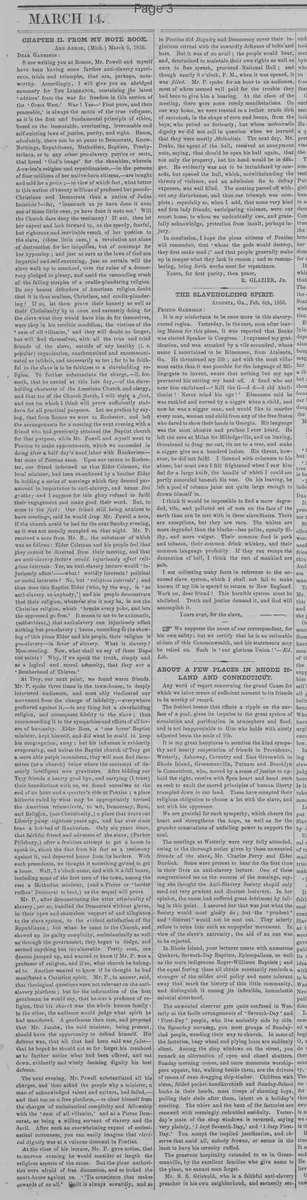
MARCH 14.
CHAPTER II. FROM MY NOTE BOOK.
ANN ARBOR, (Mich.) March 5, 1856.
DEAR GARRISON:
Since writing you at Romeo, Mr. Powell and myself have been having some further anti-slavery experience, trials and triumphs, that are, perhaps, noteworthy. Accordingly, I will give you an abridged summary for THE LIBERATOR, containing the latest 'advices' from the war for freedom in this section of the 'Great West.' War! Yes—'First pure, and then peaceable,' is always the motto of the true reformer, as it is the first and fundamental principle of ethics, based on the immutable, everlasting, irrevocable and self-existing laws of justice, purity, and right. Hence, absolutely, there can be no peace to Democrats, Know-Nothings, Republicans, Methodists, Baptists, Presbyterians, or to any other pro-slavery parties or sects, that breed God's image for the shambles, wherein America's religion and republicanism,—in the persons of four millions of her native-born citizens,—are bought and sold for a price ;—in view of which fact, what better is this nation of twenty millions of professed but pseudo-Christians and Democrats than a nation of Judas Iscariots?—for, inasmuch as ye have done it unto one of these little ones, ye have done it unto me.' Will the Church dare deny the testimony? If not, then let her expect and look forward to, as the speedy, fearful, but righteous and inevitable result of her position to the slave, (these little ones,) a revolution not alone of destruction for her iniquities, but of contempt for her hypocrisy ; and just as sure as the laws of God are impartial and self-executing, just so certain will the slave walk up to manhood, over the ruins of a democracy pledged to piracy, and amid the resounding crash of the falling temples of a cradle-plundering religion. Do any honest defenders of American religion doubt that it is thus soulless, Christless, and cradle-plundering? If so, let them prove their honesty as well as their Christianity by at once and earnestly doing for the slave what they would have him do for themselves, were they in his terrible condition, the victims of the 'sum of all villanies,' and they will doubt no longer, but will find themselves, with all the true and tried friends of the slave, outside of any healthy (i. e. popular) organization, anathematized and excommunicated as infidels, and necessarily so too ; for to be faithful to the slave is to be faithless to a slaveholding religion. To further substantiate the charge,—if, forsooth, that be needed at this late day, of the slave-holding character of the American Church and clergy, and that too of the Church North, I will state a fact, and one too which I think will prove sufficiently stubborn for all practical purposes. Let me preface by saying, that from Romeo we went to Rochester, and left the arrangements for a meeting the next evening with a friend who had previously obtained the Baptist church for that purpose, while Mr. Powell and myself went to Pontiac to make appointments, which we succeeded in doing after a half day's hard labor with Hunkerism—but more of Pontiac anon. Upon our return to Rochester, our friend informed us that Elder Coleman, the local minister, had been re-enforced by a brother Elder in holding a series of meetings which they deemed paramount in importance to anti-slavery, and hence Dei gratia; and I suppose for this glory refused to fulfil their engagement and make good their word. But, to come to the fact: Our friend still being anxious to have meetings, said he would drop Mr. Powell a note, if the church could be had for the next Sunday evening, as it was not usually occupied on that night. Mr. P. received a note from Mr. B., the substance of which was as follows: Elder Coleman and his people feel that they cannot be diverted from their meeting, and that an anti-slavery lecture would injuriously affect religious interests. Yes, an anti-slavery lecture would 'injuriously affect'—what? worldly interests? political or social interests? No, but 'religious interests'; and thus does this Baptist Elder (who, by the way, is 'as anti-slavery as anybody,') and his people demonstrate that their religion, whatever else it may be, is not the Christian religion, which 'breaks every yoke, and lets the oppressed go free.' It seems to me to be axiomatic, (self-evident,) that anti-slavery can injuriously affect nothing but pro-slavery ; hence, according to the showing of this pious Elder and his people, their religion is pro-slavery—in favor of slavery. What is slavery? Man-stealing. Now, what shall we say of these Baptist saints? Why, if we speak the truth, simply and as a logical and moral necessity, that they are a 'Brotherhood of Thieves.'
At Troy, our next point, we found warm friends. Mr. P. spoke three times in the town-house, to deeply interested audiences, and most ably vindicated our movement from the charge of infidelity,—everywhere preferred against it,—to any thing but a slaveholding religion, and consequent fidelity to the slave ; thus recommending it to the sympathies and efforts of all lovers of humanity. Elder Ross, a 'one horse' Baptist minister, kept himself, and did what he could to keep his congregation, away; but his influence is evidently evaporating, and unless the Baptist church of Troy get a more able pulpit incumbent, they will soon find themselves (as a church) below where the contempt of decently intelligent men gravitates. After bidding our Troy friends a hearty good bye, and carrying (I trust) their benedictions with us, we found ourselves at the end of an hour and a quarter's ride at Pontiac ; a place hitherto ruled by what may be appropriately termed the American triumvirate, to wit, Democracy, Rum, and Religion, (not Christianity,) a place that drove out Liberty Party eighteen years ago, and has ever since been a hot-bed of Hunkerism. Only six years since, that faithful friend and advocate of the slave, (Parker Pillsbury,) after a fruitless attempt to get a house to speak in, shook the dust from his feet as a testimony against it, and departed hence from its borders. With such precedents, we thought it something gained to get a house. Well, 7 o'clock came, and with it a full house, including some of the first men of the town, among the rest a Methodist minister, (and a Pierce or border ruffian Democrat to boot,) as the sequel will prove. Mr. P., after demonstrating the utter criminality of slavery, per se, handled the Democrats without gloves, in their open and shameless support of and allegiance to the slave system, to the evident satisfaction of the Republicans; but when he came to the Church, and showed up its guilty complicity, ecclesiastically as well as through the government, they began to dodge, and seemed anything but invulnerable. Pretty soon, one deacon jumped up, and wanted to know if Mr. P. was a professor of religion, and if so, what church he belonged to. Another wanted to know if he thought he had manifested a Christian spirit. Mr. P., in answer, said, that theological questions were not relevant on the anti-slavery platform ; but for the information of the first gentleman he would say, that he was a professor of religion, that his church was the whole human family: to the other, the audience would judge what spirit he had manifested. A gentleman then rose, and proposed that Mr. Jacobs, the said minister, being present, should have the opportunity to defend himself. His defence was, that all that had been said was false—that he hoped he should not so far forget his manhood as to further notice what had been offered, and sat down, evidently and wisely deeming dignity his best defence.
The next evening, Mr. Powell substantiated all his charges, and then asked the people why a minister, a man of acknowledged talent and culture, had failed,—and that too on a free platform,—to clear himself from the charges of ecclesiastical complicity and fellowship with the 'sum of all villanies,' and as a Pierce Democrat, as being a willing servant of slavery and the devil. After such an overwhelming exposé of ecclesiastical rottenness, you can easily imagine that clerical dignity was at a ruinous discount in Pontiac. At the close of his lecture, Mr. P. gave notice, that to-morrow evening he would consider at length the religious aspects of the cause. But the pious authorities were afraid of free discussion, and so locked the court-house against us. 'Tis conscience that makes cowards of us all.' Guilt is always cowardly, and so in Pontiac did Dignity and Democracy cover their inglorious retreat with the cowardly defences of bolts and bars. But it was of no avail; the people would hear, and, determined to maintain their own rights as well as ours to free speech, procured National Hall; and though nearly 8 o'clock, P. M., when it was opened, it was filled. Mr. P. spoke for an hour to an audience, most of whom seemed well paid for the trouble they had been to give him a hearing. At the close of the meeting, there were some rowdy manifestations. On our way home, we were treated to a rather crude dish of succotash, in the shape of corn and beans, from the boys, who pelted us furiously, but whose mobocratic dignity we did not call in question when we learned that they were mostly Methodists. The next day, Mr. Drake, the agent of the hall, received an anonymous note, saying, that should he open his hall again, that not only the property, but his head would be in danger. He evidently was not to be intimidated by cowards, but opened the hall, which, notwithstanding the threats of violence, and an admission fee to defray expenses, was well filled. The meeting passed off without any disturbance, and thus our triumph was complete; especially so, when I add, that some very kind and firm lady friends, anticipating violence, were our escort home, to whom we undoubtedly owe, and gratefully acknowledge, protection from insult, perhaps injury.
In conclusion, I hope the pious citizens of Pontiac will remember, that 'whom the gods would destroy, they first make mad;' and that people generally make up in temper what they lack in reason ; and so remembering, bring forth works meet for repentance.
Yours, for first purity, then peace,
R. GLAZIER, JR.
CHAPTER II. FROM MY NOTE BOOK.
ANN ARBOR, (Mich.) March 5, 1856.
DEAR GARRISON:
Since writing you at Romeo, Mr. Powell and myself have been having some further anti-slavery experience, trials and triumphs, that are, perhaps, noteworthy. Accordingly, I will give you an abridged summary for THE LIBERATOR, containing the latest 'advices' from the war for freedom in this section of the 'Great West.' War! Yes—'First pure, and then peaceable,' is always the motto of the true reformer, as it is the first and fundamental principle of ethics, based on the immutable, everlasting, irrevocable and self-existing laws of justice, purity, and right. Hence, absolutely, there can be no peace to Democrats, Know-Nothings, Republicans, Methodists, Baptists, Presbyterians, or to any other pro-slavery parties or sects, that breed God's image for the shambles, wherein America's religion and republicanism,—in the persons of four millions of her native-born citizens,—are bought and sold for a price ;—in view of which fact, what better is this nation of twenty millions of professed but pseudo-Christians and Democrats than a nation of Judas Iscariots?—for, inasmuch as ye have done it unto one of these little ones, ye have done it unto me.' Will the Church dare deny the testimony? If not, then let her expect and look forward to, as the speedy, fearful, but righteous and inevitable result of her position to the slave, (these little ones,) a revolution not alone of destruction for her iniquities, but of contempt for her hypocrisy ; and just as sure as the laws of God are impartial and self-executing, just so certain will the slave walk up to manhood, over the ruins of a democracy pledged to piracy, and amid the resounding crash of the falling temples of a cradle-plundering religion. Do any honest defenders of American religion doubt that it is thus soulless, Christless, and cradle-plundering? If so, let them prove their honesty as well as their Christianity by at once and earnestly doing for the slave what they would have him do for themselves, were they in his terrible condition, the victims of the 'sum of all villanies,' and they will doubt no longer, but will find themselves, with all the true and tried friends of the slave, outside of any healthy (i. e. popular) organization, anathematized and excommunicated as infidels, and necessarily so too ; for to be faithful to the slave is to be faithless to a slaveholding religion. To further substantiate the charge,—if, forsooth, that be needed at this late day, of the slave-holding character of the American Church and clergy, and that too of the Church North, I will state a fact, and one too which I think will prove sufficiently stubborn for all practical purposes. Let me preface by saying, that from Romeo we went to Rochester, and left the arrangements for a meeting the next evening with a friend who had previously obtained the Baptist church for that purpose, while Mr. Powell and myself went to Pontiac to make appointments, which we succeeded in doing after a half day's hard labor with Hunkerism—but more of Pontiac anon. Upon our return to Rochester, our friend informed us that Elder Coleman, the local minister, had been re-enforced by a brother Elder in holding a series of meetings which they deemed paramount in importance to anti-slavery, and hence Dei gratia; and I suppose for this glory refused to fulfil their engagement and make good their word. But, to come to the fact: Our friend still being anxious to have meetings, said he would drop Mr. Powell a note, if the church could be had for the next Sunday evening, as it was not usually occupied on that night. Mr. P. received a note from Mr. B., the substance of which was as follows: Elder Coleman and his people feel that they cannot be diverted from their meeting, and that an anti-slavery lecture would injuriously affect religious interests. Yes, an anti-slavery lecture would 'injuriously affect'—what? worldly interests? political or social interests? No, but 'religious interests'; and thus does this Baptist Elder (who, by the way, is 'as anti-slavery as anybody,') and his people demonstrate that their religion, whatever else it may be, is not the Christian religion, which 'breaks every yoke, and lets the oppressed go free.' It seems to me to be axiomatic, (self-evident,) that anti-slavery can injuriously affect nothing but pro-slavery ; hence, according to the showing of this pious Elder and his people, their religion is pro-slavery—in favor of slavery. What is slavery? Man-stealing. Now, what shall we say of these Baptist saints? Why, if we speak the truth, simply and as a logical and moral necessity, that they are a 'Brotherhood of Thieves.'
At Troy, our next point, we found warm friends. Mr. P. spoke three times in the town-house, to deeply interested audiences, and most ably vindicated our movement from the charge of infidelity,—everywhere preferred against it,—to any thing but a slaveholding religion, and consequent fidelity to the slave ; thus recommending it to the sympathies and efforts of all lovers of humanity. Elder Ross, a 'one horse' Baptist minister, kept himself, and did what he could to keep his congregation, away; but his influence is evidently evaporating, and unless the Baptist church of Troy get a more able pulpit incumbent, they will soon find themselves (as a church) below where the contempt of decently intelligent men gravitates. After bidding our Troy friends a hearty good bye, and carrying (I trust) their benedictions with us, we found ourselves at the end of an hour and a quarter's ride at Pontiac ; a place hitherto ruled by what may be appropriately termed the American triumvirate, to wit, Democracy, Rum, and Religion, (not Christianity,) a place that drove out Liberty Party eighteen years ago, and has ever since been a hot-bed of Hunkerism. Only six years since, that faithful friend and advocate of the slave, (Parker Pillsbury,) after a fruitless attempt to get a house to speak in, shook the dust from his feet as a testimony against it, and departed hence from its borders. With such precedents, we thought it something gained to get a house. Well, 7 o'clock came, and with it a full house, including some of the first men of the town, among the rest a Methodist minister, (and a Pierce or border ruffian Democrat to boot,) as the sequel will prove. Mr. P., after demonstrating the utter criminality of slavery, per se, handled the Democrats without gloves, in their open and shameless support of and allegiance to the slave system, to the evident satisfaction of the Republicans; but when he came to the Church, and showed up its guilty complicity, ecclesiastically as well as through the government, they began to dodge, and seemed anything but invulnerable. Pretty soon, one deacon jumped up, and wanted to know if Mr. P. was a professor of religion, and if so, what church he belonged to. Another wanted to know if he thought he had manifested a Christian spirit. Mr. P., in answer, said, that theological questions were not relevant on the anti-slavery platform ; but for the information of the first gentleman he would say, that he was a professor of religion, that his church was the whole human family: to the other, the audience would judge what spirit he had manifested. A gentleman then rose, and proposed that Mr. Jacobs, the said minister, being present, should have the opportunity to defend himself. His defence was, that all that had been said was false—that he hoped he should not so far forget his manhood as to further notice what had been offered, and sat down, evidently and wisely deeming dignity his best defence.
The next evening, Mr. Powell substantiated all his charges, and then asked the people why a minister, a man of acknowledged talent and culture, had failed,—and that too on a free platform,—to clear himself from the charges of ecclesiastical complicity and fellowship with the 'sum of all villanies,' and as a Pierce Democrat, as being a willing servant of slavery and the devil. After such an overwhelming exposé of ecclesiastical rottenness, you can easily imagine that clerical dignity was at a ruinous discount in Pontiac. At the close of his lecture, Mr. P. gave notice, that to-morrow evening he would consider at length the religious aspects of the cause. But the pious authorities were afraid of free discussion, and so locked the court-house against us. 'Tis conscience that makes cowards of us all.' Guilt is always cowardly, and so in Pontiac did Dignity and Democracy cover their inglorious retreat with the cowardly defences of bolts and bars. But it was of no avail; the people would hear, and, determined to maintain their own rights as well as ours to free speech, procured National Hall; and though nearly 8 o'clock, P. M., when it was opened, it was filled. Mr. P. spoke for an hour to an audience, most of whom seemed well paid for the trouble they had been to give him a hearing. At the close of the meeting, there were some rowdy manifestations. On our way home, we were treated to a rather crude dish of succotash, in the shape of corn and beans, from the boys, who pelted us furiously, but whose mobocratic dignity we did not call in question when we learned that they were mostly Methodists. The next day, Mr. Drake, the agent of the hall, received an anonymous note, saying, that should he open his hall again, that not only the property, but his head would be in danger. He evidently was not to be intimidated by cowards, but opened the hall, which, notwithstanding the threats of violence, and an admission fee to defray expenses, was well filled. The meeting passed off without any disturbance, and thus our triumph was complete; especially so, when I add, that some very kind and firm lady friends, anticipating violence, were our escort home, to whom we undoubtedly owe, and gratefully acknowledge, protection from insult, perhaps injury.
In conclusion, I hope the pious citizens of Pontiac will remember, that 'whom the gods would destroy, they first make mad;' and that people generally make up in temper what they lack in reason ; and so remembering, bring forth works meet for repentance.
Yours, for first purity, then peace,
R. GLAZIER, JR.
What sub-type of article is it?
Persuasive
Political
Religious
What themes does it cover?
Slavery Abolition
Religion
Politics
What keywords are associated?
Anti Slavery Lectures
Church Complicity
Pro Slavery Democrats
Pontiac Opposition
Michigan Abolition
Baptist Elders
Methodist Threats
Slavery Critique
What entities or persons were involved?
R. Glazier, Jr.
Garrison
Letter to Editor Details
Author
R. Glazier, Jr.
Recipient
Garrison
Main Argument
anti-slavery efforts face opposition from pro-slavery churches and democrats in michigan; true christianity demands fidelity to the slave, exposing the hypocrisy of american religion and politics that support slavery.
Notable Details
Denial Of Baptist Church In Rochester By Elder Coleman
Lectures In Troy Against Infidelity Charges
Opposition And Threats In Pontiac From Methodists And Democrats, Including Locking Courthouse And Pelting With Corn And Beans
Reference To Parker Pillsbury's Prior Experience
Triumph Via National Hall Despite Violence Threats