Thank you for visiting SNEWPapers!
Sign up free
The Madison Daily Leader
Madison, Lake County, South Dakota
What is this article about?
Account of Vice Admiral Zinovi Petrovitch Rojestvensky's bravery in the Russo-Turkish War of 1877, where he commanded the Vesta after Captain Popoff's death and sank three Turkish vessels near the Roumanian coast in the Black Sea, earning the St. George cross. Context includes his later command in the 1905 Russo-Japanese War and recent death in St. Petersburg.
Clipping
OCR Quality
Full Text
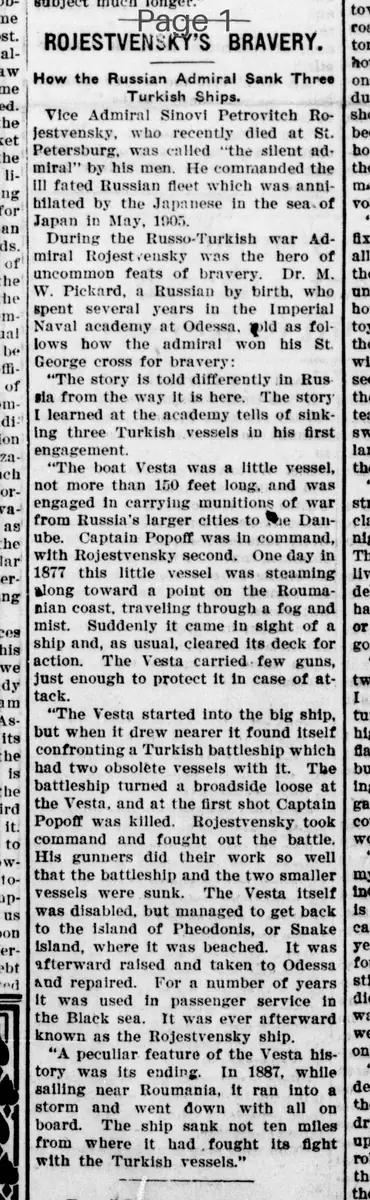
How the Russian Admiral Sank Three Turkish Ships.
Vice Admiral Zinovi Petrovitch Rojestvensky, who recently died at St. Petersburg, was called the "silent admiral" by his men. He commanded the ill-fated Russian fleet which was annihilated by the Japanese in the sea of Japan in May, 1905.
During the Russo-Turkish war Admiral Rojestvensky was the hero of uncommon feats of bravery. Dr. M. W. Pickard, a Russian by birth, who spent several years in the Imperial Naval academy at Odessa, tells as follows how the admiral won his St. George cross for bravery:
"The story is told differently in Russia from the way it is here. The story I learned at the academy tells of sinking three Turkish vessels in his first engagement.
"The boat Vesta was a little vessel, not more than 150 feet long, and was engaged in carrying munitions of war from Russia's larger cities to the Danube. Captain Popoff was in command, with Rojestvensky second. One day in 1877 this little vessel was steaming along toward a point on the Roumanian coast, traveling through a fog and mist. Suddenly it came in sight of a ship and, as usual, cleared its deck for action. The Vesta carried few guns, just enough to protect it in case of attack.
"The Vesta started into the big ship, but when it drew nearer it found itself confronting a Turkish battleship which had two obsolete vessels with it. The battleship turned a broadside loose at the Vesta, and at the first shot Captain Popoff was killed. Rojestvensky took command and fought out the battle. His gunners did their work so well that the battleship and the two smaller vessels were sunk. The Vesta itself was disabled, but managed to get back to the island of Pheodonisia, or Snake Island, where it was beached. It was afterward raised and taken to Odessa and repaired. For a number of years it was used in passenger service in the Black sea. It was ever afterward known as the Rojestvensky ship.
"A peculiar feature of the Vesta's history was its ending. In 1887, while sailing near Roumania, it ran into a storm and went down with all on board. The ship sank not ten miles from where it had fought its fight with the Turkish vessels."
What sub-type of article is it?
What keywords are associated?
What entities or persons were involved?
Where did it happen?
Foreign News Details
Primary Location
Black Sea Near Roumanian Coast
Event Date
1877
Key Persons
Outcome
captain popoff killed; three turkish vessels sunk; vesta disabled but repaired; rojestvensky awarded st. george cross
Event Details
In 1877, during the Russo-Turkish War, the Russian vessel Vesta, carrying munitions to the Danube, encountered a Turkish battleship and two smaller vessels near the Roumanian coast in fog. After Captain Popoff was killed by the first shot, Rojestvensky took command and sank all three Turkish ships. The damaged Vesta reached Snake Island, was beached, repaired in Odessa, and later served passengers until sinking in a 1887 storm near the same location.