Thank you for visiting SNEWPapers!
Sign up free
Story
August 17, 1953
Trainman News
Indianapolis, Marion County, Indiana
What is this article about?
The 1951 amendments to the Railroad Retirement Act allowed revocation of joint-and-survivor annuity elections, restoring full benefits to employees. By end of 1952, over half of such elections were canceled, increasing average monthly benefits by about $25. Details on historical provisions and statistics provided.
Clipping
OCR Quality
95%
Excellent
Full Text
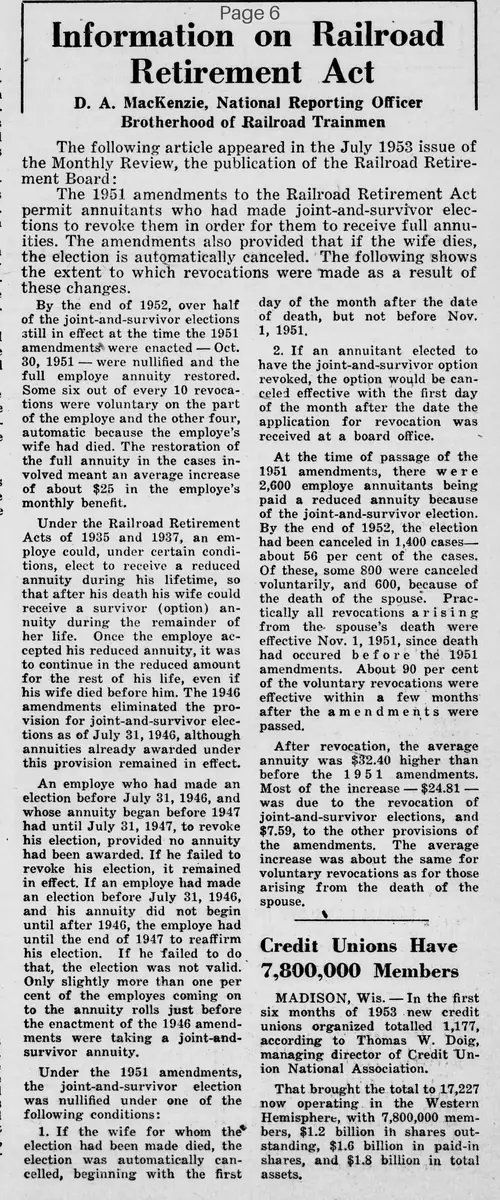
Information on
Railroad
Retirement Act
D. A. MacKenzie, National Reporting Officer
Brotherhood of Railroad Trainmen
The following article appeared in the July 1953 issue of the Monthly Review, the publication of the Railroad Retirement Board:
The 1951 amendments to the Railroad Retirement Act permit annuitants who had made joint-and-survivor elections to revoke them in order for them to receive full annuities. The amendments also provided that if the wife dies, the election is automatically canceled. 'The following shows the extent to which revocations were made as a result of these changes.
By the end of 1952, over half of the joint-and-survivor elections still in effect at the time the 1951 amendments were enacted-Oct. 30, 1951 -- were nullified and the full employe annuity restored.
Some six out of every 10 revocations were voluntary on the part of the employe and the other four, automatic because the employe's wife had died. The restoration of the full annuity in the cases involved meant an average increase of about $25 in the employe's monthly benefit.
Under the Railroad Retirement Acts of 1935 and 1937. an employee could, under certain conditions, elect to receive a reduced annuity during his lifetime, so that after his death his wife could receive a survivor (option) annuity during the remainder of her life. Once the employe accepted his reduced annuity, it was to continue in the reduced amount for the rest of his life, even if his wife died before him. The 1946 amendments eliminated the provision for joint-and-survivor elections as of July 31, 1946, although annuities already awarded under this provision remained in effect.
An employe who had made an election before July 31, 1946, and whose annuity began before 1947 had until July 31, 1947. to revoke his election, provided no annuity had been awarded. If he failed to revoke his election, it remained in effect. If an employe had made an election before July 31, 1946, and his annuity did not begin until after 1946. the employe had until the end of 1947 to reaffirm his election. If he failed to do that. the election was not valid.
Only slightly more than one per cent of the employes coming on to the annuity rolls just before the enactment of the 1946 amendments were taking a joint-and- survivor annuity.
Under the 1951 amendments, the joint-and-survivor election was nullified under one of the following conditions:
1. If the wife for whom the election had been made died, the election was automatically canceled, beginning with the first day of the month after the date of death, but not before Nov. 1, 1951.
2. If an annuitant elected to have the joint-and-survivor option revoked, the option would be canceled effective with the first day of the month after the date the application for revocation was received at a board office.
At the time of passage of the 1951 amendments, there were 2,600 employe annuitants being paid a reduced annuity because of the joint-and-survivor election.
By the end of 1952, the election had been canceled in 1,400 cases- about 56 per cent of the cases.
Of these, some 800 were canceled voluntarily, and 600. because of the death of the spouse. Practically all revocations arising from the- spouse's death were effective Nov. 1. 1951, since death had occured before 'the 1951 amendments. About 90 per cent of the voluntary revocations were effective within a few months after the amendments were passed.
After revocation, the average annuity was $32.40 higher than before the 1951 amendments.
Most of the increase --$24.81 -- was due to the revocation of joint-and-survivor elections, and $7.59, to the other provisions of the amendments.
The average increase was about the same for voluntary revocations as for those arising from the death of the spouse.
Railroad
Retirement Act
D. A. MacKenzie, National Reporting Officer
Brotherhood of Railroad Trainmen
The following article appeared in the July 1953 issue of the Monthly Review, the publication of the Railroad Retirement Board:
The 1951 amendments to the Railroad Retirement Act permit annuitants who had made joint-and-survivor elections to revoke them in order for them to receive full annuities. The amendments also provided that if the wife dies, the election is automatically canceled. 'The following shows the extent to which revocations were made as a result of these changes.
By the end of 1952, over half of the joint-and-survivor elections still in effect at the time the 1951 amendments were enacted-Oct. 30, 1951 -- were nullified and the full employe annuity restored.
Some six out of every 10 revocations were voluntary on the part of the employe and the other four, automatic because the employe's wife had died. The restoration of the full annuity in the cases involved meant an average increase of about $25 in the employe's monthly benefit.
Under the Railroad Retirement Acts of 1935 and 1937. an employee could, under certain conditions, elect to receive a reduced annuity during his lifetime, so that after his death his wife could receive a survivor (option) annuity during the remainder of her life. Once the employe accepted his reduced annuity, it was to continue in the reduced amount for the rest of his life, even if his wife died before him. The 1946 amendments eliminated the provision for joint-and-survivor elections as of July 31, 1946, although annuities already awarded under this provision remained in effect.
An employe who had made an election before July 31, 1946, and whose annuity began before 1947 had until July 31, 1947. to revoke his election, provided no annuity had been awarded. If he failed to revoke his election, it remained in effect. If an employe had made an election before July 31, 1946, and his annuity did not begin until after 1946. the employe had until the end of 1947 to reaffirm his election. If he failed to do that. the election was not valid.
Only slightly more than one per cent of the employes coming on to the annuity rolls just before the enactment of the 1946 amendments were taking a joint-and- survivor annuity.
Under the 1951 amendments, the joint-and-survivor election was nullified under one of the following conditions:
1. If the wife for whom the election had been made died, the election was automatically canceled, beginning with the first day of the month after the date of death, but not before Nov. 1, 1951.
2. If an annuitant elected to have the joint-and-survivor option revoked, the option would be canceled effective with the first day of the month after the date the application for revocation was received at a board office.
At the time of passage of the 1951 amendments, there were 2,600 employe annuitants being paid a reduced annuity because of the joint-and-survivor election.
By the end of 1952, the election had been canceled in 1,400 cases- about 56 per cent of the cases.
Of these, some 800 were canceled voluntarily, and 600. because of the death of the spouse. Practically all revocations arising from the- spouse's death were effective Nov. 1. 1951, since death had occured before 'the 1951 amendments. About 90 per cent of the voluntary revocations were effective within a few months after the amendments were passed.
After revocation, the average annuity was $32.40 higher than before the 1951 amendments.
Most of the increase --$24.81 -- was due to the revocation of joint-and-survivor elections, and $7.59, to the other provisions of the amendments.
The average increase was about the same for voluntary revocations as for those arising from the death of the spouse.
What sub-type of article is it?
Historical Event
What themes does it cover?
Justice
Recovery
What keywords are associated?
Railroad Retirement Act
1951 Amendments
Joint And Survivor Election
Annuity Revocation
Employee Benefits
Spouse Death
Voluntary Cancellation
What entities or persons were involved?
D. A. Mackenzie
Brotherhood Of Railroad Trainmen
Railroad Retirement Board
Story Details
Key Persons
D. A. Mackenzie
Brotherhood Of Railroad Trainmen
Railroad Retirement Board
Event Date
1951 10 30 To 1952 12 31
Story Details
1951 amendments to Railroad Retirement Act allowed revocation of joint-and-survivor elections for full annuities; automatic cancellation if wife died. By end 1952, 56% of 2,600 cases canceled (800 voluntary, 600 due to death), increasing average monthly benefit by $25.