Thank you for visiting SNEWPapers!
Sign up free
Editorial
October 19, 1759
The New Hampshire Gazette
Portsmouth, Rockingham County, New Hampshire
What is this article about?
A continued editorial vehemently criticizes a British minister (implied William Pitt) for his harsh treatment of the army through pointless, fatiguing expeditions to the French coast during the Seven Years' War, arguing they risk unnecessary losses, demoralize officers, and undermine military discipline and national honor.
Clipping
OCR Quality
98%
Excellent
Full Text
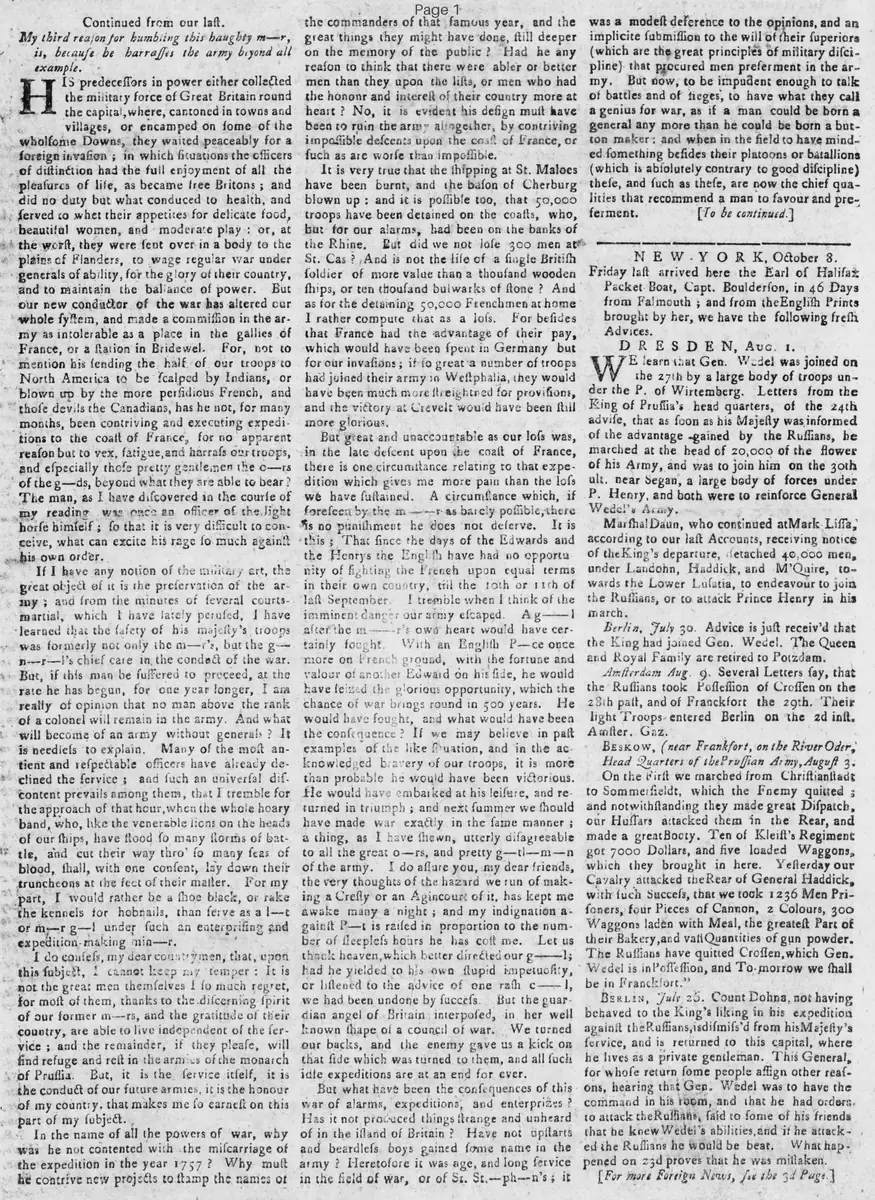
Continued from our last.
My third reason for humbling this haughty minister, is, because he harrasses the army beyond all example, similarly once ceased he military state of Great Britain round the capital, where, cantoned in towns and villages, or encamped on some of the wholesome Downs, they waited peaceably for a foreign invasion; in which situations the officers of distinction had the full enjoyment of all the pleasures of life, as became free Britons; and did no duty but what conduced to health, and served to whet their appetites for delicate food, beautiful women, and moderate play: or, at the worst, they were sent over in a body to the plains of Flanders, to wage regular war under generals of ability, for the glory of their country, and to maintain the balance of power. But our new conductor of the war has altered our whole system, and made a commission in the army as intolerable as a place in the galleys of France, or a station in Bridewell. For, not to mention his sending the half of our troops to North America to be scalped by Indians, or blown up by the more perfidious French, and those devils the Canadians, has he not, for many months, been contriving and executing expeditions to the coast of France, for no apparent reason but to vex, fatigue, and harrass our troops, and especially those pretty gentlemen the Officers of the guards, beyond what they are able to bear? The man, as I have discovered in the course of my reading was once an officer of the light horse himself: so that it is very difficult to conceive, what can excite his rage so much against his own order.
If I have any notion of the military art, the great object of it is the preservation of the army; and from the minutes of several courts-martial, which I have lately perused, I have learned that the safety of his majesty's troops was formerly not only the minister's, but the general's chief care in the conduct of the war. But, if this man be suffered to proceed, at the rate he has begun, for one year longer, I am really of opinion that no man above the rank of a colonel will remain in the army. And what will become of an army without generals? It is needless to explain. Many of the most ancient and respectable officers have already declined the service; and such an universal discontent prevails among them, that I tremble for the approach of that hour, when the whole hoary band, who, like the venerable lions on the heads of our ships, have stood so many storms of battle, and cut their way thro' so many seas of blood, shall, with one consent, lay down their truncheons at the feet of their master. For my part, I would rather be a shoe black, or rake the kennels for hobnails, than serve as a lieutenant or major general under such an enterprising and expedition-making minister.
I do confess, my dear countrymen, that, upon this subject, I cannot keep my temper: It is not the great men themselves I so much regret, for most of them, thanks to the discerning spirit of our former ministers, and the gratitude of their country, are able to live independent of the service; and the remainder, if they please, will find refuge and rest in the armies of the monarch of Prussia. But, it is the service itself, it is the conduct of our future armies, it is the honour of my country, that makes me so earnest on this part of my subject.
In the name of all the powers of war, why was he not contented with the miscarriage of the expedition in the year 1757? Why must he contrive new projects to stamp the names of the commanders of that famous year, and the great things they might have done, till deeper on the memory of the public? Had he any reason to think that there were abler or better men than they upon the lists, or men who had the honour and interest of their country more at heart? No, it is evident his design must have been to ruin the army altogether, by contriving impossible descents upon the coast of France, or such as are worse than impossible.
It is very true that the shipping at St. Maloes have been burnt, and the basin of Cherburg blown up: and it is possible too, that 50,000 troops have been detained on the coasts, who, but for our alarms, had been on the banks of the Rhine. But did we not lose 200 men at St. Cas? And is not the life of a single British soldier of more value than a thousand wooden ships, or ten thousand bulwarks of stone? And as for the detaining 60,000 Frenchmen at home I rather compute that as a loss. For besides that France had the advantage of their pay, which would have been spent in Germany but for our invasions: if so great a number of troops had joined their army in Westphalia, they would have been much more straitened for provisions, and the victory at Crevelt would have been still more glorious.
But great and unaccountable as our loss was, in the late descent upon the coast of France, there is one circumstance relating to that expedition which gives me more pain than the loss we have sustained. A circumstance which, if foreseen by the minister as easily possible, there is no punishment he does not deserve. It is this: That since the days of the Edwards and the Henrys the English have had no opportunity of fighting the French upon equal terms in their own country, till the 10th or 11th of last September. I tremble when I think of the imminent danger our army escaped. A general after the minister's own heart would have certainly fought. With an English Prince once more on French ground, with the fortune and valour of another Edward on his side, he would have seized the glorious opportunity, which the chance of war brings round in 200 years. He would have fought, and what would have been the consequence? If we may believe in past examples of the like situation, and in the acknowledged bravery of our troops, it is more than probable he would have been victorious. He would have embarked at his leisure, and returned in triumph; and next summer we should have made war exactly in the same manner; a thing, as I have shewn, utterly disagreeable to all the great officers, and pretty gentlemen of the army. I do assure you, my dear friends, the very thoughts of the hazard we run of making a Cressy or an Agincourt of it, has kept me awake many a night; and my indignation against Pitt is raised in proportion to the number of sleepless hours he has cost me. Let us thank heaven, which better directed our general: had he yielded to his own stupid impetuosity, or listened to the advice of one rash colonel, we had been undone by success. But the guardian angel of Britain interposed, in her well known shape of a council of war. We turned our backs, and the enemy gave us a kick on that side which was turned to them, and all such idle expeditions are at an end for ever.
But what have been the consequences of this war of alarms, expeditions, and enterprizes? Has it not produced things strange and unheard of in the island of Britain? Have not upstarts and beardless boys gained some name in the army? Heretofore it was age, and long service in the field of war, or of St. Stephen's; it was a modest deference to the opinions, and an implicit submission to the will of their superiors (which are the great principles of military discipline) that procured men preferment in the army. But now, to be impudent enough to talk of battles and of sieges, to have what they call a genius for war, as if a man could be born a general any more than he could be born a button maker: and when in the field to have minded something besides their platoons or battalions (which is absolutely contrary to good discipline) these, and such as these, are now the chief qualities that recommend a man to favour and preferment.
[To be continued.]
My third reason for humbling this haughty minister, is, because he harrasses the army beyond all example, similarly once ceased he military state of Great Britain round the capital, where, cantoned in towns and villages, or encamped on some of the wholesome Downs, they waited peaceably for a foreign invasion; in which situations the officers of distinction had the full enjoyment of all the pleasures of life, as became free Britons; and did no duty but what conduced to health, and served to whet their appetites for delicate food, beautiful women, and moderate play: or, at the worst, they were sent over in a body to the plains of Flanders, to wage regular war under generals of ability, for the glory of their country, and to maintain the balance of power. But our new conductor of the war has altered our whole system, and made a commission in the army as intolerable as a place in the galleys of France, or a station in Bridewell. For, not to mention his sending the half of our troops to North America to be scalped by Indians, or blown up by the more perfidious French, and those devils the Canadians, has he not, for many months, been contriving and executing expeditions to the coast of France, for no apparent reason but to vex, fatigue, and harrass our troops, and especially those pretty gentlemen the Officers of the guards, beyond what they are able to bear? The man, as I have discovered in the course of my reading was once an officer of the light horse himself: so that it is very difficult to conceive, what can excite his rage so much against his own order.
If I have any notion of the military art, the great object of it is the preservation of the army; and from the minutes of several courts-martial, which I have lately perused, I have learned that the safety of his majesty's troops was formerly not only the minister's, but the general's chief care in the conduct of the war. But, if this man be suffered to proceed, at the rate he has begun, for one year longer, I am really of opinion that no man above the rank of a colonel will remain in the army. And what will become of an army without generals? It is needless to explain. Many of the most ancient and respectable officers have already declined the service; and such an universal discontent prevails among them, that I tremble for the approach of that hour, when the whole hoary band, who, like the venerable lions on the heads of our ships, have stood so many storms of battle, and cut their way thro' so many seas of blood, shall, with one consent, lay down their truncheons at the feet of their master. For my part, I would rather be a shoe black, or rake the kennels for hobnails, than serve as a lieutenant or major general under such an enterprising and expedition-making minister.
I do confess, my dear countrymen, that, upon this subject, I cannot keep my temper: It is not the great men themselves I so much regret, for most of them, thanks to the discerning spirit of our former ministers, and the gratitude of their country, are able to live independent of the service; and the remainder, if they please, will find refuge and rest in the armies of the monarch of Prussia. But, it is the service itself, it is the conduct of our future armies, it is the honour of my country, that makes me so earnest on this part of my subject.
In the name of all the powers of war, why was he not contented with the miscarriage of the expedition in the year 1757? Why must he contrive new projects to stamp the names of the commanders of that famous year, and the great things they might have done, till deeper on the memory of the public? Had he any reason to think that there were abler or better men than they upon the lists, or men who had the honour and interest of their country more at heart? No, it is evident his design must have been to ruin the army altogether, by contriving impossible descents upon the coast of France, or such as are worse than impossible.
It is very true that the shipping at St. Maloes have been burnt, and the basin of Cherburg blown up: and it is possible too, that 50,000 troops have been detained on the coasts, who, but for our alarms, had been on the banks of the Rhine. But did we not lose 200 men at St. Cas? And is not the life of a single British soldier of more value than a thousand wooden ships, or ten thousand bulwarks of stone? And as for the detaining 60,000 Frenchmen at home I rather compute that as a loss. For besides that France had the advantage of their pay, which would have been spent in Germany but for our invasions: if so great a number of troops had joined their army in Westphalia, they would have been much more straitened for provisions, and the victory at Crevelt would have been still more glorious.
But great and unaccountable as our loss was, in the late descent upon the coast of France, there is one circumstance relating to that expedition which gives me more pain than the loss we have sustained. A circumstance which, if foreseen by the minister as easily possible, there is no punishment he does not deserve. It is this: That since the days of the Edwards and the Henrys the English have had no opportunity of fighting the French upon equal terms in their own country, till the 10th or 11th of last September. I tremble when I think of the imminent danger our army escaped. A general after the minister's own heart would have certainly fought. With an English Prince once more on French ground, with the fortune and valour of another Edward on his side, he would have seized the glorious opportunity, which the chance of war brings round in 200 years. He would have fought, and what would have been the consequence? If we may believe in past examples of the like situation, and in the acknowledged bravery of our troops, it is more than probable he would have been victorious. He would have embarked at his leisure, and returned in triumph; and next summer we should have made war exactly in the same manner; a thing, as I have shewn, utterly disagreeable to all the great officers, and pretty gentlemen of the army. I do assure you, my dear friends, the very thoughts of the hazard we run of making a Cressy or an Agincourt of it, has kept me awake many a night; and my indignation against Pitt is raised in proportion to the number of sleepless hours he has cost me. Let us thank heaven, which better directed our general: had he yielded to his own stupid impetuosity, or listened to the advice of one rash colonel, we had been undone by success. But the guardian angel of Britain interposed, in her well known shape of a council of war. We turned our backs, and the enemy gave us a kick on that side which was turned to them, and all such idle expeditions are at an end for ever.
But what have been the consequences of this war of alarms, expeditions, and enterprizes? Has it not produced things strange and unheard of in the island of Britain? Have not upstarts and beardless boys gained some name in the army? Heretofore it was age, and long service in the field of war, or of St. Stephen's; it was a modest deference to the opinions, and an implicit submission to the will of their superiors (which are the great principles of military discipline) that procured men preferment in the army. But now, to be impudent enough to talk of battles and of sieges, to have what they call a genius for war, as if a man could be born a general any more than he could be born a button maker: and when in the field to have minded something besides their platoons or battalions (which is absolutely contrary to good discipline) these, and such as these, are now the chief qualities that recommend a man to favour and preferment.
[To be continued.]
What sub-type of article is it?
Military Affairs
War Or Peace
Partisan Politics
What keywords are associated?
Military Expeditions
French Coast Raids
Army Harassment
Officer Discontent
Seven Years War
Pitt Criticism
British Troops
War Conduct
What entities or persons were involved?
Haughty Minister
New Conductor Of The War
British Army Officers
Pitt
French
Indians
Canadians
Monarch Of Prussia
Editorial Details
Primary Topic
Criticism Of The Minister's Exhausting Military Expeditions To France
Stance / Tone
Indignant And Sarcastic Opposition To The Minister's War Policies
Key Figures
Haughty Minister
New Conductor Of The War
British Army Officers
Pitt
French
Indians
Canadians
Monarch Of Prussia
Key Arguments
The Minister Harasses The Army With Pointless Expeditions To The French Coast, Fatiguing Troops Unnecessarily.
Such Actions Risk The Preservation Of The Army, The Primary Object Of Military Art.
Officers Are Demoralized And May Resign, Leaving The Army Without Experienced Leaders.
The 1757 Expedition's Failure Should Have Sufficed; New Projects Disgrace Prior Commanders.
Losses Like 200 Men At St. Cas Outweigh Any Gains In Burning Ships Or Detaining French Troops.
The Recent Descent Risked A Major Battle On French Soil, Potentially Leading To Disastrous Success.
These Policies Promote Upstarts Over Experienced Officers, Undermining Military Discipline.