Thank you for visiting SNEWPapers!
Sign up free
The Detroit Tribune
Detroit, Wayne County, Michigan
What is this article about?
NAACP petitions U.S. District Court in Montgomery, Ala., to lift Alabama's four-year ban on its operations, following Supreme Court rulings. Hearing on July 13; judge reserves decision amid state opposition on jurisdiction.
Clipping
OCR Quality
Full Text
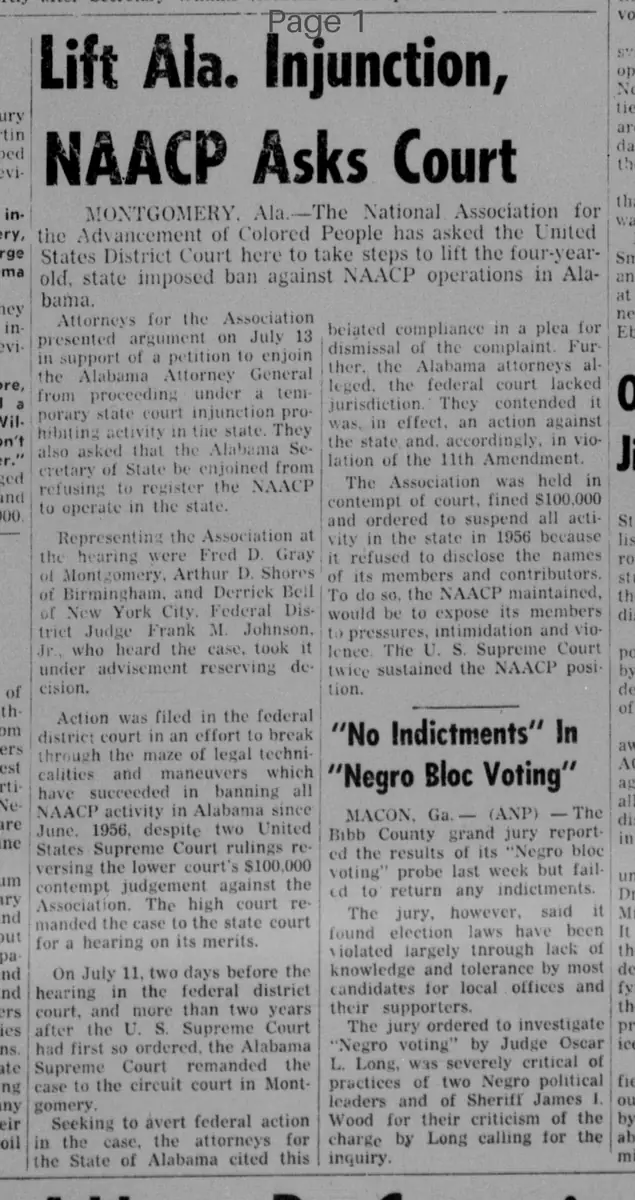
MONTGOMERY, Ala.--The National Association for the Advancement of Colored People has asked the United States District Court here to take steps to lift the four-year-old, state-imposed ban against NAACP operations in Alabama.
Attorneys for the Association presented argument on July 13 in support of a petition to enjoin the Alabama Attorney General from proceeding under a temporary state court injunction prohibiting activity in the state. They also asked that the Alabama Secretary of State be enjoined from refusing to register the NAACP to operate in the state.
Representing the Association at the hearing were Fred D. Gray of Montgomery, Arthur D. Shores of Birmingham, and Derrick Bell of New York City. Federal District Judge Frank M. Johnson, Jr., who heard the case, took it under advisement, reserving decision.
Action was filed in the federal district court in an effort to break through the maze of legal technicalities and maneuvers which have succeeded in banning all NAACP activity in Alabama since June 1956, despite two United States Supreme Court rulings reversing the lower court's $100,000 contempt judgment against the Association. The high court remanded the case to the state court for a hearing on its merits.
On July 11, two days before the hearing in the federal district court, and more than two years after the U.S. Supreme Court had first so ordered, the Alabama Supreme Court remanded the case to the circuit court in Montgomery.
Seeking to avert federal action in the case, the attorneys for the State of Alabama cited this belated compliance in a plea for dismissal of the complaint. Further, the Alabama attorneys alleged, the federal court lacked jurisdiction. They contended it was, in effect, an action against the state and, accordingly, in violation of the 11th Amendment.
The Association was held in contempt of court, fined $100,000 and ordered to suspend all activity in the state in 1956 because it refused to disclose the names of its members and contributors. To do so, the NAACP maintained, would be to expose its members to pressures, intimidation and violence. The U.S. Supreme Court twice sustained the NAACP position.
What sub-type of article is it?
What keywords are associated?
What entities or persons were involved?
Where did it happen?
Domestic News Details
Primary Location
Montgomery, Ala.
Event Date
July 13
Key Persons
Outcome
the judge took the case under advisement, reserving decision. background: naacp fined $100,000 and banned since 1956 for refusing to disclose members; u.s. supreme court twice sustained naacp position and remanded case.
Event Details
The NAACP asked the U.S. District Court to lift the four-year-old state ban on its operations in Alabama, enjoin the Alabama Attorney General from proceeding under a temporary state injunction prohibiting activity, and enjoin the Alabama Secretary of State from refusing to register the NAACP. Attorneys presented arguments on July 13. State attorneys sought dismissal, citing recent compliance with Supreme Court order and lack of federal jurisdiction under the 11th Amendment.