Thank you for visiting SNEWPapers!
Sign up free
Story
February 20, 1884
The Wellington Enterprise
Wellington, Lorain County, Ohio
What is this article about?
An article discussing the conservative nature of turkeys and geese, which resist breeding into new varieties, preferring to stay as they are. It highlights the turkey's unchanged primitive type, mysterious origins, and improvements in flavor and form through domestication, likening it to civilizing a savage.
Clipping
OCR Quality
98%
Excellent
Full Text
Conservative Turkeys.
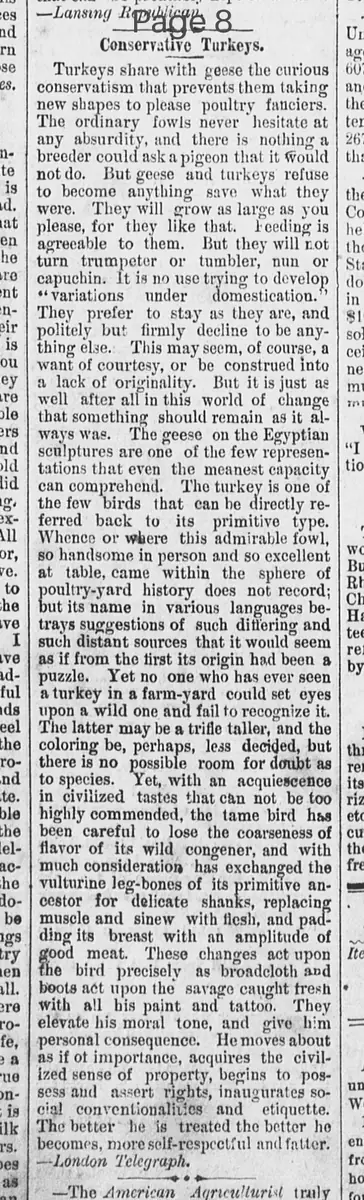
Turkeys share with geese the curious conservatism that prevents them taking new shapes to please poultry fanciers. The ordinary fowls never hesitate at any absurdity, and there is nothing a breeder could ask a pigeon that it would not do. But geese and turkeys refuse to become anything save what they were. They will grow as large as you please, for they like that. Feeding is agreeable to them. But they will not turn trumpeter or tumbler, nun or capuchin. It is no use trying to develop "variations under domestication." They prefer to stay as they are, and politely but firmly decline to be anything else. This may seem, of course, a want of courtesy, or be construed into a lack of originality. But it is just as well after all in this world of change that something should remain as it always was. The geese on the Egyptian sculptures are one of the few representations that even the meanest capacity can comprehend. The turkey is one of the few birds that can be directly referred back to its primitive type. Whence or where this admirable fowl so handsome in person and so excellent at table, came within the sphere of poultry-yard history does not record; but its name in various languages betrays suggestions of such differing and such distant sources that it would seem as if from the first its origin had been a puzzle. Yet no one who has ever seen a turkey in a farm-yard could set eyes upon a wild one and fail to recognize it. The latter may be a trifle taller, and the coloring be, perhaps, less decided, but there is no possible room for doubt as to species. Yet, with an acquiescence in civilized tastes that can not be too highly commended, the tame bird has been careful to lose the coarseness of flavor of its wild congener, and with much consideration has exchanged the vulturine leg-bones of its primitive ancestor for delicate shanks, replacing muscle and sinew with flesh, and padding its breast with an amplitude of good meat. These changes act upon the bird precisely as broadcloth and boots act upon the savage caught fresh with all his paint and tattoo. They elevate his moral tone, and give him personal consequence. He moves about as if of importance, acquires the civilized sense of property, begins to possess and assert rights, inaugurates social conventionalities and etiquette. The better he is treated the better he becomes, more self-respectful and fatter
—London Telegraph.
Turkeys share with geese the curious conservatism that prevents them taking new shapes to please poultry fanciers. The ordinary fowls never hesitate at any absurdity, and there is nothing a breeder could ask a pigeon that it would not do. But geese and turkeys refuse to become anything save what they were. They will grow as large as you please, for they like that. Feeding is agreeable to them. But they will not turn trumpeter or tumbler, nun or capuchin. It is no use trying to develop "variations under domestication." They prefer to stay as they are, and politely but firmly decline to be anything else. This may seem, of course, a want of courtesy, or be construed into a lack of originality. But it is just as well after all in this world of change that something should remain as it always was. The geese on the Egyptian sculptures are one of the few representations that even the meanest capacity can comprehend. The turkey is one of the few birds that can be directly referred back to its primitive type. Whence or where this admirable fowl so handsome in person and so excellent at table, came within the sphere of poultry-yard history does not record; but its name in various languages betrays suggestions of such differing and such distant sources that it would seem as if from the first its origin had been a puzzle. Yet no one who has ever seen a turkey in a farm-yard could set eyes upon a wild one and fail to recognize it. The latter may be a trifle taller, and the coloring be, perhaps, less decided, but there is no possible room for doubt as to species. Yet, with an acquiescence in civilized tastes that can not be too highly commended, the tame bird has been careful to lose the coarseness of flavor of its wild congener, and with much consideration has exchanged the vulturine leg-bones of its primitive ancestor for delicate shanks, replacing muscle and sinew with flesh, and padding its breast with an amplitude of good meat. These changes act upon the bird precisely as broadcloth and boots act upon the savage caught fresh with all his paint and tattoo. They elevate his moral tone, and give him personal consequence. He moves about as if of importance, acquires the civilized sense of property, begins to possess and assert rights, inaugurates social conventionalities and etiquette. The better he is treated the better he becomes, more self-respectful and fatter
—London Telegraph.
What sub-type of article is it?
Curiosity
Animal Story
What themes does it cover?
Nature
Moral Virtue
What keywords are associated?
Conservative Turkeys
Poultry Breeding
Animal Conservatism
Turkey Origins
Domestication Variations
Where did it happen?
Farm Yard
Story Details
Location
Farm Yard
Story Details
Turkeys and geese resist selective breeding changes, remaining true to their original forms unlike other poultry. The article praises the turkey's adaptability in flavor and appearance for human tastes while retaining its primitive type, drawing parallels to civilized improvement.