Thank you for visiting SNEWPapers!
Sign up free
Editorial
September 29, 1815
Daily National Intelligencer
Washington, District Of Columbia
What is this article about?
Editorial defends the honorable outcome of the War of 1812 and peace treaty negotiated by Clay, Gallatin, and Bayard, criticizing Federalist editors like the Evening Post's for denying national character gains and complaining about unresolved issues like impressment.
Clipping
OCR Quality
95%
Excellent
Full Text
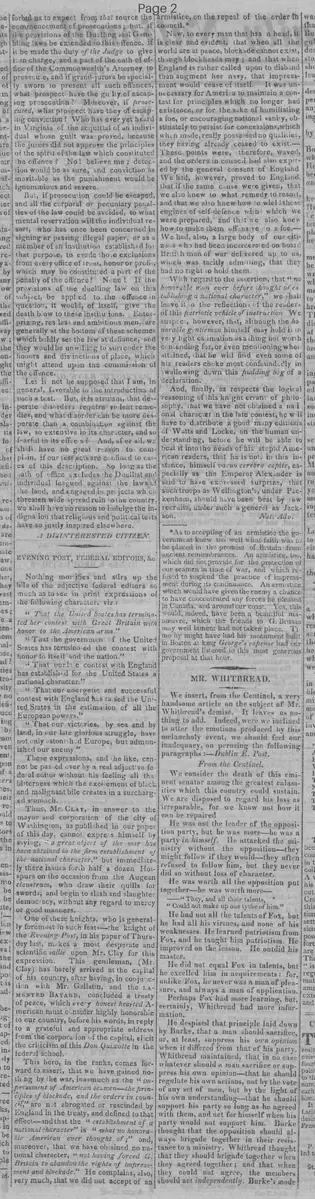
EVENING POST. FEDERAL EDITORS, &c.
Nothing mortifies and stirs up the bile of the adjective federal editors so much as to see in print expressions of the following character, viz:
"That the United States has terminated her contest with Great Britain with honor to the American arms"
"That the government of the United States has terminated the contest with honor to itself and the nation."
"That our late contest with England has established for the United States a national character."
"That our energetic and successful contest with England has raised the United States in the estimation of all the European powers."
"That our victories, by sea and by land, in our late glorious struggle, have not only astonished Europe, but admonished our enemy."
These expressions, and the like, cannot be passed over by a real adjective federal editor without his feeling all that bitterness which the excitement of black and malignant bile creates in a surcharged stomach.
Thus, Mr. CLAY, in answer to the mayor and corporation of the city of Washington, as published in our paper of this day, cannot express himself by saying, "a great object of the war has been obtained in the firm establishment of the national character," but immediately there issues forth half a dozen Hotspurs on the occasion from the Augean claustrum, who draw their quills for swords, and begin to slash and slaughter democracy, without any regard to mercy or good manners.
One of these knights, who is generally foremost in such feats—the knight of the Evening Post, in his paper of Thursday last, makes a most desperate and scientific sallie upon Mr. Clay for this expression. This gentleman, (Mr. Clay) has barely arrived at the capital of his country, after having, in conjunction with Mr. Gallatin, and the LAMENTED BAYARD, concluded a treaty of peace, which every honest hearted American must consider highly honorable to our country, before his words, in reply to a grateful and appropriate address from the corporation of the capital, elicit the criticism of this Don Quixotte in the federal school.
This hero, in the ranks, comes forward to assert, that we have gained nothing by the war, inasmuch as the "impressment of American seamen—the principles of blockade, and the orders in council," are not abrogated or rescinded by England in the treaty, and defined to that effect—and that the "establishment of a national character" is "what no honorable American ever thought of;" and, moreover, that we have obtained no national character, "not having forced G. Britain to abandon the rights of impressment and blockade." He complains, also, very much, that we did not accept of an armistice, on the repeal of the order in council.*
Now, to every man that has a head, it is clear and evident, that when all the world are at peace, blockade cannot exist, though blockheads may; and that when England is rather called upon to disband than augment her navy, that impressment would cease of itself. It was unnecessary for America to maintain a contest for principles which no longer had existence, or for the sake of humiliating a foe, or encouraging national vanity, obstinately to persist for concessions, which when made, really possessed no qualities, they having already ceased to exist.
These points were, therefore, waved, and the orders in council had also expired by the general consent of England.
We had, however, proved to England, that if the same cause were given, that we also knew to what remedy to resort, and that we also knew how to wield these engines of self-defence with which we were prepared, and that we also knew how to make them offensive to a foe.
We had, also, a large body of our citizens who had been incarcerated on board British men of war delivered up to us, which was tacitly admitting, that they had no right to hold them.
With regard to the assertion, that "no honorable man ever before thought of establishing a national character." we shall leave it to the reflections of the readers of this patriotic vehicle of instruction. We suspect, however, that, although the honorable gentleman himself may hold it in very light estimation as a thing not worth contending for, or even mentioning when attained, that he will find even some of his readers choke most confoundedly in swallowing down this pudding bog of a declaration.
And, finally, as respects the logical reasoning of this knight errant of philosophy, that we have not obtained a national character in the late contest, he will have to distribute a good many editions of Watts and Locke, on the human understanding, before he will be able to beat it into the heads of his stupid American readers, that he is not, in this instance, himself vacuo cerebro cafite, especially as the Emperor Alexander is said to have expressed surprize, that such troops as Wellington's, under Pakenham, should have been beat by raw recruits, under such a general as Jackson.
Nat. Adv.
*As to accepting of an armistice the government knew too well what faith was to be placed in the promise of Britain from ancient remembrances. An armistice, too, which did not provide for the protection of our seamen in time of war, and which refused to suspend the practice of impressment during its continuance. An armistice which would have given the enemy a chance to have concentrated any forces he pleased in Canada, and around our coast. Yes, this would, indeed, have been a beautiful manoeuvre, which the friends to G. Britain may well lament had not taken place. Timothy might have had his monument built in Boston at king George's expense had our government listened to this most generous proposal at that hour.
Nothing mortifies and stirs up the bile of the adjective federal editors so much as to see in print expressions of the following character, viz:
"That the United States has terminated her contest with Great Britain with honor to the American arms"
"That the government of the United States has terminated the contest with honor to itself and the nation."
"That our late contest with England has established for the United States a national character."
"That our energetic and successful contest with England has raised the United States in the estimation of all the European powers."
"That our victories, by sea and by land, in our late glorious struggle, have not only astonished Europe, but admonished our enemy."
These expressions, and the like, cannot be passed over by a real adjective federal editor without his feeling all that bitterness which the excitement of black and malignant bile creates in a surcharged stomach.
Thus, Mr. CLAY, in answer to the mayor and corporation of the city of Washington, as published in our paper of this day, cannot express himself by saying, "a great object of the war has been obtained in the firm establishment of the national character," but immediately there issues forth half a dozen Hotspurs on the occasion from the Augean claustrum, who draw their quills for swords, and begin to slash and slaughter democracy, without any regard to mercy or good manners.
One of these knights, who is generally foremost in such feats—the knight of the Evening Post, in his paper of Thursday last, makes a most desperate and scientific sallie upon Mr. Clay for this expression. This gentleman, (Mr. Clay) has barely arrived at the capital of his country, after having, in conjunction with Mr. Gallatin, and the LAMENTED BAYARD, concluded a treaty of peace, which every honest hearted American must consider highly honorable to our country, before his words, in reply to a grateful and appropriate address from the corporation of the capital, elicit the criticism of this Don Quixotte in the federal school.
This hero, in the ranks, comes forward to assert, that we have gained nothing by the war, inasmuch as the "impressment of American seamen—the principles of blockade, and the orders in council," are not abrogated or rescinded by England in the treaty, and defined to that effect—and that the "establishment of a national character" is "what no honorable American ever thought of;" and, moreover, that we have obtained no national character, "not having forced G. Britain to abandon the rights of impressment and blockade." He complains, also, very much, that we did not accept of an armistice, on the repeal of the order in council.*
Now, to every man that has a head, it is clear and evident, that when all the world are at peace, blockade cannot exist, though blockheads may; and that when England is rather called upon to disband than augment her navy, that impressment would cease of itself. It was unnecessary for America to maintain a contest for principles which no longer had existence, or for the sake of humiliating a foe, or encouraging national vanity, obstinately to persist for concessions, which when made, really possessed no qualities, they having already ceased to exist.
These points were, therefore, waved, and the orders in council had also expired by the general consent of England.
We had, however, proved to England, that if the same cause were given, that we also knew to what remedy to resort, and that we also knew how to wield these engines of self-defence with which we were prepared, and that we also knew how to make them offensive to a foe.
We had, also, a large body of our citizens who had been incarcerated on board British men of war delivered up to us, which was tacitly admitting, that they had no right to hold them.
With regard to the assertion, that "no honorable man ever before thought of establishing a national character." we shall leave it to the reflections of the readers of this patriotic vehicle of instruction. We suspect, however, that, although the honorable gentleman himself may hold it in very light estimation as a thing not worth contending for, or even mentioning when attained, that he will find even some of his readers choke most confoundedly in swallowing down this pudding bog of a declaration.
And, finally, as respects the logical reasoning of this knight errant of philosophy, that we have not obtained a national character in the late contest, he will have to distribute a good many editions of Watts and Locke, on the human understanding, before he will be able to beat it into the heads of his stupid American readers, that he is not, in this instance, himself vacuo cerebro cafite, especially as the Emperor Alexander is said to have expressed surprize, that such troops as Wellington's, under Pakenham, should have been beat by raw recruits, under such a general as Jackson.
Nat. Adv.
*As to accepting of an armistice the government knew too well what faith was to be placed in the promise of Britain from ancient remembrances. An armistice, too, which did not provide for the protection of our seamen in time of war, and which refused to suspend the practice of impressment during its continuance. An armistice which would have given the enemy a chance to have concentrated any forces he pleased in Canada, and around our coast. Yes, this would, indeed, have been a beautiful manoeuvre, which the friends to G. Britain may well lament had not taken place. Timothy might have had his monument built in Boston at king George's expense had our government listened to this most generous proposal at that hour.
What sub-type of article is it?
Partisan Politics
War Or Peace
What keywords are associated?
War Of 1812
Peace Treaty
National Character
Federalist Editors
Henry Clay
Impressment
Blockade
Treaty Of Ghent
What entities or persons were involved?
Mr. Clay
Mr. Gallatin
Lamented Bayard
Evening Post Editor
Emperor Alexander
Jackson
Wellington
Pakenham
Editorial Details
Primary Topic
Defense Of The War Of 1812's Honorable Outcome Against Federalist Criticism
Stance / Tone
Strongly Pro War Success And Anti Federalist
Key Figures
Mr. Clay
Mr. Gallatin
Lamented Bayard
Evening Post Editor
Emperor Alexander
Jackson
Wellington
Pakenham
Key Arguments
The United States Terminated The Contest With Great Britain With Honor To American Arms And The Nation
The War Established A National Character And Raised The United States In European Estimation
Victories By Sea And Land Astonished Europe And Admonished The Enemy
The Peace Treaty Is Honorable, Releasing Incarcerated American Citizens From British Ships
Impressment And Blockades Cease With Peace, Making Further Concessions Unnecessary
Federalist Editors React Bitterly To Positive Assessments Of The War
No Honorable American Thought Of Establishing National Character Is False, As Evidenced By International Recognition