Thank you for visiting SNEWPapers!
Sign up free
Story
September 30, 1868
Edgefield Advertiser
Edgefield, Edgefield County, South Carolina
What is this article about?
An elderly, wealthy widow seeks a companion for her invalid state and hires a young, friendless woman named Alice, who shares her tragic past as a foundling rejected by her fiancé's family. The widow reveals she is the fiancé's aunt, leading to their reunion and marriage.
Clipping
OCR Quality
98%
Excellent
Full Text
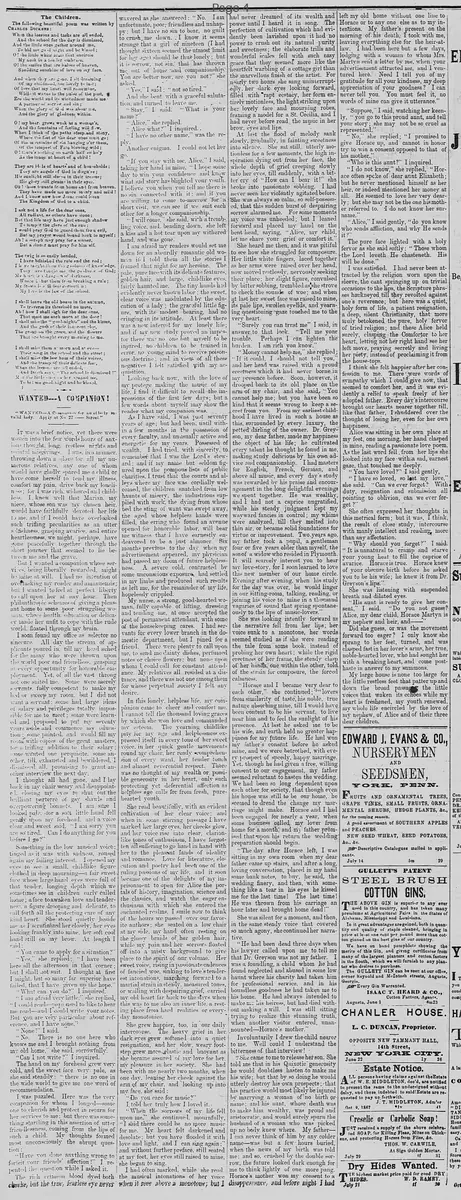
WANTED—A COMPANION!
"WANTED—A Companion for an elderly invalid lady. Apply at No. 27 — Street."
It was a brief notice, yet there were woven into the few words hours of anxious thought, long, restless nights and painful misgivings. I was, in a manner, throwing down a glove for all my numerous relatives, any one of whom would have gladly spared me a child or have come herself to tend my illness, comfort my pain, drive back my loneliness; for I was rich, widowed and childless. I knew well that Marian, my niece, whose son was my chosen heir, would have faithfully devoted her life to me, and if I could have overlooked such trifling peculiarities as an utter selfishness, grasping avarice, and entire heartlessness, we might, perhaps, have gone peacefully together through the short journey that seemed to lie between me and the grave.
But I wanted a companion whose services, being liberally rewarded, might be mine at will. I had no intention of overtasking my reader and amanuensis; but I wanted to feel at perfect liberty to call upon her at any hour. Then philanthropic schemes of giving a pleasant home to some poor struggling woman, whose health, education or delicacy made her unfit to cope with the rude world, floated through my brain.
I soon found my office as selector no sinecure. All day the stream of applicants poured in, till my head ached for the many who were thrown upon the world poor and friendless, grasping at every opportunity for honorable employment. Yet, of all the vast throng not one suited me. Some were merely servants, fully competent to make my bed or sweep my room, but I did not want a servant; some had large ideas of salary and privileges totally impossible for me to meet; some were learned and proposed to put my seventy years aside and commence my education; some painted, and would fill my room with copies of the great masters, for a trifling addition to their salary; one wanted one perquisite, some another, till, exhausted and bewildered, I dismissed all, promising to grant another interview the next day.
I thought all had gone, and I lay back in my chair weary and disappointed, closing my eyes to shut out the brilliant parterre of gay shawls and overpowering bonnets. I am sure I looked pale, for a soft little hand fell gently upon my forehead, and a voice clear and sweet said, "I am sorry you are so tired. Can I do anything for you before I go?"
Something in the low musical voice, tinged as it was with sadness, roused again my failing interest. I opened my eyes to see a small, childlike figure clothed in deep mourning—a fair sweet face whose large hazel eyes were full of that tender, longing depth which we sometimes see in children early called home; a face to awaken love and tenderness, a figure drooping and delicate, to call forth all the protecting care of any kind heart. She stood quietly beside me as I scrutinized her closely, her eyes looking frankly into mine, her soft cool hand still on my brow. At length I said:
"You came to apply for a situation?"
"Yes," she replied; "I have been here all the afternoon in that corner; but I shall not suit. I thought at first I might, but so many far superior have failed, that I have given up the hope."
"What can you do?" I inquired.
"I am afraid very little," she replied. "I could read—papa used to like to hear me read—and I could write your notes. But you are very particular about reference, and I have none."
"None!" I said.
"No. There is no one here who knows me and I brought nothing from my old home," she said sorrowfully.
"Can I not write?" I inquired.
The hand on my forehead grew very cold, and the sweet face very pale, as she said steadily: "there is no one in the wide world to give me one word of recommendation."
I was puzzled. Here was the very companion for whom I longed—some one to cherish and protect in return for her services to me; but there was something startling in this assertion of utter friendlessness, coming from the lips of such a child. My thoughts formed most unconsciously the abrupt question:
"Have you done anything wrong to forfeit your friends' affection!" I repeated the question while I asked it.
The rich crimson blood dyed both cheeks, but the true, fearless eye never wavered as she answered: "No. I am unfortunate, poor; friendless and unhappy; but I have no sin to bear, no guilt to crush me down. I know it seems strange that a girl of nineteen (I had thought sixteen seemed the utmost limit for her age) should be thus lonely; but it is sorrow, not sin, that has thrown me out of home and companionship. You are better now, are you not?" she asked.
And she bent with a graceful salutation, and turned to leave me.
"Stay," I said. "What is your name?"
"Alice," she replied.
"Alice what?" I inquired.
"I have no other name," was the reply.
Another enigma. I could not let her go.
"If you stay with me, Alice," I said, taking her hand in mine, "I hope some day to win your confidence and know what sad story has blighted your youth. I believe you when you tell me there is no sin connected with it; and if you are willing to come to-morrow for a short visit, we can see if we suit each other for a longer companionship."
"I will come," she said, with a trembling voice, and, bending down, she left a kiss and a hot tear upon my withered hand, and was gone.
I am afraid my readers would set me down for an absurdly romantic old woman if I told them all the stories I framed that night for my heroine. The pale, pure face with its delicate features, golden hair, and large, childlike eyes fairly haunted me. The tiny hands had evidently never known labor; the sweet, clear voice was modulated by the education of a lady; the graceful little figure, with its modest bearing, had no cringing in its attitude. At least there was a new interest for my lonely life; and if my new study proved an impostor there was no one but myself to be injured, no children to be trained in error, no young mind to receive poisonous doctrine; and in view of all these negatives I felt satisfied with my acquisition.
Looking back now, with the love of my protege making the music of my life, I find it difficult to recall the impressions of the first few days; but a few words about myself may show the reader what my companion was.
As I have said, I was past seventy years of age; but had been, until within a few months, in the possession of every faculty, and unusually active and energetic for my years. Possessed of wealth, I had tried, with sincerity, to remember that I was the Lord's steward; and if my name but seldom figured upon the pompous lists of public charities, I trust that the courts and alleys where my face was cordially welcomed, the children snatched from low haunts of misery, the industrious supplied with work, the dying from whose bed the sting of want was swept away, the aged whose helpless hands were filled, the erring who found an avenue opened for honorable labor, will bear me witness that I have earnestly endeavored to be a just almoner. Six months previous to the day when my advertisement appeared, my physician had passed my doom of future helplessness.
A severe cold, contracted by some unconscious exposure, had settled in my limbs and produced such results as left me, for the remainder of my life, hopelessly crippled. My nurse, a strong, good-hearted woman, fully capable of lifting, dressing and tending me, at once accepted the post of permanent attendant, with some of the housekeeping cares. I had servants for every lower branch in the domestic department, but I pined for a friend. There were plenty to call upon me, to send me dainty dishes, perfumed notes or choice flowers; but none upon whom I could call for constant attendance. My relatives all resided at a distance, and there was not one among them for whose perpetual society I felt any desire.
In this lonely, helpless life, my companion came to cheer and comfort me. I cannot tell the thousand loving graces by which she won love and commanded my esteem. The yearning childlike pity for my age and helplessness expressed itself in every tone of her sweet voice, in her quick gentle movements round my chair, her ready comprehension of every want, her tender touch and almost reverential respect. There was no thought of my wealth or possible generosity in her heart, only such protecting yet deferential affection as helpless age calls for from fresh, pure-hearted youth.
She read beautifully, with an evident cultivation of her clear voice; and when in some stirring passage I have marked her large eyes, her cheeks glow, and her voice rise into clear, clarion-like tones of enthusiasm, I have forgotten all suffering to go hand in hand with her to the pleasant lands of ideality and romance. Love for literature, elocution and poetry had been one of the ruling passions of my life, and it soon became one of the delights of my imprisonment to open for Alice the portals of history, imagination, science and the classics, and watch the eager enthusiasm with which she entered the enchanted realms. I smile now to think of the hours we passed over our favorite authors: she seated on a low chair at my side, my hand often resting on the glossy braids of her golden hair, while my pain and her sorrows floated off into a misty background to give place to the spirit of our volume. Her sweet voice, rising in passionate cadences of fancied woe, sinking to love's tenderest intonations, marching forward to a martial strain in steady, measured tones, or wailing with despairing grief, carried my old heart far back to the days when this was to me also an inner life, a resting place from hard realities or every-day monotonies.
She grew happier, too, in our daily intercourse. The heavy grief in her dark eyes grew softened into a quiet resignation, and her slow weary footstep grew more elastic and buoyant as she became assured of my love for her, my pleasure in her society. She had been with me nearly two months, when one day, leaning her cheek against the arm of my chair, and looking up into my face, she said:
"Do you care for music?"
I told her truly how I loved it.
"When the sorrows of my life fell upon me," she continued, mournfully, "I said there could be no more music for me. My heart felt darkened and desolate; but you have flooded it with love and light, and I can sing again;" and without further preface, still seated at my feet, her eyes still raised to mine, she began to sing.
I had often marked, while she read, the musical intonations of her voice when it rose above a whisper; but I had never dreamed of its wealth and power until I heard it in song. The perfection of cultivation which had evidently been lavished upon it had no power to crush out its natural purity and sweetness; the elaborate trills and wonderful scales fell with such easy grace that they seemed more like the heartfelt warbling of a cottage girl than the marvellous finish of the artist. For nearly two hours she sang uninterruptedly, her dark eyes looking forward, filled with rapt ecstasy, her form entirely motionless, the light striking upon her lovely face and mourning robes, framing a model for a St. Cecilia, and I had never before read the music in her brow, eyes and lips.
At last the flood of melody sank slowly, gradually, in fainting sweetness into silence. She sat still, utterly motionless for a few moments, the high inspiration dying out from her face, the whole depth of grief creeping slowly into her eyes, till suddenly, with a bitter cry of "How can I bear it!" she broke into passionate sobbing. I had never seen her violently agitated before. She was always so calm, so self-possessed, that this sudden burst of despairing sorrow alarmed me. For some moments my voice was unheeded; but I leaned forward and placed my hand on the bent head, saying, "Alice, my child, let me share your grief or comfort it."
She heard me then, and it was pitiful to see how she struggled for composure. Her little white fingers, laced together as her arms were raised over her head, now moved restlessly, nervously seeking their place; her slight figure, convulsed by bitter sobbing, trembled as she strove to check the sounds of woe; and when at last her sweet face was raised to mine, its pale lips, swollen eyelids, and yearning questioning gaze touched me to the very heart.
"Surely you can trust me," I said, in answer to that look. "Tell me your trouble. Perhaps I can lighten the burden. I am rich, you know."
"Money cannot help me," she replied; "If it could, I should not tell you," and her head was raised with a proud erectness which it had never borne in my presence before. Soon, however, it drooped back to its old place on the arm of my chair, and she said, "You cannot help me; but you have been so kind that it seems wrong to keep a secret from you. From my earliest childhood I have lived in such a house as this, surrounded by every luxury, the petted darling of the owner. Dr. Greyson, my dear father, made my happiness the object of his life; he cultivated every talent he thought he found in me, making study delicious by his own advice and companionship. I had masters for English, French, German, and above all music, and every day's study was rewarded by his praise and encouragement in the long delightful evenings we spent together. He was wealthy and I had not a caprice ungratified while his steady judgment kept my wayward fancies in control; my whims were analyzed, till they melted into thin air, or became solid foundations for virtue or improvement. Two years ago my father took a pupil, a gentleman four or five years older than myself, the son of a widow who resided in Plymouth. It will scarcely interest you to hear my love-story, for I soon learned to love this new member of our home circle. Evening after evening, when his study for the day was over, he would linger in our sitting-room, talking, reading, or joining his voice to mine in a thousand vagaries of sound that spring spontaneously to the lips of music-lovers.
She was looking intently forward as the narrative fell from her lips; her voice sunk to a monotone, her words seemed studied as if she were reading the tale from some book, instead of probing her own heart; while the rigid erectness of her frame, the steady clasp of her hands, one within the other, told of the strain for composure, the forced calmness.
"Horace and I became very dear to each other," she continued; "lovers from similarity of taste, his noble, true nature absorbing mine, till I would have been content to be his servant, to live near him and to feel the sunlight of his presence. At last he asked me to be his wife, and earth held no greater happiness for my future life. He had won my father's consent before he asked mine, and we were betrothed, with every prospect of speedy, happy marriage. Yet, though he had given a free, willing consent to our engagement, my father seemed reluctant to hasten the wedding. We had been so long dependent upon each other for society, that though even his house was still to be our home, he seemed to dread the change my marriage might make. Horace and I had been engaged for nearly a year, when some business called my lover from home for a month; and my father promised that upon his return the wedding preparation should begin.
"The day after Horace left, I was sitting in my own room when my dear father came up stairs, and after a long loving conversation, placed in my hand some bank notes, to buy, he said, the wedding finery, and then, with something like a tear in his eyes he kissed me for the last time! The last time! He was thrown from his carriage an hour later and brought home dead!"
She was silent for a moment, and then in the same steady voice that covered so much agony, she continued her narrative.
"He had been dead three days when his lawyer called upon me to tell me that Dr. Greyson was not my father. I was a foundling, a child whom he had found neglected and abused in some low haunt where his charity had taken him for professional service, and in his boundless goodness he had taken me to his home. He had always intended to make me his heiress, but had died without making a will. I was still sitting trying to realize this stunning truth, when another visitor entered, unannounced—Horace's mother.
Involuntarily I drew the child nearer to me. Well could I understand the bitterness of that interview!
"She came to me to release her son. She told me that in his Quixotic generosity he would doubtless hasten to make me his wife; but that by so doing he would utterly destroy his own prospects; that his practice would most likely be injured by marrying a woman of no birth or name; and his aunt, whose death was to make him wealthy, was proud and aristocratic, and would surely spurn the husband of a woman who was picked up nobody knew where. My father—I can never think of him by any colder name—was but a few hours buried, when the news of my birth was told me; and so, crushed by the double sorrow, the future looked dark enough for me to think lightly of one more pang. Horace's mother won my consent to a disappearance, and before night I had left my old home without one line to Horace or to any one else as to my intentions. My father's present on the morning of his death I took with me, leaving everything else for the heir-at-law. I had been here but a few days, lodging with a woman to whom Mrs. Martyn sent a letter by me, when your advertisement attracted me, and I ventured here. Need I tell you of my gratitude for all your kindness, my deep appreciation of your goodness? I can never tell you. You must feel it, no words of mine can give it utterance."
"Suppose," I said, watching her keenly, "you go to this proud aunt, and tell your story; she may not be so cruel as represented."
"No," she replied; "I promised to give Horace up, and cannot in honor try to win a consent opposed to that of his mother."
"Who is this aunt?" I inquired.
"I do not know," she replied, "Horace often spoke of dear aunt Elizabeth but he never mentioned himself as her heir, or indeed mentioned her money at all. He seemed to love her very dearly; but she may not be the one his mother referred to. I do not know her surname."
"Alice," I said gently, "do you know who sends affliction, and why He sends it?"
The pure face lighted with a holy fervor as she said softly: "Those whom the Lord loveth He chasteneth. His will be done."
I was satisfied. I had never been attracted by the religion worn upon the sleeve, the cant springing up on trivial occasions to the lips, the Scripture phrases hackneyed till they revolted against one's reverence; but here was a quiet holy form of life, a patient resignation, a deep, silent Christianity, that more truly betokened the pure, holy fervor of tried religion; and these Alice held surely, clasping the Comforter to her heart, letting not her right hand see her left move, praying secretly and living her piety, instead of proclaiming it from the house-tops.
I think she felt happier after her confession to me. There were words of sympathy which I could give now, that seemed to comfort her, and it was evidently a relief to speak freely of her adopted father. Every day's intercourse brought our hearts nearer together till, like that father, I shuddered over the thought of losing her, even for her own happiness.
Alice was sitting in her own place at my feet, one morning, her hand clasped in mine, reading a passionate love poem. As the last word fell from her lips she looked into my face with a sad, earnest gaze, that touched me deeply.
"You have loved?" I said gently.
"I have so loved, so lost my love," she said. "Can we ever forget? With duty, resignation and submission all pointing to oblivion, can we ever forget?"
She often expressed her thoughts in this metrical form; but it was, I think, the result of close study, intercourse with manly intellect and reading more than any affectation.
"Why should you forget?" I said. "It is unnatural to cramp and starve your young heart to fill the caprice of avarice. Horace is true. Horace knew of your obscure birth before he asked you to be his wife; he knew it from Dr. Greyson's lips."
She was listening with suspended breath and dilated eyes.
"His aunt is ready to give her consent," I said.
"Do you not guess?
Alice, my dear child, Horace Martyn is my nephew and heir, and"
Did she guess, or was the movement forward too eager? I only know she sprang to her feet, turned, and was clasped fast in her lover's arms, her true, noble-hearted lover, who had sought her with a breaking heart, and come post-haste in answer to my summons.
My large house is none too large for the little restless feet that patter up and down the broad passages; the little voices that waken its echoes while my heart is freshened, my youth renewed my whole life encircled by the love of my nephew, of Alice and of their three dear children.
"WANTED—A Companion for an elderly invalid lady. Apply at No. 27 — Street."
It was a brief notice, yet there were woven into the few words hours of anxious thought, long, restless nights and painful misgivings. I was, in a manner, throwing down a glove for all my numerous relatives, any one of whom would have gladly spared me a child or have come herself to tend my illness, comfort my pain, drive back my loneliness; for I was rich, widowed and childless. I knew well that Marian, my niece, whose son was my chosen heir, would have faithfully devoted her life to me, and if I could have overlooked such trifling peculiarities as an utter selfishness, grasping avarice, and entire heartlessness, we might, perhaps, have gone peacefully together through the short journey that seemed to lie between me and the grave.
But I wanted a companion whose services, being liberally rewarded, might be mine at will. I had no intention of overtasking my reader and amanuensis; but I wanted to feel at perfect liberty to call upon her at any hour. Then philanthropic schemes of giving a pleasant home to some poor struggling woman, whose health, education or delicacy made her unfit to cope with the rude world, floated through my brain.
I soon found my office as selector no sinecure. All day the stream of applicants poured in, till my head ached for the many who were thrown upon the world poor and friendless, grasping at every opportunity for honorable employment. Yet, of all the vast throng not one suited me. Some were merely servants, fully competent to make my bed or sweep my room, but I did not want a servant; some had large ideas of salary and privileges totally impossible for me to meet; some were learned and proposed to put my seventy years aside and commence my education; some painted, and would fill my room with copies of the great masters, for a trifling addition to their salary; one wanted one perquisite, some another, till, exhausted and bewildered, I dismissed all, promising to grant another interview the next day.
I thought all had gone, and I lay back in my chair weary and disappointed, closing my eyes to shut out the brilliant parterre of gay shawls and overpowering bonnets. I am sure I looked pale, for a soft little hand fell gently upon my forehead, and a voice clear and sweet said, "I am sorry you are so tired. Can I do anything for you before I go?"
Something in the low musical voice, tinged as it was with sadness, roused again my failing interest. I opened my eyes to see a small, childlike figure clothed in deep mourning—a fair sweet face whose large hazel eyes were full of that tender, longing depth which we sometimes see in children early called home; a face to awaken love and tenderness, a figure drooping and delicate, to call forth all the protecting care of any kind heart. She stood quietly beside me as I scrutinized her closely, her eyes looking frankly into mine, her soft cool hand still on my brow. At length I said:
"You came to apply for a situation?"
"Yes," she replied; "I have been here all the afternoon in that corner; but I shall not suit. I thought at first I might, but so many far superior have failed, that I have given up the hope."
"What can you do?" I inquired.
"I am afraid very little," she replied. "I could read—papa used to like to hear me read—and I could write your notes. But you are very particular about reference, and I have none."
"None!" I said.
"No. There is no one here who knows me and I brought nothing from my old home," she said sorrowfully.
"Can I not write?" I inquired.
The hand on my forehead grew very cold, and the sweet face very pale, as she said steadily: "there is no one in the wide world to give me one word of recommendation."
I was puzzled. Here was the very companion for whom I longed—some one to cherish and protect in return for her services to me; but there was something startling in this assertion of utter friendlessness, coming from the lips of such a child. My thoughts formed most unconsciously the abrupt question:
"Have you done anything wrong to forfeit your friends' affection!" I repeated the question while I asked it.
The rich crimson blood dyed both cheeks, but the true, fearless eye never wavered as she answered: "No. I am unfortunate, poor; friendless and unhappy; but I have no sin to bear, no guilt to crush me down. I know it seems strange that a girl of nineteen (I had thought sixteen seemed the utmost limit for her age) should be thus lonely; but it is sorrow, not sin, that has thrown me out of home and companionship. You are better now, are you not?" she asked.
And she bent with a graceful salutation, and turned to leave me.
"Stay," I said. "What is your name?"
"Alice," she replied.
"Alice what?" I inquired.
"I have no other name," was the reply.
Another enigma. I could not let her go.
"If you stay with me, Alice," I said, taking her hand in mine, "I hope some day to win your confidence and know what sad story has blighted your youth. I believe you when you tell me there is no sin connected with it; and if you are willing to come to-morrow for a short visit, we can see if we suit each other for a longer companionship."
"I will come," she said, with a trembling voice, and, bending down, she left a kiss and a hot tear upon my withered hand, and was gone.
I am afraid my readers would set me down for an absurdly romantic old woman if I told them all the stories I framed that night for my heroine. The pale, pure face with its delicate features, golden hair, and large, childlike eyes fairly haunted me. The tiny hands had evidently never known labor; the sweet, clear voice was modulated by the education of a lady; the graceful little figure, with its modest bearing, had no cringing in its attitude. At least there was a new interest for my lonely life; and if my new study proved an impostor there was no one but myself to be injured, no children to be trained in error, no young mind to receive poisonous doctrine; and in view of all these negatives I felt satisfied with my acquisition.
Looking back now, with the love of my protege making the music of my life, I find it difficult to recall the impressions of the first few days; but a few words about myself may show the reader what my companion was.
As I have said, I was past seventy years of age; but had been, until within a few months, in the possession of every faculty, and unusually active and energetic for my years. Possessed of wealth, I had tried, with sincerity, to remember that I was the Lord's steward; and if my name but seldom figured upon the pompous lists of public charities, I trust that the courts and alleys where my face was cordially welcomed, the children snatched from low haunts of misery, the industrious supplied with work, the dying from whose bed the sting of want was swept away, the aged whose helpless hands were filled, the erring who found an avenue opened for honorable labor, will bear me witness that I have earnestly endeavored to be a just almoner. Six months previous to the day when my advertisement appeared, my physician had passed my doom of future helplessness.
A severe cold, contracted by some unconscious exposure, had settled in my limbs and produced such results as left me, for the remainder of my life, hopelessly crippled. My nurse, a strong, good-hearted woman, fully capable of lifting, dressing and tending me, at once accepted the post of permanent attendant, with some of the housekeeping cares. I had servants for every lower branch in the domestic department, but I pined for a friend. There were plenty to call upon me, to send me dainty dishes, perfumed notes or choice flowers; but none upon whom I could call for constant attendance. My relatives all resided at a distance, and there was not one among them for whose perpetual society I felt any desire.
In this lonely, helpless life, my companion came to cheer and comfort me. I cannot tell the thousand loving graces by which she won love and commanded my esteem. The yearning childlike pity for my age and helplessness expressed itself in every tone of her sweet voice, in her quick gentle movements round my chair, her ready comprehension of every want, her tender touch and almost reverential respect. There was no thought of my wealth or possible generosity in her heart, only such protecting yet deferential affection as helpless age calls for from fresh, pure-hearted youth.
She read beautifully, with an evident cultivation of her clear voice; and when in some stirring passage I have marked her large eyes, her cheeks glow, and her voice rise into clear, clarion-like tones of enthusiasm, I have forgotten all suffering to go hand in hand with her to the pleasant lands of ideality and romance. Love for literature, elocution and poetry had been one of the ruling passions of my life, and it soon became one of the delights of my imprisonment to open for Alice the portals of history, imagination, science and the classics, and watch the eager enthusiasm with which she entered the enchanted realms. I smile now to think of the hours we passed over our favorite authors: she seated on a low chair at my side, my hand often resting on the glossy braids of her golden hair, while my pain and her sorrows floated off into a misty background to give place to the spirit of our volume. Her sweet voice, rising in passionate cadences of fancied woe, sinking to love's tenderest intonations, marching forward to a martial strain in steady, measured tones, or wailing with despairing grief, carried my old heart far back to the days when this was to me also an inner life, a resting place from hard realities or every-day monotonies.
She grew happier, too, in our daily intercourse. The heavy grief in her dark eyes grew softened into a quiet resignation, and her slow weary footstep grew more elastic and buoyant as she became assured of my love for her, my pleasure in her society. She had been with me nearly two months, when one day, leaning her cheek against the arm of my chair, and looking up into my face, she said:
"Do you care for music?"
I told her truly how I loved it.
"When the sorrows of my life fell upon me," she continued, mournfully, "I said there could be no more music for me. My heart felt darkened and desolate; but you have flooded it with love and light, and I can sing again;" and without further preface, still seated at my feet, her eyes still raised to mine, she began to sing.
I had often marked, while she read, the musical intonations of her voice when it rose above a whisper; but I had never dreamed of its wealth and power until I heard it in song. The perfection of cultivation which had evidently been lavished upon it had no power to crush out its natural purity and sweetness; the elaborate trills and wonderful scales fell with such easy grace that they seemed more like the heartfelt warbling of a cottage girl than the marvellous finish of the artist. For nearly two hours she sang uninterruptedly, her dark eyes looking forward, filled with rapt ecstasy, her form entirely motionless, the light striking upon her lovely face and mourning robes, framing a model for a St. Cecilia, and I had never before read the music in her brow, eyes and lips.
At last the flood of melody sank slowly, gradually, in fainting sweetness into silence. She sat still, utterly motionless for a few moments, the high inspiration dying out from her face, the whole depth of grief creeping slowly into her eyes, till suddenly, with a bitter cry of "How can I bear it!" she broke into passionate sobbing. I had never seen her violently agitated before. She was always so calm, so self-possessed, that this sudden burst of despairing sorrow alarmed me. For some moments my voice was unheeded; but I leaned forward and placed my hand on the bent head, saying, "Alice, my child, let me share your grief or comfort it."
She heard me then, and it was pitiful to see how she struggled for composure. Her little white fingers, laced together as her arms were raised over her head, now moved restlessly, nervously seeking their place; her slight figure, convulsed by bitter sobbing, trembled as she strove to check the sounds of woe; and when at last her sweet face was raised to mine, its pale lips, swollen eyelids, and yearning questioning gaze touched me to the very heart.
"Surely you can trust me," I said, in answer to that look. "Tell me your trouble. Perhaps I can lighten the burden. I am rich, you know."
"Money cannot help me," she replied; "If it could, I should not tell you," and her head was raised with a proud erectness which it had never borne in my presence before. Soon, however, it drooped back to its old place on the arm of my chair, and she said, "You cannot help me; but you have been so kind that it seems wrong to keep a secret from you. From my earliest childhood I have lived in such a house as this, surrounded by every luxury, the petted darling of the owner. Dr. Greyson, my dear father, made my happiness the object of his life; he cultivated every talent he thought he found in me, making study delicious by his own advice and companionship. I had masters for English, French, German, and above all music, and every day's study was rewarded by his praise and encouragement in the long delightful evenings we spent together. He was wealthy and I had not a caprice ungratified while his steady judgment kept my wayward fancies in control; my whims were analyzed, till they melted into thin air, or became solid foundations for virtue or improvement. Two years ago my father took a pupil, a gentleman four or five years older than myself, the son of a widow who resided in Plymouth. It will scarcely interest you to hear my love-story, for I soon learned to love this new member of our home circle. Evening after evening, when his study for the day was over, he would linger in our sitting-room, talking, reading, or joining his voice to mine in a thousand vagaries of sound that spring spontaneously to the lips of music-lovers.
She was looking intently forward as the narrative fell from her lips; her voice sunk to a monotone, her words seemed studied as if she were reading the tale from some book, instead of probing her own heart; while the rigid erectness of her frame, the steady clasp of her hands, one within the other, told of the strain for composure, the forced calmness.
"Horace and I became very dear to each other," she continued; "lovers from similarity of taste, his noble, true nature absorbing mine, till I would have been content to be his servant, to live near him and to feel the sunlight of his presence. At last he asked me to be his wife, and earth held no greater happiness for my future life. He had won my father's consent before he asked mine, and we were betrothed, with every prospect of speedy, happy marriage. Yet, though he had given a free, willing consent to our engagement, my father seemed reluctant to hasten the wedding. We had been so long dependent upon each other for society, that though even his house was still to be our home, he seemed to dread the change my marriage might make. Horace and I had been engaged for nearly a year, when some business called my lover from home for a month; and my father promised that upon his return the wedding preparation should begin.
"The day after Horace left, I was sitting in my own room when my dear father came up stairs, and after a long loving conversation, placed in my hand some bank notes, to buy, he said, the wedding finery, and then, with something like a tear in his eyes he kissed me for the last time! The last time! He was thrown from his carriage an hour later and brought home dead!"
She was silent for a moment, and then in the same steady voice that covered so much agony, she continued her narrative.
"He had been dead three days when his lawyer called upon me to tell me that Dr. Greyson was not my father. I was a foundling, a child whom he had found neglected and abused in some low haunt where his charity had taken him for professional service, and in his boundless goodness he had taken me to his home. He had always intended to make me his heiress, but had died without making a will. I was still sitting trying to realize this stunning truth, when another visitor entered, unannounced—Horace's mother.
Involuntarily I drew the child nearer to me. Well could I understand the bitterness of that interview!
"She came to me to release her son. She told me that in his Quixotic generosity he would doubtless hasten to make me his wife; but that by so doing he would utterly destroy his own prospects; that his practice would most likely be injured by marrying a woman of no birth or name; and his aunt, whose death was to make him wealthy, was proud and aristocratic, and would surely spurn the husband of a woman who was picked up nobody knew where. My father—I can never think of him by any colder name—was but a few hours buried, when the news of my birth was told me; and so, crushed by the double sorrow, the future looked dark enough for me to think lightly of one more pang. Horace's mother won my consent to a disappearance, and before night I had left my old home without one line to Horace or to any one else as to my intentions. My father's present on the morning of his death I took with me, leaving everything else for the heir-at-law. I had been here but a few days, lodging with a woman to whom Mrs. Martyn sent a letter by me, when your advertisement attracted me, and I ventured here. Need I tell you of my gratitude for all your kindness, my deep appreciation of your goodness? I can never tell you. You must feel it, no words of mine can give it utterance."
"Suppose," I said, watching her keenly, "you go to this proud aunt, and tell your story; she may not be so cruel as represented."
"No," she replied; "I promised to give Horace up, and cannot in honor try to win a consent opposed to that of his mother."
"Who is this aunt?" I inquired.
"I do not know," she replied, "Horace often spoke of dear aunt Elizabeth but he never mentioned himself as her heir, or indeed mentioned her money at all. He seemed to love her very dearly; but she may not be the one his mother referred to. I do not know her surname."
"Alice," I said gently, "do you know who sends affliction, and why He sends it?"
The pure face lighted with a holy fervor as she said softly: "Those whom the Lord loveth He chasteneth. His will be done."
I was satisfied. I had never been attracted by the religion worn upon the sleeve, the cant springing up on trivial occasions to the lips, the Scripture phrases hackneyed till they revolted against one's reverence; but here was a quiet holy form of life, a patient resignation, a deep, silent Christianity, that more truly betokened the pure, holy fervor of tried religion; and these Alice held surely, clasping the Comforter to her heart, letting not her right hand see her left move, praying secretly and living her piety, instead of proclaiming it from the house-tops.
I think she felt happier after her confession to me. There were words of sympathy which I could give now, that seemed to comfort her, and it was evidently a relief to speak freely of her adopted father. Every day's intercourse brought our hearts nearer together till, like that father, I shuddered over the thought of losing her, even for her own happiness.
Alice was sitting in her own place at my feet, one morning, her hand clasped in mine, reading a passionate love poem. As the last word fell from her lips she looked into my face with a sad, earnest gaze, that touched me deeply.
"You have loved?" I said gently.
"I have so loved, so lost my love," she said. "Can we ever forget? With duty, resignation and submission all pointing to oblivion, can we ever forget?"
She often expressed her thoughts in this metrical form; but it was, I think, the result of close study, intercourse with manly intellect and reading more than any affectation.
"Why should you forget?" I said. "It is unnatural to cramp and starve your young heart to fill the caprice of avarice. Horace is true. Horace knew of your obscure birth before he asked you to be his wife; he knew it from Dr. Greyson's lips."
She was listening with suspended breath and dilated eyes.
"His aunt is ready to give her consent," I said.
"Do you not guess?
Alice, my dear child, Horace Martyn is my nephew and heir, and"
Did she guess, or was the movement forward too eager? I only know she sprang to her feet, turned, and was clasped fast in her lover's arms, her true, noble-hearted lover, who had sought her with a breaking heart, and come post-haste in answer to my summons.
My large house is none too large for the little restless feet that patter up and down the broad passages; the little voices that waken its echoes while my heart is freshened, my youth renewed my whole life encircled by the love of my nephew, of Alice and of their three dear children.
What sub-type of article is it?
Romance
Family Drama
Personal Triumph
What themes does it cover?
Love
Family
Fortune Reversal
What keywords are associated?
Companion Hiring
Foundling Story
Romantic Reunion
Family Revelation
Inheritance Twist
What entities or persons were involved?
Alice
Dr. Greyson
Horace Martyn
Mrs. Martyn
Elderly Widow
Where did it happen?
No. 27 — Street
Story Details
Key Persons
Alice
Dr. Greyson
Horace Martyn
Mrs. Martyn
Elderly Widow
Location
No. 27 — Street
Story Details
Elderly widow hires Alice as companion; Alice reveals she is a foundling who lost her betrothed Horace due to her origins after her adoptive father's death; widow discloses she is Horace's aunt, reunites the couple who later have children.