Thank you for visiting SNEWPapers!
Sign up free
The Daily Advertiser
New York, New York County, New York
What is this article about?
Report on the third session of Rhode Island's General Assembly in Providence, last Monday of October. Debates on paying state notes in depreciated currency, rejection of constitutional convention, retention of tender law, and other acts passed amid divisions over paper money.
Clipping
OCR Quality
Full Text
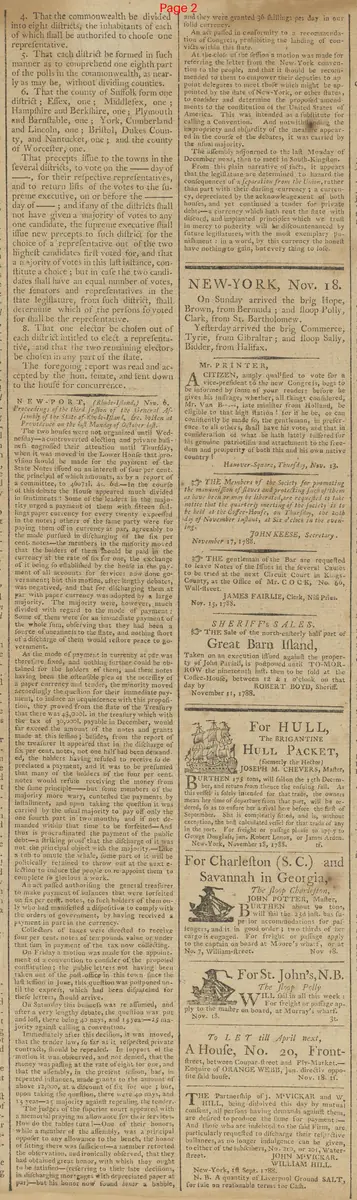
Proceedings of the third session of the General Assembly of the State of Rhode-Island, &c. holden at Providence on the last Monday of October last.
The two houses were not organized until Wednesday—a controverted election and private business engrossed their attention until Thursday, when it was moved in the Lower House that provision should be made for the payment of the State Notes issued on an interest of four per cent. the principal of which amounts, as by a report of a committee, to 460,714l. 4s. 6d.—In the course of this debate the House appeared much divided in sentiments: Some of the leaders in the majority urged a payment of them with fifteen shillings paper currency for every twenty expressed in the notes; others of the same party were for paying them off in currency at par, agreeably to the mode pursued in discharging of the six per cent. notes—the members in the minority moved that the holders of them should be paid in the currency at the rate of six for one, the exchange of it being so established by the house in the payment of all accounts for services now done government; but this motion, after lengthy debates, was negatived, and that for discharging them at par with paper currency was adopted by a large majority. The majority were, however, much divided with regard to the mode of payment: Some of them were for an immediate payment of the whole sum, observing that they had been a source of uneasiness to the state, and nothing short of a discharge of them would restore peace to government.
As the mode of payment in currency at par was therefore fixed, and nothing further could be obtained for the holders of them, and these notes having been the ostensible plea of the necessity of a paper currency and tender, the minority moved accordingly the question for their immediate payment, to induce an acquiescence with this proposition, they proved from the state of the Treasury that there was 43,000l. in the treasury which with the tax of 30,000l. payable in December, would far exceed the amount of the notes and grants made at this session; besides, from the report of the treasurer it appeared that in the discharge of six per cent. notes, not one half had been demanded, the holders having refused to receive so depreciated a payment, and it was to be presumed that many of the holders of the four per cent. notes would refuse receiving the money from the same principle—but some members of the majority more wary, contested the payments by installment, and upon taking the question it was carried by the usual majority to pay off only the one fourth part in two months, and if not demanded within that time to be forfeited—And thus is procrastinated the payment of the public debt—a striking proof that the discharge of it was not the principal object with the majority.—Like a tub to amuse the whale, some part of it will be politically retained to throw out at the next election to induce the people to re-appoint them to complete so glorious a work.
An act passed authorizing the general treasurer to make payment of balances that were forfeited on six per cent. notes, to such holders of them only who had manifested a disposition to comply with the orders of government, by having received a payment in part in the currency.
Collectors of taxes were directed to receive four per cent. notes of ten pounds value or under that sum in payment of the tax now collecting.
On Friday a motion was made for the appointment of a convention to consider of the proposed constitution; the public letters not having been taken out of the post-office in this town since the last session in June, this question was postponed until the express, which had been dispatched for these letters, should arrive.
On Saturday this business was re-assumed, and after a very lengthy debate, the question was put and lost, there being 40 nays, and 15 yeas—25 majority against calling a convention.
Immediately after this decision, it was moved, that the tender law, so far as it respected private contracts, should be repealed. In support of the motion it was observed, and not denied, that the money was passing at the rate of eight for one, and that the assembly, in the present session, had, in repeated instances, made grants to the amount of above 12,000l. at a discount of six for one; but, upon taking the question, there were 40 nays, and 15 yeas—25 majority against repealing the tender.
The judges of the superior court appeared with a memorial praying an allowance for their services. How do the tables turn!—One of their honors, while a member of the assembly, was a principal opposer to any allowance to the bench, the honor of sitting there was sufficient—a member retorted the observation, and ironically observed, that they had obtained great honor, with which they ought to be satisfied—(referring to their late decisions, in discharging mortgages with depreciated paper at par)—but his honor now found honor a bauble, and they were granted 36 shillings per day in our solid currency.
An act passed in conformity to a recommendation of Congress, prohibiting the landing of convicts within this state.
At the close of the session a motion was made for referring the letter from the New-York convention to the people, and that it should be recommended to them to empower their deputies to appoint delegates to meet those which might be appointed by the state of New-York, or other states, to consider and determine the proposed amendments to the constitution of the United States of America. This was intended as a substitute for calling a Convention. And notwithstanding the impropriety and absurdity of the measure appeared in the course of the debates, it was carried by the usual majority.
The assembly adjourned to the last Monday of December next, then to meet in South-Kingston.
From this plain narrative of facts, it appears that the legislature are determined to hazard the consequences of a separation from the Union, rather than part with their darling currency; a currency, depreciated by the acknowledgment of both houses, and yet continued a tender for private debts—a currency which hath rent the state with discord, and implanted principles which we trust in mercy to posterity will be discountenanced by future legislatures, with the most exemplary punishment: in a word, by this currency the honest have nothing to gain, but every thing to lose.
What sub-type of article is it?
What keywords are associated?
Where did it happen?
Domestic News Details
Primary Location
Providence
Event Date
Last Monday Of October Last
Outcome
votes: 25 majority to pay four per cent notes at par in paper currency by installments (one fourth in two months); 25 majority against calling constitutional convention; 25 majority against repealing tender law; acts passed for note payments, tax collection, judge allowances, convict prohibition, and referring new-york letter to people; adjourned to last monday of december in south-kingston.
Event Details
Rhode Island General Assembly session debated payment of four per cent state notes (principal 460,714l. 4s. 6d.) in depreciated paper currency at par despite minority push for better rates; majority divided on immediacy but opted for partial payment; rejected convention on U.S. Constitution; retained tender law for private contracts; granted judges 36 shillings per day; passed acts on notes, taxes, convicts; referred constitutional amendments letter to people.