Thank you for visiting SNEWPapers!
Sign up free
Literary
September 10, 1875
Vermont Farmer
Newport, Saint Johnsbury, Orleans County, Caledonia County, Vermont
What is this article about?
An anonymous contributor named Ernestine shares informal thoughts on dress for women and men in rural Vermont, advocating for becoming, cheerful attire that reflects inner beauty and avoids extremes of plainness or display. She critiques overly somber clothing, praises neat farmer outfits, and touches on women's rights and child-rearing.
Clipping
OCR Quality
95%
Excellent
Full Text
For the Vermont Farmer
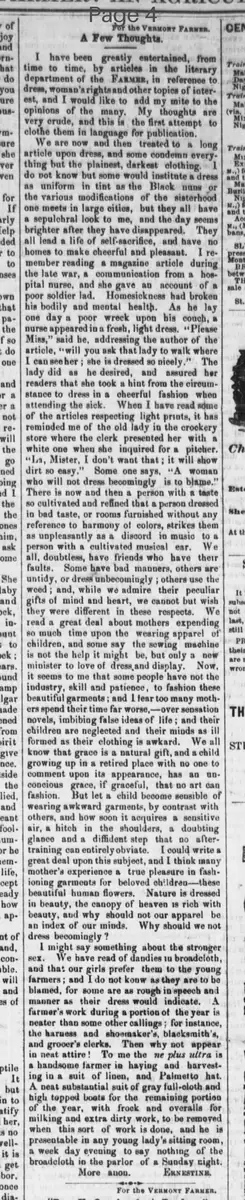
A Few Thoughts
I have been greatly entertained, from time to time, by articles in the literary department of the Farmer, in reference to dress, woman's rights and other topics of interest, and I would like to add my mite to the opinions of the many. My thoughts are very crude, and this is the first attempt to clothe them in language for publication.
We are now and then treated to a long article upon dress, and some condemn everything but the plainest, darkest clothing. I do not know but some would institute a dress as uniform in tint as the Black nuns or the various modifications of the sisterhood one meets in large cities, but they all have a sepulchral look to me, and the day seems brighter after they have disappeared. They all lead a life of self-sacrifice, and have no homes to make cheerful and pleasant. I remember reading a magazine article during the late war, a communication from a hospital nurse, and she gave an account of a poor soldier lad. Homesickness had broken his bodily and mental health. As he lay one day a poor wreck upon his couch, a nurse appeared in a fresh, light dress. "Please Miss," said he, addressing the author of the article, "will you ask that lady to walk where I can see her; she is dressed so nicely." The lady did as he desired, and assured her readers that she took a hint from the circumstance to dress in a cheerful fashion when attending the sick. When I have read some of the articles respecting light prints, it has reminded me of the old lady in the crockery store where the clerk presented her with a white one when she inquired for a pitcher. "La, Mister, I don't want that; it will show dirt so easy." Some one says, "A woman who will not dress becomingly is to blame."
There is now and then a person with a taste so cultivated and refined that a person dressed in bad taste, or rooms furnished without any reference to harmony of colors, strikes them as unpleasantly as a discord in music to a person with a cultivated musical ear. We all, doubtless, have friends who have their faults. Some have bad manners, others are untidy, or dress unbecomingly; others use the weed; and, while we admire their peculiar gifts of mind and heart, we cannot but wish they were different in these respects. We read a great deal about mothers expending so much time upon the wearing apparel of children, and some say the sewing machine is not the help it might be, but only a new minister to love of dress and display. Now, it seems to me that some people have not the industry, skill and patience, to fashion these beautiful garments; and I fear too many mothers spend their time far worse,—over sensation novels, imbibing false ideas of life: and their children are neglected and their minds as ill formed as their clothing is awkward. We all know that grace is a natural gift, and a child growing up in a retired place with no one to comment upon its appearance, has an unconscious grace, if graceful, that no art can fashion. But let a child become sensible of wearing awkward garments, by contrast with others, and how soon it acquires a sensitive air, a hitch in the shoulders, a doubting glance and a diffident step that no after-training can entirely obviate. I could write a great deal upon this subject, and I think many mother's experience a true pleasure in fashioning garments for beloved children—these beautiful human flowers. Nature is dressed in beauty, the canopy of heaven is rich with beauty, and why should not our apparel be an index of our minds. Why should we not dress becomingly?
I might say something about the stronger sex. We have read of dandies in broadcloth, and that our girls prefer them to the young farmers; and I do not know as they are to be blamed, for some are as rough in speech and manner as their dress would indicate. A farmer's work during a portion of the year is neater than some other callings; for instance, the harness and shoemaker's, blacksmith's, and grocer's clerks. Then why not appear in neat attire! To me the ne plus ultra is a handsome farmer in haying and harvesting in a suit of linen, and Palmetto hat. A neat substantial suit of gray full-cloth and high topped boots for the remaining portion of the year, with frock and overalls for milking and extra dirty work, to be removed when this sort of work is done, and he is presentable in any young lady's sitting room, a week day evening to say nothing of the broadcloth in the parlor of a Sunday night.
More anon.
Ernestine
A Few Thoughts
I have been greatly entertained, from time to time, by articles in the literary department of the Farmer, in reference to dress, woman's rights and other topics of interest, and I would like to add my mite to the opinions of the many. My thoughts are very crude, and this is the first attempt to clothe them in language for publication.
We are now and then treated to a long article upon dress, and some condemn everything but the plainest, darkest clothing. I do not know but some would institute a dress as uniform in tint as the Black nuns or the various modifications of the sisterhood one meets in large cities, but they all have a sepulchral look to me, and the day seems brighter after they have disappeared. They all lead a life of self-sacrifice, and have no homes to make cheerful and pleasant. I remember reading a magazine article during the late war, a communication from a hospital nurse, and she gave an account of a poor soldier lad. Homesickness had broken his bodily and mental health. As he lay one day a poor wreck upon his couch, a nurse appeared in a fresh, light dress. "Please Miss," said he, addressing the author of the article, "will you ask that lady to walk where I can see her; she is dressed so nicely." The lady did as he desired, and assured her readers that she took a hint from the circumstance to dress in a cheerful fashion when attending the sick. When I have read some of the articles respecting light prints, it has reminded me of the old lady in the crockery store where the clerk presented her with a white one when she inquired for a pitcher. "La, Mister, I don't want that; it will show dirt so easy." Some one says, "A woman who will not dress becomingly is to blame."
There is now and then a person with a taste so cultivated and refined that a person dressed in bad taste, or rooms furnished without any reference to harmony of colors, strikes them as unpleasantly as a discord in music to a person with a cultivated musical ear. We all, doubtless, have friends who have their faults. Some have bad manners, others are untidy, or dress unbecomingly; others use the weed; and, while we admire their peculiar gifts of mind and heart, we cannot but wish they were different in these respects. We read a great deal about mothers expending so much time upon the wearing apparel of children, and some say the sewing machine is not the help it might be, but only a new minister to love of dress and display. Now, it seems to me that some people have not the industry, skill and patience, to fashion these beautiful garments; and I fear too many mothers spend their time far worse,—over sensation novels, imbibing false ideas of life: and their children are neglected and their minds as ill formed as their clothing is awkward. We all know that grace is a natural gift, and a child growing up in a retired place with no one to comment upon its appearance, has an unconscious grace, if graceful, that no art can fashion. But let a child become sensible of wearing awkward garments, by contrast with others, and how soon it acquires a sensitive air, a hitch in the shoulders, a doubting glance and a diffident step that no after-training can entirely obviate. I could write a great deal upon this subject, and I think many mother's experience a true pleasure in fashioning garments for beloved children—these beautiful human flowers. Nature is dressed in beauty, the canopy of heaven is rich with beauty, and why should not our apparel be an index of our minds. Why should we not dress becomingly?
I might say something about the stronger sex. We have read of dandies in broadcloth, and that our girls prefer them to the young farmers; and I do not know as they are to be blamed, for some are as rough in speech and manner as their dress would indicate. A farmer's work during a portion of the year is neater than some other callings; for instance, the harness and shoemaker's, blacksmith's, and grocer's clerks. Then why not appear in neat attire! To me the ne plus ultra is a handsome farmer in haying and harvesting in a suit of linen, and Palmetto hat. A neat substantial suit of gray full-cloth and high topped boots for the remaining portion of the year, with frock and overalls for milking and extra dirty work, to be removed when this sort of work is done, and he is presentable in any young lady's sitting room, a week day evening to say nothing of the broadcloth in the parlor of a Sunday night.
More anon.
Ernestine
What sub-type of article is it?
Essay
What themes does it cover?
Social Manners
Moral Virtue
What keywords are associated?
Dress
Women's Rights
Social Manners
Farmers Attire
Moral Dress
Child Rearing
Rural Life
What entities or persons were involved?
Ernestine
Literary Details
Title
A Few Thoughts
Author
Ernestine
Subject
On Dress, Woman's Rights, And Social Topics
Key Lines
"Please Miss," Said He, Addressing The Author Of The Article, "Will You Ask That Lady To Walk Where I Can See Her; She Is Dressed So Nicely."
"A Woman Who Will Not Dress Becomingly Is To Blame."
Nature Is Dressed In Beauty, The Canopy Of Heaven Is Rich With Beauty, And Why Should Not Our Apparel Be An Index Of Our Minds. Why Should We Not Dress Becomingly?
To Me The Ne Plus Ultra Is A Handsome Farmer In Haying And Harvesting In A Suit Of Linen, And Palmetto Hat.