Thank you for visiting SNEWPapers!
Sign up free
The Enquirer
Richmond, Henrico County, Virginia
What is this article about?
Count Rumford presented experiments to the National Institute of France on the adhesion of water particles, demonstrating how small heavy objects float on water's surface due to a pellicle, using ether, mercury spherules, and other setups to explore viscosity and surface tension.
Clipping
OCR Quality
Full Text
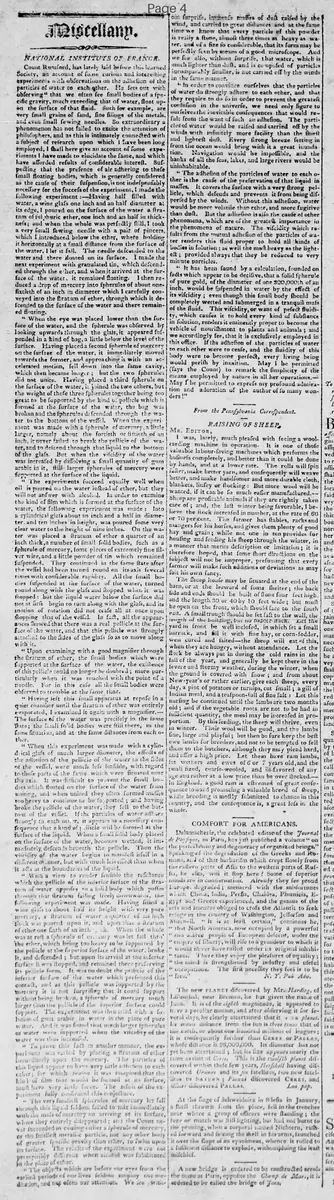
NATIONAL INSTITUTE OF FRANCE.
Count Rumford, has lately laid before this learned Society, an account of some curious and interesting experiments with observations on the adhesion of the particles of water to each other. He sets out with observing that we often see small bodies of a specific gravity, much exceeding that of water, float upon the surface of that fluid. Such for example, are very small grains of sand, fine shavings of the metals, and even small sewing needles. So extraordinary a phenomenon has not failed to excite the attention of philosophers, and as this is intimately connected with a subject of research upon which I have been long employed, I shall here give an account of some experiments I have made to elucidate the same, and which have afforded results of considerable interest. Suspecting that the presence of air adhering to these small floating bodies, which is generally considered as the cause of their suspension, is not indispensably necessary for the success of the experiment, I made the following experiment: Having half filled with water, a wine glass one inch and a half diameter at its edge, I poured on the surface of the water a stratum of sulphuric ether, one inch and a half in thickness; and when the whole was perfectly still, I took a very small sewing needle with a pair of pincers, which I introduced below the ether, where holding it horizontally at a small distance from the surface of the water, I let it fall. The needle descended to the water and there floated on its surface. I made the next experiment with granulated tin, which descended through the ether, and when it arrived at the surface of the water, it remained floating. I then reduced a drop of mercury into spherules of about one-sixtieth of an inch in diameter which I carefully conveyed into the stratum of ether, through which it descended to the surface of the water and there remained floating.
"When the eye was placed lower than the surface of the water, and the spherule was observed by looking upwards through the glass, it appeared suspended in a kind of bag, a little below the level of the surface. Having placed a second spherule of mercury on the surface of the water, it immediately moved towards the former, and approaching it with an accelerated motion, fell down into the same cavity, which then became larger: but the two spherules did not unite. Having placed a third spherule on the surface of the water, it joined the two others, but the weight of these three spherules together being too great to be supported by the kind of pellicle which is formed at the surface of the water, the bag was broken and the spherules descended through the water to the bottom of the vessel. When the experiment was made with a spherule of mercury, a little larger, namely about the fortieth or fiftieth of an inch, it never failed to break the pellicle of the water, and to descend through that liquid to the bottom of the glass. But when the viscosity of the water was increased by dissolving a small quantity of gum arabic in it, still larger spherules of mercury were supported at the surface of the liquid.
"The experiments succeed equally well when oil is poured on the water instead of ether, but they will not answer with alcohol. In order to examine the kind of film which is formed at the surface of the water, the following experiment was made: Into a cylindrical glass about an inch and a half in diameter, and ten inches in height, was poured some very clear water to the height of nine inches. On the water was placed a stratum of ether a quarter of an inch thick, a number of small solid bodies, such as a spherule of mercury, some pieces of extremely fine silver wire, and a little powder of tin which remained suspended. They continued in the same state after the vessel had been turned round on its axis several times with considerable rapidity. All the small bodies suspended at the surface of the water, turned round along with the glass and stopped when it was stopped: but the liquid water below the surface did not at first begin to turn along with the glass, and its motion of rotation did not cease all at once upon stopping that of the vessel. In fact, all the appearances showed that there was a real pellicle at the surface of the water, and that this pellicle was strongly attached to the sides of the glass so as to move along with it.
"Upon examining with a good magnifier through the stratum of ether, the small bodies which were supported at the surface of the water, the existence of this pellicle could no longer be doubted: more particularly when it was touched with the point of a needle. For in this case all the small bodies were observed to tremble at the same time.
"Having left this small apparatus at repose in a quiet chamber until the stratum of ether was entirely evaporated, I examined it again with a magnifier. The surface of the water was precisely in the same state; the small solid bodies were still there, in the same situation, and at the same distances from each other.
"When this experiment was made with a cylindrical glass of much larger diameter, the effects of the adhesion of the pellicle of the water to the sides of the vessel, were much less sensible, with regard to those parts of the same which were situated near the axis. It was difficult to prevent the small bodies which floated on the surface of the water from uniting, and when united they often formed masses too heavy to continue to be supported; and having broke the pellicle of the water, they fell to the bottom of the vessel. If the particles of water adhere strongly to each other, it appears as a necessary consequence that a kind of pellicle will be formed at the surface of the liquid. When a small solid body placed on the surface of the water, becomes wetted, it immediately descends beneath the pellicle. Then the viscosity of the water begins to manifest itself in a different manner, but with much less effect than when it acts at the boundaries of the liquid.
"With a view to render sensible the resistance which the pellicle of the interior surface of the stratum of water opposes to a solid body which passes through that stratum falling freely downwards, the following experiment was made. Having filled a wine glass to about half its height with very pure mercury, a stratum of water a quarter of an inch thick was poured upon it, and upon that a stratum of ether one sixth of an inch. When the whole was at rest a spherule of mercury was let fall through the ether, which being too heavy to be supported by the pellicle at the superior surface of the water, broke it, and descended; but upon its arrival at the inferior surface it was stopped, and remained there preserving its pellicle form. It was no doubt the pellicle of the inferior surface of the water which presented this contact, and as this pellicle was supported by the mercury it is not surprising that it could support without being broken, a spherule of mercury much larger than the pellicle of the superior surface could support. The experiment was then tried with a solution of gum arabic in water in the place of pure water. And it was found that much larger spherules of water were supported when the viscosity of the water was thus increased.
"To prove this fact in another manner, the experiment was varied by placing a stratum of ether immediately upon the mercury. The particles of this liquid appear to have very little adhesion to each other; for which reason it was imagined that the kind of film that would be formed at its surface must have very little force. The result of the experiment fully confirmed this conjecture.
"The very smallest spherules of mercury let fall through this liquid seldom failed to mix immediately with the mass of mercury on arriving at its surface, where they entirely disappeared; and the Count never succeeded in causing either a spherule of mercury, or the smallest metallic particle, nor any other body of greater specific gravity than ether, to swim upon its surface. The results of the experiment were totally different when alcohol was substituted in the place of ether.
"The objects which are before our eyes from the earliest periods of our lives seldom employ our meditation, and no often our attention. We see without surprise, immense masses of dust raised by the wind, and carried to great distances and at the same time we know that every particle of this powder is really a stone, almost three times as heavy as water, and of a size so considerable, that its form may be perfectly seen by means of a good microscope. And we see also, without surprise, that water, which is much lighter than dust, and is composed of particles incomparably smaller, is not carried off by the winds in the same manner.
"In order to convince ourselves that the particles of water do strongly adhere to each other, and that they require to do so in order to prevent the greatest confusion in the universe, we need only figure to ourselves the inevitable consequences that would result from the want of such an adhesion. The particles of water would be raised and carried off by the winds with infinitely more facility than the finest and lightest dust. Every strong breeze setting in from the ocean would bring with it a great inundation. Navigation would be impossible, and the banks of all the seas, lakes, and large rivers would be uninhabitable.
"The adhesion of the particles of water to each other is the cause of the preservation of that liquid in masses. It covers the surface with a very strong pellicle, which defends and prevents it from being dispersed by the winds. Without this adhesion, water would be more volatile than ether, and more fugitive than dust. But the adhesion is also the cause of other phenomena, which are of the greatest importance in the phenomena of nature. The viscosity which results from the mutual adhesion of the particles of water renders this fluid proper to hold all kinds of bodies in solution; as well the most heavy as the lightest; provided always that they be reduced to very minute particles.
"It has been found by a calculation, founded on facts which appear to be decisive, that a solid spherule of pure gold, of the diameter of one 500,000th of an inch, would be suspended in water by the effect of its viscosity; even though this small body should be completely wetted and submerged in a tranquil mass of the fluid. This viscosity, or want of perfect fluidity, which causes it to hold every kind of substance in solution, renders it eminently proper to become the vehicle of nourishment to plants and animals; and we accordingly see, that it is exclusively employed in this office. If this adhesion of the particles of water to each other were to cease, and the fluidity of this body were to become perfect, every living being would perish by inanition. May I be permitted (says the Count) to remark the simplicity of the means employed by nature in all her operations. May I be permitted to express my profound admiration and adoration of the author of so many wonders!"
What sub-type of article is it?
What keywords are associated?
What entities or persons were involved?
Where did it happen?
Foreign News Details
Primary Location
France
Event Date
Lately
Key Persons
Event Details
Count Rumford presented an account of experiments to the National Institute of France demonstrating the adhesion and viscosity of water particles, showing how small dense objects like needles, tin granules, and mercury spherules float on water's surface via a pellicle, tested with ether, oil, alcohol, and gum arabic solutions, and discussing implications for nature and life.