Thank you for visiting SNEWPapers!
Sign up free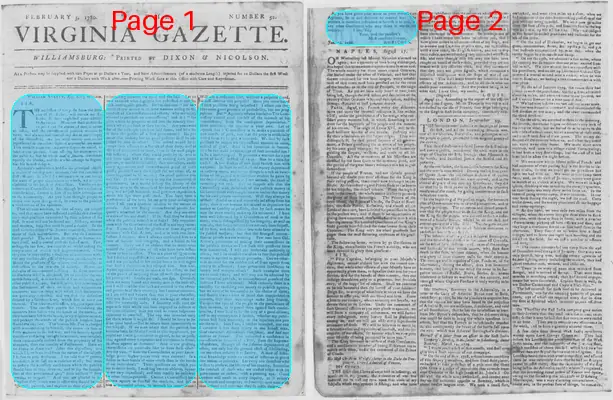
The Virginia Gazette
Richmond, Williamsburg, Richmond County, Virginia
What is this article about?
Agricola defends his prior publication on trade reform and critiques of commissaries' conduct during the Revolutionary War against William Aylett's criticisms. He argues for scrutiny of public officers to prevent peculation, emphasizing circumstantial evidence and the need for regulations to protect public funds from depreciation and abuse.
Merged-components note: The component on page 2 is the direct continuation and signature of the letter to the editor starting on page 1, as indicated by sequential reading order and textual flow.
Clippings
1 of 2
OCR Quality
Full Text
SIR,
The occasion of my not having for so long neglected your address to Agricola. Whoever shall undertake to point at the abuses of men in power or office, and the correction of public errors or vices, will always find himself exposed to the obloquy of the interested; that his well meant endeavors represented in the odious light of ungrateful calumnies. This consideration too frequently deters the timid, or luke-warm patriot, from offering his sentiments to the public; but he whose zeal is sincere, contemns equally the abuses, and those who attempt to stigmatize his honest designs.
Agricola's publication had for its principal object, a matter of much greater moment than the conduct of staff officers: It aimed at a reformation in our trade; for want of proper regulations in which, we are precipitated to the brink of destruction. Yet the observations on Commissaries &c. though but a collateral consideration, seemed to him of no little consequence to the community. As you have thought proper to attack him upon this ground, he owes to the public a vindication of his opinions.
That all communities, in time of war, are subject to, and that many have sustained considerable damage from malpractices committed by their officers of the staff, is what will not be denied me. History, ancient and modern, fixes this truth beyond a doubt. In the most virtuous times of the Roman republic, instances occur of such malversation. But why do I mention such proofs? The evil has its origin in human nature itself, and is coeval with the fall of man. Few, unhappily too few, are capable of withstanding the temptations of wealth and aggrandizement, when they can be acquired by a sacrifice of conscience without any considerable risk of temporal punishments: Hence the practices of peculation and monopoly, so destructive to the interests of society. Hence the defaults of unaccounted millions. In some measure to illustrate what is advanced, let us consider the immense sums lodged in the hands of Commissaries, and other public agents; the difficulties that intervene in the settlements of their intricate and voluminous accounts; and the delay with which such settlements are generally attended; and we find the defaulter secured by a Gordian knot, which few or none can unravel. The subalterns in office, are gone upon their travels. The necessary papers for elucidating the accounts have fallen into the hands of the enemy, or they have been lost in the brook, in a precipitate retreat; and perhaps thousands of the public treasure have shared the like fate. The famous Mr. Fox is charged with appropriating to himself, the enormous sum of forty millions in the last war, and his security against detection and being brought to account, was certainly more intricately derived from the perplexity of his accounts, than the venality of Parliament. Have we no Foxes in America? After this digression, into which I have been led from the nature of the subject, I hasten to your strictures. I am told that "general accusation is in fact no accusation at all; but tends to destroy the necessary confidence which the public should have in their servants, and to sap the foundation of that government which their authors seem anxious to support." And you are pleased to say "therefore the accusers men in office they should be well aimed, pointed, and explicit in their charge, discriminating between the good and the bad. Let us now examine what Agricola has published to call for such irrefragable proofs. He has said that "the low credit of our money is in some measure owing to the conduct of Commissaries and others, who are wisely allowed to purchase on commissions;" and that "the plan which he proposes would save the country thousands which are sunk in their hands." Are you aware Sir of the principle you have laid down, and how far it suits the genius of a free government? Do you mean that nothing but proof positive shall be objected to men in office? This indeed would be to tempt those officers to a breach of their duty, and of the trust committed to them, even in the most palpable instance; where they could profit by it, and at the same time had a chance of evading such proof positive, it would be to establish their characters, under every appearance and circumstantial proof of their guilt; provided only the subject did not admit of, or there happened to be wanting the proof positive you call for: It would be truly to sap the foundation of government; as it would destroy the liberty of the citizen, even in the exercise of his judgment and reason; and subject him to the most grievous impositions, while his lips were padlocked. You have been a practitioner of the law; let me pray your indulgence while I ask you a question relative to the nature of proofs. Are not strong circumstantial proofs frequently admitted in the courts? Are they not even in cases of life and death? If so, shall they be denied when the public interest is at stake? My acquaintance with the Gentlemen of the staff is not very extensive. Formerly I had the pleasure of some degree of intimacy with Col. Aylett, and it is with real satisfaction I declare, that I always considered him as a man of honour and integrity, and a friend to his country. Sorry am I to observe that he takes upon himself the justification of all who have been subordinate to him in office. This is a piece of Quixotism that I did not expect from his candour and good sense; and I am persuaded in his cooler hours he will regret that such a declaration has escaped him. Has Col. Aylett appointed every subaltern in his office, or had he the power of inspiring them all with the purity of his principles? Credat qui vult, non ego. Certainly there are many honest and worthy men in the business, and I well consider that such are entitled to the esteem and gratitude of their country; but I cannot conceive, as I am told and believe that this is your character, why you should so readily take umbrage at what affects the unworthy only. I sincerely wish that the eagerness with which you have engaged in defence of the commissariat, may not tend to create suspicions injurious to yourself. The cap was intended only for those whom it might fit : I should be sorry to see it on your head. But to return more immediately to the subject: If we even admit that the public has hitherto been faithfully served in this department, yet ought not a wise government to guard, as far as possible, against every temptation and incitement to fraud, in their agents or servants? And is the granting commissions on purchases like to have such effect? But say you, "have the Commissaries to your knowledge given higher prices than were current? Is a dollar in their hands of more worth than in the hands of an individual?" These questions on which you lay so much stress, I must beg leave to observe, appear to me very superficial; and may readily be answered by other interrogatories. Cannot a Commissary have private agents to forestall the markets, and sell to him at increased prices, to increase his commissions? Will not a judicious hint, without palpable fraud, be sufficient for this purpose? Have you never heard of such practices being suspected? I assure you they have upon great grounds of probability, but not proof positive. But "Agricola refutes himself - The Commissary cannot avail himself of the increase of his commissions, from the consequent depreciation." Here unluckily the blunder is your own. Let us suppose that a Commissary is to make a purchase of 100,000 lb. of pork, and that the price is artificially raised from 20 to 50 d. a hundred: We find by such purchase he makes his commissions amount to 1000, instead of 500 l. And is his invention so barren, that he can make no advantage of such increased sum? Is he a land jobber? It procures a warrant for 2000 acres of land, instead of 1000. Has he a turn for trade? A few strokes of this kind furnish him with a capital. In short he will find the money depreciated in nothing more, and in few things so much as necessaries of life; and it is therefore evident he gains by the depreciation, and is in some latitude, the cause of extending the evil. Let us suppose also that the Commissary with thousands of the public money in his hands meets with temptations to realize this money for his own private emolument. Will they always be resisted? And if he is unfortunately led astray from his duty, does it not become his interest to depreciate the money as speedily as possible, that by such means he may the more readily make up his accounts? I have been well informed by a Gentleman of rank in the army, who is distinguished by his integrity, as well as veracity, that such practices have not only been suspected by him, and those choice few who have attended to the public welfare; but that the strongest circumstantial proofs are not wanting. Few men have Col. Aylett's patriotism of sinking their commissions in the public service. That such evil practices have been committed, I will not undertake positively to affirm; but I see occasion too often to fear that public money is applied to private purposes. Can we otherwise account for the sudden rise of some agents from penury to affluence; from precarious subsistence to luxury and voluptuousness? Such examples there are in these times; and will they not be admitted by the impartial public, as circumstantial proofs of the doctrine I have advanced? Most certainly there is a necessity for confiding our money to public agents; but we cannot be too careful in the choice of them; and should always have in mind that comprehensive proverb, that short reckonings make long friends.
To open the eyes of the people to the peculations of their servants, or to guard them against such contingencies, I hold to be the duty of a good citizen; and to my countrymen I submit, whether my publication had such tendency, or the injurious one you ascribe to it. Sure I am, I neither intended, nor can I conceive it has done injury to one honest man. Good characters discriminate themselves, and bad ones deserve no favour. Too unlimited a confidence in the officers or servants of a state, from the Supreme Magistrate, through all the different departments of office; not only has the general effect of debilitation, but too often reduces it to slavery. A man of historical knowledge needs no recital of instances to prove this axiom in politics. Let every one therefore who wishes to preserve the liberty of his country, scrutinize the conduct of those who are trusted either with its government or riches, with a piercing eye. Good servants will exult in every inquiry, as it evinces their worth and integrity; and corrupt ones meet with that infamy and contempt they so justly deserve.
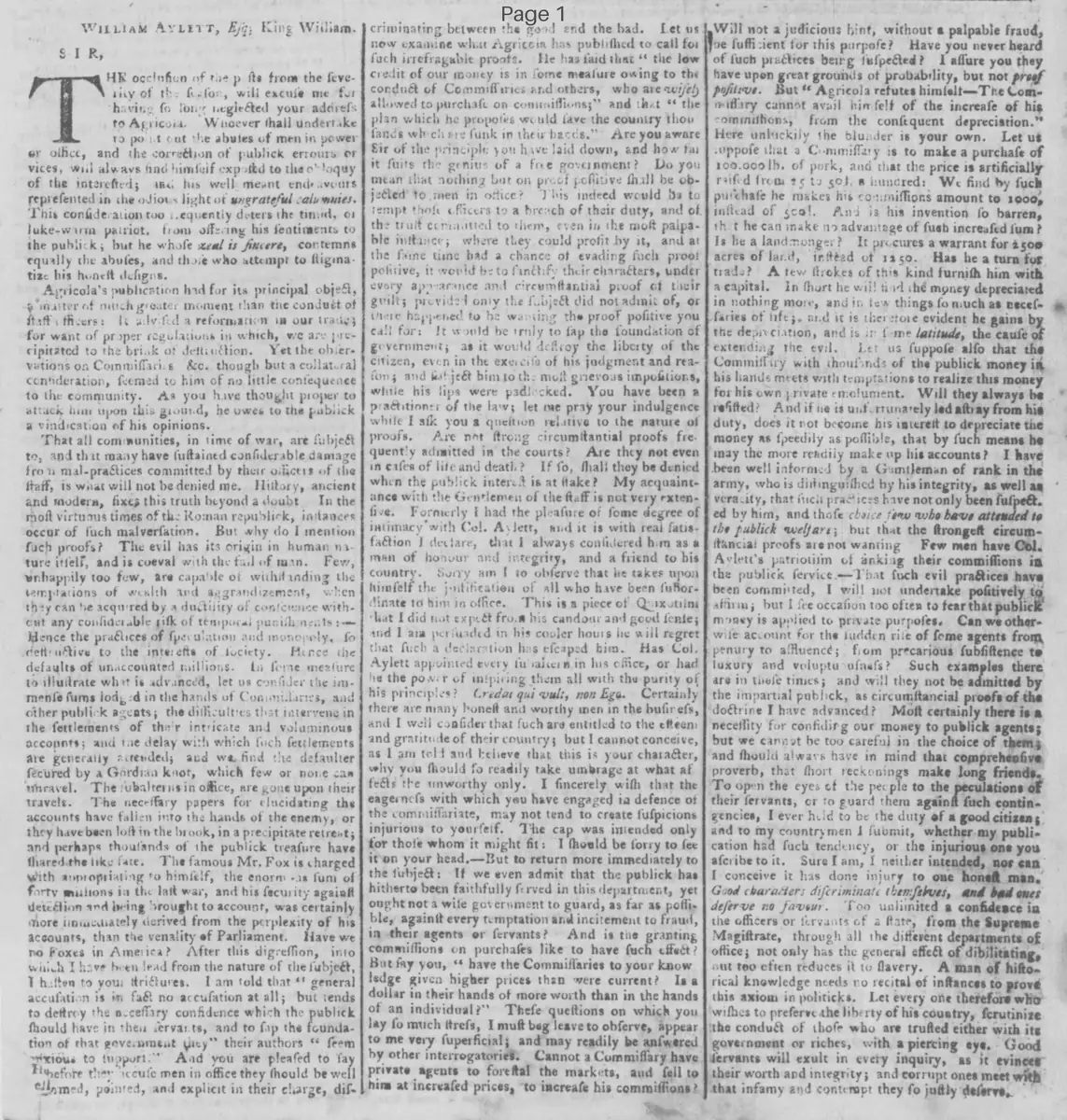
As you have given your name to your remarks on Agricola, he is not desirous to conceal his. The printer is therefore instructed to furnish it to you, or any other Gentleman who may think it worth the inquiry.
I am, Sir,
Your, and the public's
Most obedient servant,
Jan. 24, 1780.
AGRICOLE.
What sub-type of article is it?
What themes does it cover?
What keywords are associated?
What entities or persons were involved?
Letter to Editor Details
Author
Agricole
Recipient
William Aylet, Esq;
Main Argument
agricola defends his critiques of commissaries' practices, arguing they contribute to currency depreciation and public financial loss during the war, and advocates for regulatory reforms and public scrutiny using circumstantial evidence rather than requiring proof positive.
Notable Details