Thank you for visiting SNEWPapers!
Sign up free
The Voice Of Freedom
Montpelier, Brandon, Washington County, Rutland County, Vermont
What is this article about?
An article from the Herald of Freedom praises Vermont Lt. Gov. Camp's legal argument that the U.S. Constitution does not permit slavery, asserting it contradicts the document's purpose of universal liberty and that Southern laws lack legal basis for enslavement, treating slavery as mere practice, not enforceable law.
Clipping
OCR Quality
Full Text
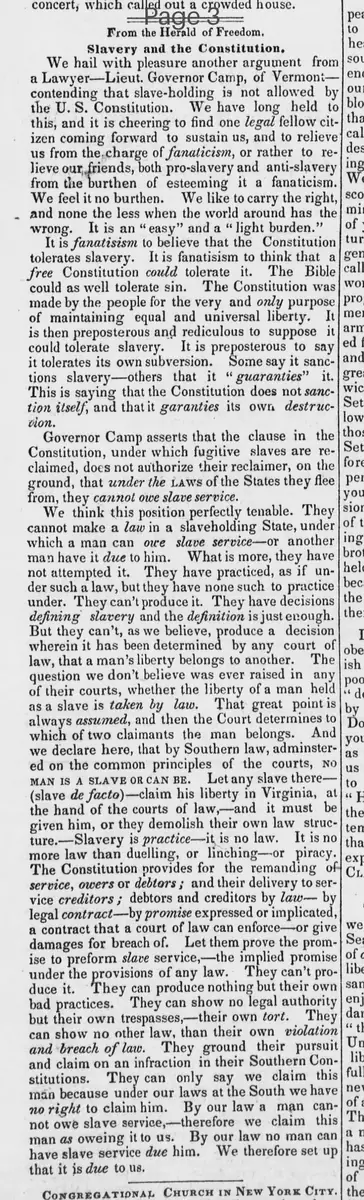
Slavery and the Constitution.
We hail with pleasure another argument from a Lawyer—Lieut. Governor Camp, of Vermont, contending that slave-holding is not allowed by the U.S. Constitution. We have long held to this, and it is cheering to find one legal fellow citizen coming forward to sustain us, and to relieve us from the charge of fanaticism, or rather to relieve our friends, both pro-slavery and anti-slavery, from the burthen of esteeming it a fanaticism.
We feel it no burthen. We like to carry the right and none the less when the world around has the wrong. It is an "easy" and a "light burden."
It is fanaticism to believe that the Constitution tolerates slavery. It is fanaticism to think that a free Constitution could tolerate it. The Bible could as well tolerate sin. The Constitution was made by the people for the very and only purpose of maintaining equal and universal liberty. It is then preposterous and ridiculous to suppose it could tolerate slavery. It is preposterous to say it tolerates its own subversion. Some say it sanctions slavery—others that it "guaranties" it. This is saying that the Constitution does not sanction itself, and that it guaranties its own destruction.
Governor Camp asserts that the clause in the Constitution, under which fugitive slaves are reclaimed, does not authorize their reclaimer, on the ground, that under the Laws of the States they flee from, they cannot owe slave service.
We think this position perfectly tenable. They cannot make a law in a slaveholding State, under which a man can owe slave service—or another man have it due to him. What is more, they have not attempted it. They have practiced, as if under such a law, but they have none such to practice under. They can't produce it. They have decisions defining slavery and the definition is just enough.
But they can't, as we believe, produce a decision wherein it has been determined by any court of law, that a man's liberty belongs to another. The question we don't believe was ever raised in any of their courts, whether the liberty of a man held as a slave is taken by law. That great point is always assumed, and then the Court determines to which of two claimants the man belongs. And we declare here, that by Southern law, administered on the common principles of the courts, No MAN IS A SLAVE OR CAN BE. Let any slave there—(slave de facto)—claim his liberty in Virginia, at the hand of the courts of law,—and it must be given him, or they demolish their own law structure.—Slavery is practice—it is no law. It is no more law than duelling, or lynching—or piracy.
The Constitution provides for the remanding of service, owers or debtors; and their delivery to service creditors; debtors and creditors by law—by legal contract—by promise expressed or implicated. A contract that a court of law can enforce—or give damages for breach of. Let them prove the promise to perform slave service,—the implied promise under the provisions of any law. They can't produce it. They can produce nothing but their own bad practices. They can show no legal authority but their own trespasses, their own tort. They can show no other law, than their own violation and breach of law. They ground their pursuit and claim on an infraction in their Southern Constitutions. They can only say we claim this man because under our laws at the South we have no right to claim him. By our law a man cannot owe slave service,—therefore we claim this man as owing it to us. By our law no man can have slave service due him. We therefore set up that it is due to us.
What sub-type of article is it?
What themes does it cover?
What keywords are associated?
What entities or persons were involved?
Where did it happen?
Story Details
Key Persons
Location
Vermont, Southern Slaveholding States
Story Details
The article endorses Lt. Gov. Camp's contention that the U.S. Constitution prohibits slavery, arguing that it aims for universal liberty and that Southern laws do not legally establish slave service, making slavery mere unlawful practice; the fugitive slave clause applies only to legal debts, not slavery.