Thank you for visiting SNEWPapers!
Sign up free
The Intelligencer, & Petersburg Commercial Advertiser
Petersburg, Virginia
What is this article about?
U.S. Congress proceedings on March 18 and 20, 1826: House considers observatory bill and resolutions on executions; Senate debates Cumberland Road appropriations; House addresses militia discipline and Michigan contested election.
Clipping
OCR Quality
Full Text
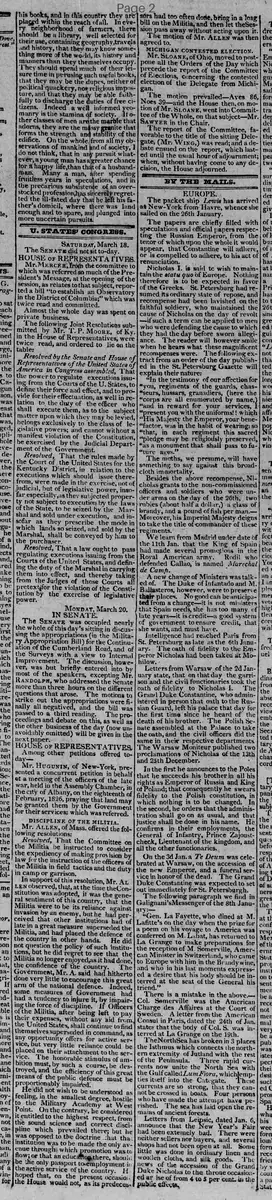
SATURDAY, March 18.
The Senate did not sit to-day.
HOUSE OF REPRESENTATIVES.
Mr. MERCER. From the committee to which was referred so much of the President's Message, at the opening of the session, as relates to that subject, reported a bill "to establish an Observatory in the District of Columbia;" which was twice read and committed.
Almost the whole day was spent on private business.
The following Joint Resolutions submitted by Mr. T. P. MOORE, of Ky. in the House of Representatives, were twice read, and ordered to lie on the table:
Resolved by the Senate and House of Representatives of the United States of America in Congress assembled, That the power to regulate executions issuing from the Courts of the U. States, to define their force and effect, and to provide for their effectuation, as well in relation to the duty of the officer who shall execute them, as to the subject matter upon which they may be levied, belongs exclusively to the class of legislative powers; and cannot without a manifest violation of the Constitution, be exercised by the Judicial Department of the Government.
Resolved, That the rules made by the Court of the United States for the Kentucky District, in relation to the executions which should issue therefrom, were made in the exercise, not of judicial, but of legislative power, insofar especially, as they subjected property not subject to execution by the laws of the State, to be seized by the Marshal and sold under execution, and insofar as they prescribe the mode in which lands so seized, and sold by the Marshal, shall be conveyed by him to the purchaser.
Resolved, That a law ought to pass regulating executions issuing from the Courts of the United States, and defining the duty of the Marshal in carrying them into effect, and thereby taking from the Judges of those Courts all pretext for the violation of the Constitution by the exercise of legislative power.
MONDAY, March 20.
IN SENATE.
The Senate was occupied nearly the whole of this day's sitting in discussing the appropriations (in the Military Appropriation Bill) for the Continuation of the Cumberland Road, and of the Surveys with a view to Internal Improvement. The discussion, however, was but briefly entered into by most of the speakers, excepting Mr. Randolph, who addressed the Senate more than three hours on the different questions that arose. The motions to strike out the appropriations were finally all negatived, and the bill was passed to a third reading. The proceedings and debate on this, as well as the other business of the day (now unavoidably omitted) will be given in the next paper.
HOUSE OF REPRESENTATIVES.
Among other petitions offered to-day-.
Mr. Hugunin, of New-York, presented a concurrent petition in behalf of a meeting of the officers of the late war, held in the Assembly Chamber, in the city of Albany, on the eighteenth of February, 1826, praying that land may be granted them by the Government for their services: which was referred.
DISCIPLINE OF THE MILITIA.
Mr. ALLEN, of Mass. offered the following resolutions:
Resolved, That the Committee on the Militia be instructed to consider the expediency of making provision by law for the instruction of the officers of the Militia in field tactics and the duty in camp or garrison.
In support of this resolution, Mr. ALLEN observed, that, at the time the Constitution was adopted, it was the general sentiment of this country, that the Militia were to be its reliance against invasion by an enemy, but he had perceived that other institutions had of late in a great measure superseded the Militia, and had placed the defence of the country in other hands. He did not question the policy of such institutions, but he did regret to see that the Militia no longer enjoyed, as it had done, the confidence of the country. The Government, Mr. A. said had hitherto done very little to encourage this great arm of the national defence. Indeed, some measures of Government had had a tendency to injure it, by impairing the force of discipline. If Officers of the Militia, after being left to pay their expenses, without any aid from the United States, shall continue to find themselves superseded in command, as any opportunity offers for active service, but very little reliance could be placed on their attachment to the service. The honorable stimulus of ambition must, by such a course, be destroyed, and the efficiency of this great means of the public defence must be proportionably impaired.
He did not wish to be understood as feeling, in the smallest degree, hostile to the Military Academy at West Point. On the contrary, he considered it entitled to the highest respect, from the sound science and correct discipline which prevailed there; but he was opposed to the doctrine that that institution was to be made the only avenue through which promotion was to flow; or that an education there, should be the only passport to employment in the active service of the country. He hoped that, on the present occasion the House would not, as its predecessors had too often done, bring in a long bill on the Militia and then let the Session pass away without acting upon it.
The motion of Mr. ALLEN was then agreed to.
MICHIGAN CONTESTED ELECTION.
Mr. SLOANE, of Ohio, moved to postpone all the Orders of the Day which precede the report of the Committee of Elections, concerning the contested election of the Delegate from Michigan.
The motion prevailed-Ayes 86, Noes 39 -and the House then, on motion of Mr. SLOANE, went into Committee of the Whole, on that subject-Mr. SAWYER in the Chair.
The report of the Committee, favorable to the title of the sitting Delegate, (Mr WING,) was read; and a debate ensued on the report, which lasted until the usual hour of adjournment; when, without having come to any decision, the House adjourned.
What sub-type of article is it?
What keywords are associated?
What entities or persons were involved?
Where did it happen?
Domestic News Details
Primary Location
United States Congress
Event Date
March 18 20, 1826
Key Persons
Outcome
observatory bill committed; joint resolutions on executions laid on table; cumberland road appropriations bill passed to third reading; militia resolution agreed to; michigan election debate adjourned without decision; war officers' petition referred.
Event Details
Proceedings in U.S. Senate and House of Representatives: On March 18, House reports bill for observatory in D.C. and receives resolutions asserting legislative power over executions. On March 20, Senate debates and advances military appropriations for Cumberland Road and internal improvements; House refers petition for land grants to war officers, agrees to resolution for militia officer instruction, and debates Michigan contested election favoring sitting delegate Mr. Wing.