Thank you for visiting SNEWPapers!
Sign up free
Gazette Of The United States
Philadelphia, Philadelphia County, Pennsylvania
What is this article about?
Account of captured Vendéan rebel leader Charette's wounds, interrogation, and statements in prison before his execution by shooting at Angers. He praises French generals, regrets the war's prolongation due to divisions, and describes his capture and appearance.
Clipping
OCR Quality
Full Text
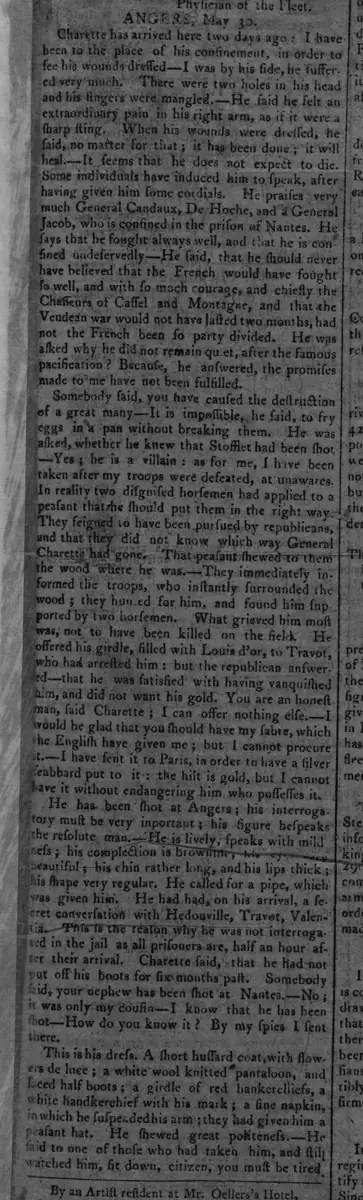
Some individuals have induced him to speak, after having given him some cordials. He praises very much General Canclaux, De Hoche, and a General Jacob, who is confined in the prison of Nantes. He says that he fought always well, and that he is confined undeservedly--He said, that he should never have believed that the French would have fought so well, and with so much courage, and chiefly the Chouans of Castel and Montagne, and that the Vendean war would not have lasted two months, had not the French been so party divided. He was asked why he did not remain quiet, after the famous pacification? Because, he answered, the promises made to me have not been fulfilled.
Somebody said, you have caused the destruction of a great many--It is impossible, he said, to fry eggs in a pan without breaking them. He was asked, whether he knew that Stofflet had been shot? Yes: he is a villain: as for me, I have been taken after my troops were defeated, at unawares.
In reality two disguised horsemen had applied to a peasant that he should put them in the right way. They feigned to have been pursued by republicans, and that they did not know which way General Charette had gone. That peasant shewed to them the wood where he was.--They immediately informed the troops, who instantly surrounded the wood; they hunted for him, and found him supported by two horsemen. What grieved him most was, not to have been killed on the field. He offered his girdle, filled with Louis d'or, to Travot, who had arrested him: but the republican answered--that he was satisfied with having vanquished him, and did not want his gold. You are an honest man, said Charette; I can offer nothing else.--I would be glad that you should have my sabre, which the English have given me; but I cannot procure it.--I have sent it to Paris, in order to have a silver scabbard put to it: the hilt is gold, but I cannot have it without endangering him who possesses it.
He has been shot at Angers; his interrogatory must be very important; his figure bespeaks the resolute man. He is lively, speaks with mildness; his complexion is brown, beautiful; his chin rather long, and his lips thick; his shape very regular. He called for a pipe, which was given him. He had had on his arrival, a secret conversation with Hédouville, Travot, Valentia. This is the reason why he was not interrogated in the jail as all prisoners are, half an hour after their arrival. Charette said, that he had not put off his boots for six months past. Somebody said, your nephew has been shot at Nantes.--No; it was only my cousin--I know that he has been shot--How do you know it? By my spies I sent there.
This is his dress. A short guard coat, with fleurs de lis: a white wool knitted pantaloon, and laced half boots; a girdle of red handkerchiefs, a white handkerchief with his mark; a fine napkin, in which he suspended his arm; they had given him a peasant hat. He shewed great politeness.--He said to one of those who had taken him, and still watched him, sit down, citizen, you must be tired.
What sub-type of article is it?
What keywords are associated?
What entities or persons were involved?
Where did it happen?
Foreign News Details
Primary Location
Angers
Event Date
Two Days Ago
Key Persons
Outcome
charette shot at angers; stofflet shot; charette's cousin shot at nantes; charette captured after troops defeated
Event Details
Charette arrived wounded two days ago, with head holes and mangled fingers; spoke after cordials, praising generals and Chouans, blaming unfulfilled promises; captured via peasant betrayal in wood; offered gold and sabre to Travot; described appearance and dress; secret conversation before interrogation.