Thank you for visiting SNEWPapers!
Sign up free
Story
June 14, 1820
The Rhode Island Republican
Newport, Newport County, Rhode Island
What is this article about?
A man is wrongfully convicted and executed for his father's murder based on his sister's circumstantial evidence, including footprints and a bloody hammer. Four years later, she confesses on her deathbed to framing her innocent brother.
Clipping
OCR Quality
95%
Excellent
Full Text
Curious case of Conviction on circumstantial evidence.
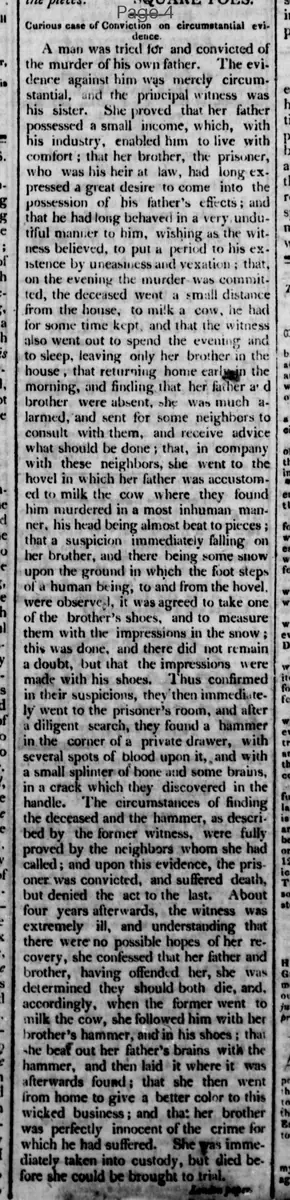
A man was tried for and convicted of the murder of his own father. The evidence against him was merely circumstantial, and the principal witness was his sister. She proved that her father possessed a small income, which, with his industry, enabled him to live with comfort; that her brother, the prisoner who was his heir at law, had long expressed a great desire to come into the possession of his father's effects; and that he had long behaved in a very undutiful manner to him, wishing as the witness believed, to put a period to his existence by uneasiness and vexation; that, on the evening the murder was committed, the deceased went a small distance from the house, to milk a cow, he had for some time kept, and that the witness also went out to spend the evening and to sleep, leaving only her brother in the house, that returning home early in the morning, and finding that her father and brother were absent, she was much alarmed, and sent for some neighbors to consult with them, and receive advice what should be done; that, in company with these neighbors, she went to the hovel in which her father was accustomed to milk the cow where they found him murdered in a most inhuman manner, his head being almost beat to pieces; that a suspicion immediately falling on her brother, and there being some snow upon the ground in which the foot steps of a human being, to and from the hovel, were observed, it was agreed to take one of the brother's shoes, and to measure them with the impressions in the snow; this was done, and there did not remain a doubt, but that the impressions were made with his shoes. Thus confirmed in their suspicions, they then immediately went to the prisoner's room, and after a diligent search, they found a hammer in the corner of a private drawer, with several spots of blood upon it, and with a small splinter of bone and some brains, in a crack which they discovered in the handle. The circumstances of finding the deceased and the hammer, as described by the former witness, were fully proved by the neighbors whom she had called; and upon this evidence, the prisoner was convicted, and suffered death, but denied the act to the last. About four years afterwards, the witness was extremely ill, and understanding that there were no possible hopes of her recovery, she confessed that her father and brother, having offended her, she was determined they should both die, and, accordingly, when the former went to milk the cow, she followed him with her brother's hammer, and in his shoes: that she beat out her father's brains with the hammer, and then laid it where it was afterwards found; that she then went from home to give a better color to this wicked business; and that her brother was perfectly innocent of the crime for which he had suffered. She was immediately taken into custody, but died before she could be brought to trial.
A man was tried for and convicted of the murder of his own father. The evidence against him was merely circumstantial, and the principal witness was his sister. She proved that her father possessed a small income, which, with his industry, enabled him to live with comfort; that her brother, the prisoner who was his heir at law, had long expressed a great desire to come into the possession of his father's effects; and that he had long behaved in a very undutiful manner to him, wishing as the witness believed, to put a period to his existence by uneasiness and vexation; that, on the evening the murder was committed, the deceased went a small distance from the house, to milk a cow, he had for some time kept, and that the witness also went out to spend the evening and to sleep, leaving only her brother in the house, that returning home early in the morning, and finding that her father and brother were absent, she was much alarmed, and sent for some neighbors to consult with them, and receive advice what should be done; that, in company with these neighbors, she went to the hovel in which her father was accustomed to milk the cow where they found him murdered in a most inhuman manner, his head being almost beat to pieces; that a suspicion immediately falling on her brother, and there being some snow upon the ground in which the foot steps of a human being, to and from the hovel, were observed, it was agreed to take one of the brother's shoes, and to measure them with the impressions in the snow; this was done, and there did not remain a doubt, but that the impressions were made with his shoes. Thus confirmed in their suspicions, they then immediately went to the prisoner's room, and after a diligent search, they found a hammer in the corner of a private drawer, with several spots of blood upon it, and with a small splinter of bone and some brains, in a crack which they discovered in the handle. The circumstances of finding the deceased and the hammer, as described by the former witness, were fully proved by the neighbors whom she had called; and upon this evidence, the prisoner was convicted, and suffered death, but denied the act to the last. About four years afterwards, the witness was extremely ill, and understanding that there were no possible hopes of her recovery, she confessed that her father and brother, having offended her, she was determined they should both die, and, accordingly, when the former went to milk the cow, she followed him with her brother's hammer, and in his shoes: that she beat out her father's brains with the hammer, and then laid it where it was afterwards found; that she then went from home to give a better color to this wicked business; and that her brother was perfectly innocent of the crime for which he had suffered. She was immediately taken into custody, but died before she could be brought to trial.
What sub-type of article is it?
Crime Story
Mystery
Deception Fraud
What themes does it cover?
Deception
Betrayal
Crime Punishment
What keywords are associated?
Circumstantial Evidence
Wrongful Conviction
Deathbed Confession
Framed Murder
Sister Perpetrator
What entities or persons were involved?
Brother (Prisoner)
Sister (Witness)
Father (Deceased)
Where did it happen?
Family Home And Hovel
Story Details
Key Persons
Brother (Prisoner)
Sister (Witness)
Father (Deceased)
Location
Family Home And Hovel
Story Details
A sister testifies against her brother, leading to his conviction and execution for their father's murder based on circumstantial evidence including footprints and a bloody hammer. Four years later, on her deathbed, she confesses to committing the murder herself using her brother's shoes and hammer to frame him.