Thank you for visiting SNEWPapers!
Sign up free
Editorial
December 12, 1866
Clearfield Republican
Clearfield, Clearfield County, Pennsylvania
What is this article about?
Editorial from Hollidaysburg Standard, republished, urges President Johnson to aggressively remove political opponents from office to support his policy, unlike Lincoln's wholesale removals, noting most offices are held by enemies amid a hostile Congress.
Clipping
OCR Quality
95%
Excellent
Full Text
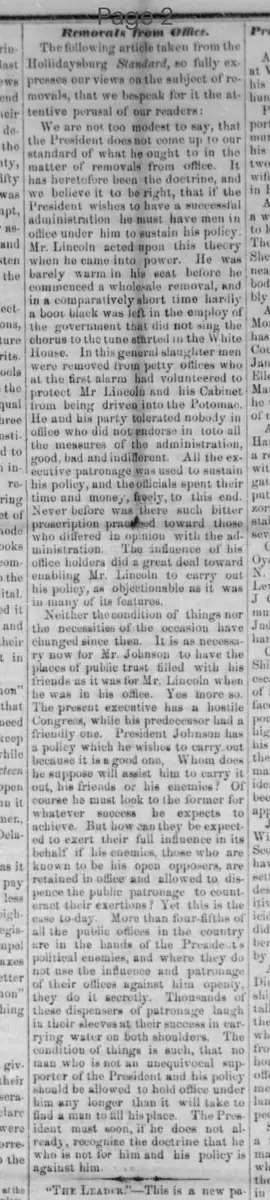
The following article taken from the Hollidaysburg Standard, so fully expresses our views on the subject of removals, that we bespeak for it the attentive perusal of our readers:
We are not too modest to say, that the President does not come up to our standard of what he ought to in the matter of removals from office. It has heretofore been the doctrine, and we believe it to be right, that if the President wishes to have a successful administration he must have men in office under him to sustain his policy. Mr. Lincoln acted upon this theory when he came into power. He was barely warm in his seat before he commenced a wholesale removal, and in a comparatively short time hardly a boot black was left in the employ of the government that did not sing the chorus to the tune started in the White House. In this general slaughter men were removed from petty offices who at the first alarm had volunteered to protect Mr. Lincoln and his Cabinet from being driven into the Potomac. He and his party tolerated nobody in office who did not endorse in toto all the measures of the administration, good, bad and indifferent. All the executive patronage was used to sustain his policy, and the officials spent their time and money, freely, to this end. Never before was there such bitter proscription practiced toward those who differed in opinion with the administration. The influence of his office holders did a great deal toward enabling Mr. Lincoln to carry out his policy, as objectionable as it was in many of its features.
Neither the condition of things nor the necessities of the occasion have changed since then. It is as necessary now for Mr. Johnson to have the places of public trust filled with his friends as it was for Mr. Lincoln when he was in his office. Yes, more so. The present executive has a hostile Congress, while his predecessor had a friendly one. President Johnson has a policy which he wishes to carry out because it is a good one. Whom does he suppose will assist him to carry it out, his friends or his enemies? Of course he must look to the former for whatever success he expects to achieve. But how can they be expected to exert their full influence in its behalf if his enemies, those who are known to be his open opposers, are retained in office and allowed to dispense the public patronage to counteract their exertions? Yet this is the case to-day. More than four-fifths of all the public offices in the country are in the hands of the President's political enemies, and where they do not use the influence and patronage of their offices against him openly, they do it secretly. Thousands of these dispensers of patronage laugh in their sleeves at their success in carrying water on both shoulders. The condition of things is such, that no man who is not an unequivocal supporter of the President and his policy should be allowed to hold office under him any longer than it will take to find a man to fill his place. The President must soon, if he does not already, recognize the doctrine that he who is not for him and his policy is against him.
We are not too modest to say, that the President does not come up to our standard of what he ought to in the matter of removals from office. It has heretofore been the doctrine, and we believe it to be right, that if the President wishes to have a successful administration he must have men in office under him to sustain his policy. Mr. Lincoln acted upon this theory when he came into power. He was barely warm in his seat before he commenced a wholesale removal, and in a comparatively short time hardly a boot black was left in the employ of the government that did not sing the chorus to the tune started in the White House. In this general slaughter men were removed from petty offices who at the first alarm had volunteered to protect Mr. Lincoln and his Cabinet from being driven into the Potomac. He and his party tolerated nobody in office who did not endorse in toto all the measures of the administration, good, bad and indifferent. All the executive patronage was used to sustain his policy, and the officials spent their time and money, freely, to this end. Never before was there such bitter proscription practiced toward those who differed in opinion with the administration. The influence of his office holders did a great deal toward enabling Mr. Lincoln to carry out his policy, as objectionable as it was in many of its features.
Neither the condition of things nor the necessities of the occasion have changed since then. It is as necessary now for Mr. Johnson to have the places of public trust filled with his friends as it was for Mr. Lincoln when he was in his office. Yes, more so. The present executive has a hostile Congress, while his predecessor had a friendly one. President Johnson has a policy which he wishes to carry out because it is a good one. Whom does he suppose will assist him to carry it out, his friends or his enemies? Of course he must look to the former for whatever success he expects to achieve. But how can they be expected to exert their full influence in its behalf if his enemies, those who are known to be his open opposers, are retained in office and allowed to dispense the public patronage to counteract their exertions? Yet this is the case to-day. More than four-fifths of all the public offices in the country are in the hands of the President's political enemies, and where they do not use the influence and patronage of their offices against him openly, they do it secretly. Thousands of these dispensers of patronage laugh in their sleeves at their success in carrying water on both shoulders. The condition of things is such, that no man who is not an unequivocal supporter of the President and his policy should be allowed to hold office under him any longer than it will take to find a man to fill his place. The President must soon, if he does not already, recognize the doctrine that he who is not for him and his policy is against him.
What sub-type of article is it?
Partisan Politics
What keywords are associated?
Presidential Removals
Political Patronage
Johnson Policy
Lincoln Administration
Office Proscription
What entities or persons were involved?
President Johnson
Mr. Lincoln
Congress
Editorial Details
Primary Topic
Advocacy For Removals Of Political Opponents From Office To Support Presidential Policy
Stance / Tone
Strongly Pro Removal And Supportive Of Johnson's Policy
Key Figures
President Johnson
Mr. Lincoln
Congress
Key Arguments
Presidents Need Supporters In Office For Successful Administration
Lincoln Conducted Wholesale Removals To Ensure Policy Support
Johnson Faces Hostile Congress And Needs Friends In Office More Than Lincoln Did
Most Public Offices Held By Johnson's Enemies Who Undermine His Policy
Only Unequivocal Supporters Should Hold Office Under The President