Thank you for visiting SNEWPapers!
Sign up free
Story
December 4, 1806
Alexandria Daily Advertiser
Alexandria, Virginia
What is this article about?
Promotional article from Philadelphia Gazette detailing the fertile soil, rich productions, cheap land, and economic potential of Louisiana, the recently acquired U.S. territory, encouraging emigration and commerce, especially with New England.
Clipping
OCR Quality
95%
Excellent
Full Text
From the Philadelphia Gazette,
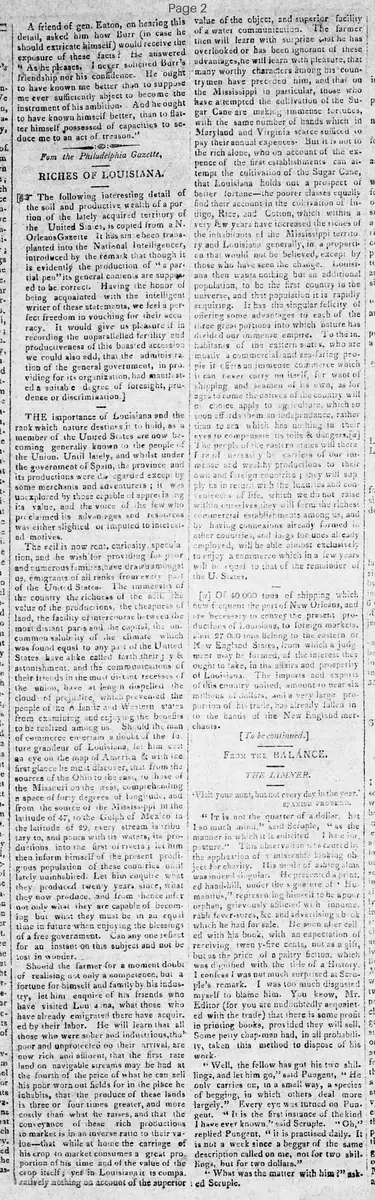
RICHES OF LOUISIANA.
The following interesting detail of the soil and productive wealth of a portion of the lately acquired territory of the United States, is copied from a N. Orleans Gazette. It has since been transplanted into the National Intelligencer, introduced by the remark that though it is evidently the production of "a partial pen" its general contents are supposed to be correct. Having the honor of being acquainted with the intelligent writer of these statements, we feel a perfect freedom in vouching for their accuracy. It would give us pleasure if in recording the unparallelled fertility and productiveness of this boasted accession we could also add, that the administration of the general government, in providing for its organization, had manifested a suitable degree of foresight, prudence or discrimination.
THE importance of Louisiana and the rank which nature destines it to hold, as a member of the United States are now becoming generally known to the people of the Union. Until lately, and whilst under the government of Spain, the province and its productions were regarded except by some merchants and adventurers; it was unexplored by those capable of appreciating its value, and the voice of the few who proclaimed its advantages and resources was either slighted or imputed to interested motives.
The veil is now rent, curiosity, speculation, and the wish for providing for poor and numerous families, have drawn amongst us, emigrants of all ranks from every part of the United States. The immensity of the country the richness of the soil, the value of the productions, the cheapness of land, the facility of intercourse between the most distant parts and the capital the uncommon salubrity of the climate which was found equal to any part of the United States, have alike called forth their joy & astonishment, and the communications of their friends in the most distant recesses of the union, have at length dispelled the cloud of prejudice, which prevented the people of the Atlantic and Western states from examining and enjoying the benefits to be realised amongst us. Should the man of commerce entertain a doubt of the future grandeur of Louisiana, let him cast an eye on the map of America & with one glance he must discover, that from the sources of the Ohio to the east, to those of the Missouri on the west, comprehending a space of forty degrees of longitude, and from the source of the Mississippi in the latitude of 47, to the Gulph of Mexico in the latitude of 29, every stream is tributary to, and pours with its waters, its productions into the Mississippi river; let him then inform himself of the present prodigious population of these countries until lately uninhabited. Let him enquire what they produced twenty years since, what they now produce, and from hence infer not only what they are capable of becoming but what they must be in an equal time in future when enjoying the blessings of a free government. Can any one reflect for an instant on this subject and not be lost in wonder.
Should the farmer for a moment doubt of realising not only a competence, but a fortune for himself and family by his industry, let him enquire of his friends who have visited Louisiana, what those who have already emigrated there have acquired by their labor. He will learn that all those who were sober and industrious, though poor and unprotected on their arrival, are now rich and affluent, that the first rate land on navigable streams may be had at the fourth of the price of what he can sell his poor worn out fields for in the place he inhabits, that the produce of these lands is three or four times greater, and more costly than what he raises, and that the conveyance of these rich productions to market is in an inverse ratio to their value--that while at home the carriage of his crop to market consumes a great proportion of his time and of the value of the crop itself; yet in Louisiana it is comparatively nothing on account of the superior value of the object, and superior facility of a water communication. The farmer then will learn with surprize that he has overlooked or has been ignorant of these advantages, he will learn with pleasure, that many worthy characters among his countrymen have preceded him, and have on the Mississippi in particular, those who have attempted the cultivation of the Sugar Cane are making immense fortunes, with the same number of hands which in Maryland and Virginia scarce sufficed to pay their annual expences-- But it is not to the rich alone, who on account of the expence of the first establishments can attempt the cultivation of the Sugar Cane, that Louisiana holds out a prospect of better fortune--the poorer classes find their account in the cultivation of Indigo, Rice, and Cotton, which within a very few years have increased the riches of the inhabitants of the Mississippi territory and Louisiana generally, in a proportion that would not be believed, except by those who have seen the change. Louisiana then wants nothing but an additional population, to be the first country in the universe, and that population it is rapidly acquiring. It has the singular felicity of offering some advantages to each of the three great portions into which nature has divided our immense empire. To the inhabitants of the eastern states, who are mostly a commercial and sea-faring people it offers an immense commerce which it can never carry on itself, for want of shipping and seamen of its own, as for ages to come the natives of the country will of choice apply to agriculture, which so soon affords them an independence, rather than to sea which has nothing in their eyes to compensate its toils & dangers. The people of the eastern states will therefore of necessity be carriers of our immense and wealthy productions to their own and foreign countries; they will supply us in return with the luxuries and conveniences of life, which we do not raise within ourselves, they will form the richest commercial establishments among us, and by having connexions already formed in other countries, and large fortunes already employed, will be able almost exclusively to enjoy a commerce which in a few years will be equal to that of the remainder of the U. States.
[a] Of 40,000 tons of shipping which now frequent the port of New Orleans, and are necessary to convey the present productions of Louisiana, to foreign markets, about 27,000 tons belong to the eastern or New England States, from which a judgment may be formed, of the interest they ought to take, in the affairs and prosperity of Louisiana. Their imports and exports united, amount to near six millions of dollars, and a very large proportion of their trade, has already fallen into the hands of the New England merchants.
[To be continued.]
RICHES OF LOUISIANA.
The following interesting detail of the soil and productive wealth of a portion of the lately acquired territory of the United States, is copied from a N. Orleans Gazette. It has since been transplanted into the National Intelligencer, introduced by the remark that though it is evidently the production of "a partial pen" its general contents are supposed to be correct. Having the honor of being acquainted with the intelligent writer of these statements, we feel a perfect freedom in vouching for their accuracy. It would give us pleasure if in recording the unparallelled fertility and productiveness of this boasted accession we could also add, that the administration of the general government, in providing for its organization, had manifested a suitable degree of foresight, prudence or discrimination.
THE importance of Louisiana and the rank which nature destines it to hold, as a member of the United States are now becoming generally known to the people of the Union. Until lately, and whilst under the government of Spain, the province and its productions were regarded except by some merchants and adventurers; it was unexplored by those capable of appreciating its value, and the voice of the few who proclaimed its advantages and resources was either slighted or imputed to interested motives.
The veil is now rent, curiosity, speculation, and the wish for providing for poor and numerous families, have drawn amongst us, emigrants of all ranks from every part of the United States. The immensity of the country the richness of the soil, the value of the productions, the cheapness of land, the facility of intercourse between the most distant parts and the capital the uncommon salubrity of the climate which was found equal to any part of the United States, have alike called forth their joy & astonishment, and the communications of their friends in the most distant recesses of the union, have at length dispelled the cloud of prejudice, which prevented the people of the Atlantic and Western states from examining and enjoying the benefits to be realised amongst us. Should the man of commerce entertain a doubt of the future grandeur of Louisiana, let him cast an eye on the map of America & with one glance he must discover, that from the sources of the Ohio to the east, to those of the Missouri on the west, comprehending a space of forty degrees of longitude, and from the source of the Mississippi in the latitude of 47, to the Gulph of Mexico in the latitude of 29, every stream is tributary to, and pours with its waters, its productions into the Mississippi river; let him then inform himself of the present prodigious population of these countries until lately uninhabited. Let him enquire what they produced twenty years since, what they now produce, and from hence infer not only what they are capable of becoming but what they must be in an equal time in future when enjoying the blessings of a free government. Can any one reflect for an instant on this subject and not be lost in wonder.
Should the farmer for a moment doubt of realising not only a competence, but a fortune for himself and family by his industry, let him enquire of his friends who have visited Louisiana, what those who have already emigrated there have acquired by their labor. He will learn that all those who were sober and industrious, though poor and unprotected on their arrival, are now rich and affluent, that the first rate land on navigable streams may be had at the fourth of the price of what he can sell his poor worn out fields for in the place he inhabits, that the produce of these lands is three or four times greater, and more costly than what he raises, and that the conveyance of these rich productions to market is in an inverse ratio to their value--that while at home the carriage of his crop to market consumes a great proportion of his time and of the value of the crop itself; yet in Louisiana it is comparatively nothing on account of the superior value of the object, and superior facility of a water communication. The farmer then will learn with surprize that he has overlooked or has been ignorant of these advantages, he will learn with pleasure, that many worthy characters among his countrymen have preceded him, and have on the Mississippi in particular, those who have attempted the cultivation of the Sugar Cane are making immense fortunes, with the same number of hands which in Maryland and Virginia scarce sufficed to pay their annual expences-- But it is not to the rich alone, who on account of the expence of the first establishments can attempt the cultivation of the Sugar Cane, that Louisiana holds out a prospect of better fortune--the poorer classes find their account in the cultivation of Indigo, Rice, and Cotton, which within a very few years have increased the riches of the inhabitants of the Mississippi territory and Louisiana generally, in a proportion that would not be believed, except by those who have seen the change. Louisiana then wants nothing but an additional population, to be the first country in the universe, and that population it is rapidly acquiring. It has the singular felicity of offering some advantages to each of the three great portions into which nature has divided our immense empire. To the inhabitants of the eastern states, who are mostly a commercial and sea-faring people it offers an immense commerce which it can never carry on itself, for want of shipping and seamen of its own, as for ages to come the natives of the country will of choice apply to agriculture, which so soon affords them an independence, rather than to sea which has nothing in their eyes to compensate its toils & dangers. The people of the eastern states will therefore of necessity be carriers of our immense and wealthy productions to their own and foreign countries; they will supply us in return with the luxuries and conveniences of life, which we do not raise within ourselves, they will form the richest commercial establishments among us, and by having connexions already formed in other countries, and large fortunes already employed, will be able almost exclusively to enjoy a commerce which in a few years will be equal to that of the remainder of the U. States.
[a] Of 40,000 tons of shipping which now frequent the port of New Orleans, and are necessary to convey the present productions of Louisiana, to foreign markets, about 27,000 tons belong to the eastern or New England States, from which a judgment may be formed, of the interest they ought to take, in the affairs and prosperity of Louisiana. Their imports and exports united, amount to near six millions of dollars, and a very large proportion of their trade, has already fallen into the hands of the New England merchants.
[To be continued.]
What sub-type of article is it?
Historical Event
Curiosity
What themes does it cover?
Exploration
Triumph
Fortune Reversal
What keywords are associated?
Louisiana
Fertility
Emigration
Agriculture
Commerce
New Orleans
Mississippi River
Where did it happen?
Louisiana, Mississippi River, New Orleans
Story Details
Location
Louisiana, Mississippi River, New Orleans
Event Date
Lately Acquired Territory (Post 1803)
Story Details
Article promotes Louisiana's vast territory, fertile soil, cheap land, and high-value crops like sugar cane, indigo, rice, and cotton, highlighting emigration success, commerce potential with eastern states, and future prosperity under U.S. government.