Thank you for visiting SNEWPapers!
Sign up free
Salt Lake Evening Democrat
Salt Lake City, Salt Lake County, Utah
What is this article about?
Special correspondence from Indian River, Florida, on March 14, detailing the state's geography, climate, history, and economic growth, especially the orange industry devastated by the 1886 freeze. Describes travels up St. John's River, visits to sites like Harriet Beecher Stowe's home, and encounters with senators.
Clipping
OCR Quality
Full Text
Her Products--Orange Raising and Its
Profits--The Freeze of 1886--South
Florida--Senator Manderson's Admirer.
[Special Correspondence.]
ON THE INDIAN RIVER, Fla., March 14.
How little is known of Florida, still it is
one of the largest states of the Union in size,
and it is growing as fast as any state of the
south. It was one of the first parts of Amer-
ica discovered, and settlements were made
upon it when the country west of the Alle-
ghanies was a wilderness. Yet for 300 years
it remained practically unknown, and to-day
there are parts of it almost as unexplored as
the valley of the Congo. Florida is the Italy
of America. It is a long, narrow peninsula
running into the Gulf of Mexico on one side
and the Atlantic on the other, bounded on
the top by Georgia, and having a long handle
reaching over under the state of Alabama. It
contains 58,000 square miles, and is nearly
once and one-half the size of Ohio, eleven
times as large as Connecticut and forty times
as big as Rhode Island. You could put Mas-
sachusetts, Rhode Island, Connecticut, New
Hampshire, New Jersey and Delaware in
Florida and have room for half a dozen
Rhode Islands to spare. It is larger by
Massachusetts than New York and larger
by New Hampshire than Louisiana.
It is 700 miles from its western end down to
its termination at the south, and its average
breadth is less than 90 miles. Its surface is
level and its highest point is only 300 feet
above the level of the sea. It has thousands
of miles of navigable rivers, one of which, the
St. John's, runs 400 miles northward and it has
numerous lakes, one of which, Lake Okecho-
bee, is the largest fresh water body wholly in
any one state of the Union, and which covers
650 square miles of ground. The climate of
Florida seldom goes below 30 degs. in the
winter and not above 90 degs. in the summer,
and the average mean temperature of the
state is 73 degs. To-day is early in March,
and the air is so hot in our special car that
we have perspired sitting with open windows
and without overcoats in a train going at the
rate of thirty miles an hour. I am told that
most of the winter is as warm as an Ohio
June, and I never found pleasanter weather
than that we had sailing up the St. John's
river.
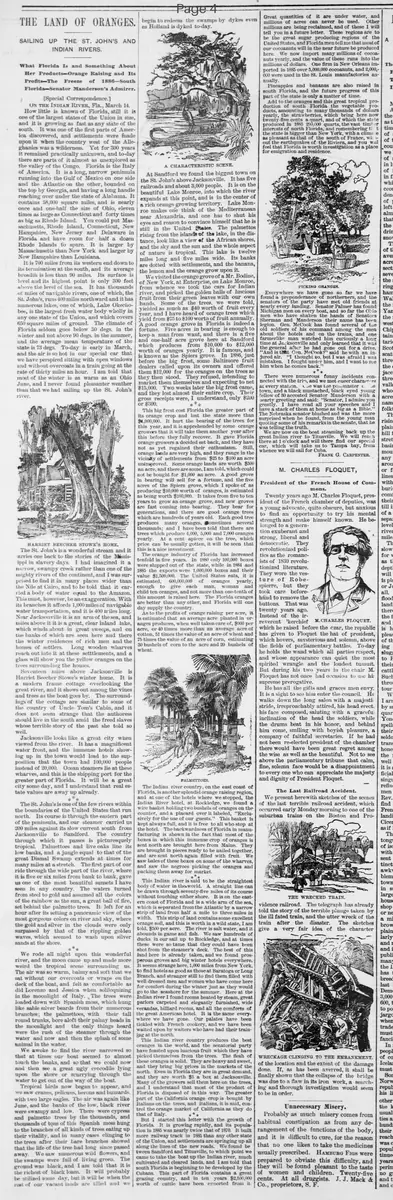
HARRIET BEECHER STOWE'S HOME.
The St. John's is a wonderful stream and it
carries one back to the stories of the Missis-
sippi in slavery days. I had imagined it a
narrow, swampy creek rather than one of the
mighty rivers of the continent, and I was sur-
prised to find it in many places wider than
the Nile at Cairo, and to be told that it car-
ried a body of water equal to the Amazon.
This must, however, be an exaggeration. With
its branches it affords 1,000 miles of navigable
water transportation, and it is 400 miles long.
Near Jacksonville it is an arm of the sea, and
miles above it it is a great, clear inland lake,
which winds about in great sweeps, and on
the banks of which are seen here and there
the winter residences of rich men and the
homes of settlers. Long wooden wharves
reach out into it at these settlements, and a
glass will show you the yellow oranges on the
trees surrounding the houses.
Seventeen miles above Jacksonville is
Harriet Beecher Stowe's winter home. It is
a modern frame cottage overlooking the
great river, and it shows out among the vines
and trees as the boat goes by. The surround-
ings of the cottage are similar to some of
the country of Uncle Tom's Cabin, and it
does not seem strange that the authoress
should live in the south amid the freed slaves
whose terrible story of the past she told so
well.
Jacksonville looks like a great city when
viewed from the river. It has a magnificent
water front, and the immense hotels show-
ing up in the town would lead to the sup-
position that the town had 100,000 people
instead of 20,000. Ocean steamers lie at these
wharves, and this is the shipping port for the
greater part of Florida. It will be a great
city some day, and I understand that real es-
tate values are away up already.
The St. John's is one of the few rivers within
the boundaries of the United States that run
north. Its course is through the eastern part
of the peninsula, and our steamer carried us
200 miles against its slow current south from
Jacksonville to Sandford. The country
through which it passes is picturesquely
tropical. Palmettoes and live oaks line its
low banks, and a jungle equal to that of the
great Dismal Swamp extends at times for
many miles at a stretch. The first part of our
ride through the wide part of the river, where
it is five or six miles from bank to bank, gave
us one of the most beautiful sunsets I have
seen in any country. The waters turned
from steel to gold and assumed all the colors
of the rainbow as the sun, a great ball of fire,
set behind the palmetto trees. It left for an
hour after its setting a panoramic view of the
most gorgeous colors on river and sky, where
the gold and silver in the clouds were only
surpassed by that of the rippling golden
waves, which seemed to wash upon silver
sands at the shore.
We rode all night upon this wonderful
river, and the moon came up and made more
weird the tropical scene surrounding us.
The air was so warm, balmy and soft that we
sat without our overcoats or wraps on the
deck of the boat, and felt as comfortable as
did Lorenzo and Jessica when soliloquizing
in the moonlight of Italy. The trees were
loaded down with Spanish moss, which hung
like sable silver beards from their numerous
branches; the palmettoes, with their tall
round trunks, bore aloft their palmy heads in
the moonlight and the only things heard
were the rush of the steamer through the
water and now and then the splash of some
animal in the water.
We awoke to find the river narrowed so
that at times our boat seemed to almost
touch the banks, and so that we could now
and then see a great ugly crocodile lying
upon the shore or scurrying through the
water to get out of the way of the boat.
Tropical birds now began to appear, and
we saw cranes, pelicans, herons and buzzards,
with two large eagles. The air was again like
June, and the banks of the low, black river
were swampy and low. There were cypress
and palmetto trees by the thousands, and
thousands of tons of this Spanish moss hung
to the branches of all kinds of trees eating up
their vitality, and in many cases clinging to
the trees after their large branches showed
that the life of the tree had long since passed
away. We saw numerous wild flowers, and
the swamps were full of living green. The
ground was black, and I am told that it is
the richest of black loam. It will probably
be utilized some day, but it will be when the
rest of our vacant lands are tilled and we
begin to redeem the swamps by dykes even
as Holland is dyked to-day.
A CHARACTERISTIC SCENE
At Sandford we found the biggest town on
the St. John's above Jacksonville. It has five
railroads and about 3,000 people. It is on the
beautiful Lake Monroe, into which the river
expands at this point, and is in the center of
a rich orange growing territory. Lake Mon-
roe makes one think of the Mediterranean
near Alexandria, and one has to shut his
eyes and reason to convince himself that he is
still in the United States. The palmettos
rising from the island of the lake, in the dis-
tance, look like a view of the African shores.
and the sky and the sun and the whole aspect
of nature is tropical. This lake is twelve
miles long and five miles wide. Its banks
are dotted with settlements, and the banana,
the lemon and the orange grow upon it.
We visited the orange grove of a Mr. Bodine,
of New York, at Enterprise, on Lake Monroe.
from whence we took the cars for Indian
river, and picked the golden balls of luscious
fruit from their green leaves with our own
hands. Some of the trees, we were told,
yielded as much as $40 worth of fruit every
year, and I have heard of orange trees which
yield from $75 to $100 worth of fruit annually.
A good orange grove in Florida is indeed a
fortune. Five acres in bearing is enough to
keep a man from want, and there is a five
and one-half acre grove here at Sandford
which produces from $10,000 to $12,000
worth of oranges yearly. It is famous, and
is known as the Spiers grove. In 1886, just
before the big frost, some Baltimore fruit
dealers called upon its owners and offered
them $12,000 for the oranges on the trees as
they then stood. They refused, intending to
market them themselves and expecting to net
$15,000. Two weeks later the big frost came,
and they lost almost their entire crop. Their
gross receipts were, I understand, only $200
or $500.
This big frost cost Florida the greater part of
its orange crop and lost the state more than
$1,000,000. It hurt the bearing of the trees for
this year, and it is apprehended by some orange
growers that it will take them another year after
this before they fully recover. It gave Florida
orange growers a decided set back, and they have
not as yet regained their enthusiasm. Still,
orange lands are very high, and they range in the
vicinity of settlements from $25 to $100 an acre
unimproved. Some orange lands are worth $500
an acre, and there are some, I am told, which could
not be bought for $1,000 an acre. A good grove
in bearing will sell for a fortune, and the five
acres of the Spiers grove, which I spoke of as
producing $10,000 worth of oranges, is estimated
as being worth $100,000. It takes from five to ten
years to grow an orange grove, and new groves
are fast coming into bearing. They bear for
generations, and there are good orange trees
which are hundreds of years old. Each good tree
produces many oranges, sometimes several
thousands; and I have been told that there are
trees which produce 4,000, 5,000 and 7,000 oranges
yearly. At a cent apiece on the tree, which
price can be usually gotten, it will be seen that
this is a nice investment.
The orange industry of Florida has increased
tenfold in five years. In 1880 only 100,000 boxes
were shipped out of the state, while in 1884 and
1885 the exports were 1,000,000 boxes and their
value $1,500,000. The United States eats, it is
estimated, 600,000,000 oranges yearly,
enough to give each man, woman and child ten oranges, and not more than one-tenth of
this amount is raised here. The Florida oranges
are better than any other, and Florida will one
day supply the country.
As to the profits of orange raising per acre, it
is estimated that an average acre planted in or-
anges produces, when well taken care of, $900 per
acre, or 40 times more than an average acre of
cotton, 51 times the value of an acre of wheat and
75 times the value of an acre of corn, estimating
30 bushels of corn to the acre and 20 bushels of
wheat.
PALMETTOES.
The Indian river country, on the east coast of
Florida, is another splendid orange raising region,
and at one of the hotels where we stopped, the
Indian River hotel, at Rockledge, we found a
wire basket holding two bushels of oranges on the
counter, and a placard over it labeled, "Exclu-
sively for the use of our guests." This basket is
kept always full, and it is free to all who stop at
the hotel. The backwardness of Florida in manu-
facturing is shown in the fact that most of the
boxes in which this immense crop of oranges is
sent north are brought here from Maine. They
are brought in pieces ready to be nailed together,
and are sent north again filled with fruit. We
saw bales of these boxes on some of the wharves,
and saw the negroes picking the oranges and
packing them away for market.
This Indian river is said to be the straightest
body of water in the world. A straight line can
be drawn through seventy-five miles of its course
without touching either shore. It is on the east-
tern coast of Florida and is a wide arm of the sea,
which is separated from the Atlantic by a narrow
strip of land from half a mile to three miles in
width. This strip of land contains some excellent
orange soil, and this is worth in a wild state, I am
told, $500 per acre. The river is salt water, and it
abounds in game and fish. We saw hundreds of
ducks in our sail up to Rockledge, and at times
these were so tame that they could have been
shot from the steamer's deck. The best of this
land here is already taken, and we found pros-
perous groves and big winter hotels everywhere.
It seems strange here, 1,000 miles from New York,
to find hotels as good as those at Saratoga or Long
Branch, and stranger still to find them filled with
well dressed men and women who have come here
for comfort during the winter just as they would
go to the seashore for the summer. Here at the
Indian river I found rooms heated by steam, great
parlors carpeted and elegantly furnished, wide
verandas, billiard rooms, and all the comforts of
the great American hotel. It is the same every-
where we have gone. Our palates have been
tickled with French cookery, and we have been
waited upon by waiters who have had their train-
ing at the north.
This Indian river country produces the best
oranges in the world, and the senatorial party
have feasted upon luscious fruit which they have
picked themselves from the trees. The flesh of
these oranges is solid. They are heavy and sweet,
and they bring big prices in the markets of the
north. Even in Florida they are in great demand.
and they are worth $5 a box at Jacksonville.
Many of the growers sell them here on the trees.
and I understand that most of the product of
Florida is disposed of in this way. The greater
part of the California orange crop is bought by
Italians on the trees, and Italians, it is said, con-
trol the orange market of California as they do
that of Italy.
But I started this letter with the growth of
Florida. It is growing rapidly, and its popula-
tion in 1885 was nearly twice that of 1870. It built
more railway track in 1885 than any other state
of the Union, and settlements are springing up all
along the lines of the new roads. We found be-
tween Sandford and Titusville, to which point we
came to take the boat up the Indian river, much
cultivated and cleared lands, and I am told that
south Florida is beginning to be developed by the
Cubans. This part of Florida contains a great
grazing country, and in ten years $2,500,000
worth of cattle have been exported from it.
Great quantities of it are under water, and
millions of acres can never be used. Other
millions are being reclaimed, and of these I will
tell you in a future letter. These regions are to
be the great sugar producing regions of the
United States, and Florida men tell me that most of
our cocoanuts will in the near future be produced
here. We now import many millions of cocoa-
nuts yearly, and the value of these runs into the
millions of dollars. One firm in New Orleans im-
ported in 1885 over 5,000,000 cocoanuts, and 2,000,
000 were used in the St. Louis manufactories an-
nually.
Pineapples and bananas are also raised in
south Florida, and the future progress of this
part of the state is only a matter of time.
Add to the oranges and this great tropical pro-
duction of south Florida the vegetable pro-
ducts, amounting to many thousands of dollars
yearly, the strawberries, which bring here now
twenty-five cents a quart, and of which the state
produced in 1885 290,000 quarts, the vast timber
interests of north Florida, and remembering that
the state is bigger than New York, with a climate
as pleasant as that of the south of France, with-
out the earthquakes of the Riviera, and you will
feel that Florida is worth investigation as a place
for emigration and residence.
PICKING ORANGES.
Everywhere we have gone so far we have
found a preponderance of northerners, and the
senators of the party have met old friends at
nearly every landing. Senator Palmer has found
Michigan men on every boat, and so far the Ohio
men who have shaken the hands of Senators
Sherman and Manderson their name has been
legion. Gen. McCook has found several of his
old soldiers of his command among the men
about the hotels and on the trains, and one
farmerlike man watched him curiously a long
time at Jacksonville and only learned that it was
the general after he had gone out for a drive.
"And is that Gen. McCook;" said he with an in-
jured air, "I thought so, but I was afraid I was
mistaken. I fought under him, and I want to see
him when he comes back."
There were numerous funny incidents con-
nected with the trip, and we met queer characters
at every station. One was the postmaster of a
town, and a black mustached, black eyed young
fellow of 30 accosted Senator Manderson with a
hearty greeting and said: "Senator, I admire you
greatly. I have read all your speeches and I
have a stack of them at home as big as a Bible."
The Nebraska senator blushed and was the more
surprised when he found, from the young man
quoting some of his remarks in the senate, that he
was telling the truth.
We are now on the boat steaming back up the
great Indian river to Titusville. We will reach
there at 1 o'clock and will there find our special
car, which will take us to Tampa bay, from
whence we will sail for Cuba.
FRANK G. CARPENTER.
What sub-type of article is it?
What themes does it cover?
What keywords are associated?
What entities or persons were involved?
Where did it happen?
Story Details
Key Persons
Location
Florida, Indian River, St. John's River, Jacksonville, Sandford
Event Date
March 14
Story Details
Journalist Frank G. Carpenter travels through Florida with a senatorial party, describing its geography, tropical climate, navigable rivers, and booming orange industry. Details the 1886 freeze's devastating impact on crops, visits orange groves, Harriet Beecher Stowe's home, and notes economic prospects in South Florida including sugar, cattle, and fruits.