Thank you for visiting SNEWPapers!
Sign up free
The New Hampshire Gazette And General Advertiser
Portsmouth, Rockingham County, New Hampshire
What is this article about?
Proceedings of the U.S. House of Representatives from June 27 to July 1, 1789, covering passage of the War Department bill, amendments to Impost and Tonnage Bills via conference with Senate, debates on Treasury Department bill including restrictions on officers' commerce involvement, and eventual concurrence on tonnage discrimination clause after debate.
Clipping
OCR Quality
Full Text
(Continued.)
In the House of Representatives of the United States
SATURDAY, June 27, 1789.
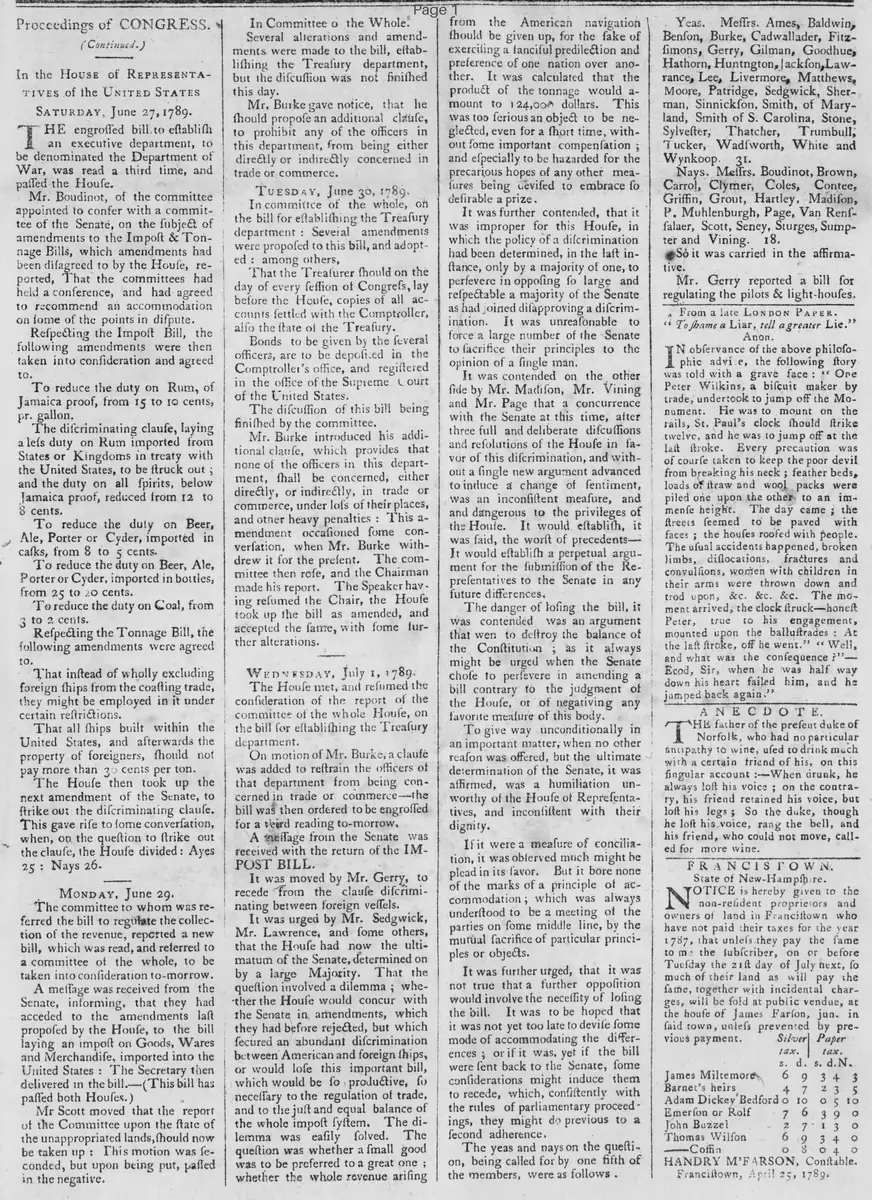
The engrossed bill, to establish an executive department, to be denominated the Department of War, was read a third time, and passed the House.
Mr. Boudinot, of the committee appointed to confer with a committee of the Senate, on the subject of amendments to the Impost & Tonnage Bills, which amendments had been disagreed to by the House, reported, That the committees had held a conference, and had agreed to recommend an accommodation on some of the points in dispute.
Respecting the Impost Bill, the following amendments were then taken into consideration and agreed to.
To reduce the duty on Rum, of Jamaica proof, from 15 to 10 cents, pr. gallon.
The discriminating clause, laying a less duty on Rum imported from States or Kingdoms in treaty with the United States, to be struck out: and the duty on all spirits, below Jamaica proof, reduced from 12 to 8 cents.
To reduce the duty on Beer, Ale, Porter or Cyder, imported in casks, from 8 to 5 cents.
To reduce the duty on Beer, Ale, Porter or Cyder, imported in bottles, from 25 to 20 cents.
To reduce the duty on Coal, from 3 to 2 cents.
Respecting the Tonnage Bill, the following amendments were agreed to.
That instead of wholly excluding foreign ships from the coasting trade, they might be employed in it under certain restrictions.
That all ships built within the United States, and afterwards the property of foreigners, should not pay more than 30 cents per ton.
The House then took up the next amendment of the Senate, to strike out the discriminating clause.
This gave rise to some conversation, when, on the question to strike out the clause, the House divided: Ayes 25: Nays 26.
MONDAY, June 29.
The committee to whom was referred the bill to regulate the collection of the revenue, reported a new bill, which was read, and referred to a committee of the whole, to be taken into consideration to-morrow.
A message was received from the Senate, informing, that they had acceded to the amendments last proposed by the House, to the bill laying an impost on Goods, Wares and Merchandize, imported into the United States: The Secretary then delivered in the bill. (This bill has passed both Houses.)
Mr. Scott moved that the report of the Committee upon the state of the unappropriated lands, should now be taken up: This motion was seconded, but upon being put, passed in the negative.
In Committee of the Whole:
Several alterations and amendments were made to the bill establishing the Treasury department, but the discussion was not finished this day.
Mr. Burke gave notice, that he should propose an additional clause, to prohibit any of the officers in this department, from being either directly or indirectly concerned in trade or commerce.
Tuesday, June 30, 1789.
In committee of the whole, on the bill for establishing the Treasury department: Several amendments were proposed to this bill, and adopted: among others.
That the Treasurer should on the day of every session of Congress, lay before the House, copies of all accounts settled with the Comptroller, also the state of the Treasury.
Bonds to be given by the several officers, are to be deposited in the Comptroller's office, and registered in the office of the Supreme Court of the United States.
The discussion of this bill being finished by the committee.
Mr. Burke introduced his additional clause, which provides that none of the officers in this department, shall be concerned; either directly or indirectly, in trade or commerce, under loss of their places, and other heavy penalties: This amendment occasioned some conversation, when Mr. Burke withdrew it for the present. The committee then rose, and the Chairman made his report. The Speaker having resumed the Chair, the House took up the bill as amended, and accepted the same, with some further alterations.
Wednesday, July 1, 1789.
The House met, and resumed the consideration of the report of the committee of the whole House, on the bill for establishing the Treasury department.
On motion of Mr. Burke, a clause was added to restrain the officers of that department from being concerned in trade or commerce--the bill was then ordered to be engrossed for a third reading to-morrow.
A message from the Senate was received with the return of the IMPOST BILL.
It was moved by Mr. Gerry, to recede from the clause discriminating between foreign vessels.
It was urged by Mr. Sedgwick, Mr. Lawrence, and some others, that the House had now the ultimatum of the Senate, determined on by a large Majority. That the question involved a dilemma; whether the House would concur with the Senate in amendments, which they had before rejected, but which secured an abundant discrimination between American and foreign ships, or would lose this important bill, which would be so productive, so necessary to the regulation of trade, and to the just and equal balance of the whole impost system. The dilemma was easily solved. The question was whether a small good was to be preferred to a great one; whether the whole revenue arising from the American navigation should be given up, for the sake of exercising a fanciful predilection and preference of one nation over another. It was calculated that the product of the tonnage would amount to 124,000 dollars. This was too serious an object to be neglected, even for a short time, without some important compensation; and especially to be hazarded for the precarious hopes of any other measures being devised to embrace so desirable a prize.
It was further contended, that it was improper for this House, in which the policy of a discrimination had been determined, in the last instance, only by a majority of one, to persevere in opposing so large and respectable a majority of the Senate as had joined disapproving a discrimination. It was unreasonable to force a large number of the Senate to sacrifice their principles to the opinion of a single man.
It was contended on the other side by Mr. Madison, Mr. Vining and Mr. Page that a concurrence with the Senate at this time, after three full and deliberate discussions and resolutions of the House in favor of this discrimination, and without a single new argument advanced to induce a change of sentiment, was an inconsistent measure, and dangerous to the privileges of the House. It would establish, it was said, the worst of precedents--It would establish a perpetual argument for the submission of the Representatives to the Senate in any future differences.
The danger of losing the bill, it was contended was an argument that went to destroy the balance of the Constitution; as it always might be urged when the Senate chose to persevere in amending a bill contrary to the judgment of the House, or of negativing any favorite measure of this body.
To give way unconditionally in an important matter; when no other reason was offered, but the ultimate determination of the Senate, it was affirmed, was a humiliation unworthy of the House of Representatives, and inconsistent with their dignity.
If it were a measure of conciliation, it was observed much might be plead in its favor. But it bore none of the marks of a principle of accommodation; which was always understood to be a meeting of the parties on some middle line, by the mutual sacrifice of particular principles or objects.
It was further urged, that it was not true that a further opposition would involve the necessity of losing the bill. It was to be hoped that it was not yet too late to devise some mode of accommodating the differences; or if it was, yet if the bill were sent back to the Senate, some considerations might induce them to recede, which, consistently with the rules of parliamentary proceedings, they might do previous to a second adherence.
The yeas and nays on the question, being called for by one fifth of the members, were as follows.
Yeas. Messrs. Ames, Baldwin, Benson, Burke, Cadwallader, Fitzsimons, Gerry, Gilman, Goodhue, Hathorn, Huntington, Jackson, Lawrence, Lee, Livermore, Matthews, Moore, Partridge, Sedgwick, Sherman, Sinnickson, Smith, of Maryland, Smith of S. Carolina, Stone, Sylvester, Thatcher, Trumbull, Tucker, Wadsworth, White and Wynkoop. 31.
Nays. Messrs. Boudinot, Brown, Carrol, Clymer, Coles, Contee, Griffin, Grout, Hartley, Madison, P. Muhlenburgh, Page, Van Rensselaer, Scott, Seney, Sturges, Sumter and Vining. 18.
So it was carried in the affirmative.
Mr. Gerry reported a bill for regulating the pilots & light-houses.
What sub-type of article is it?
What keywords are associated?
What entities or persons were involved?
Where did it happen?
Story Details
Key Persons
Location
House Of Representatives Of The United States
Event Date
June 27 To July 1, 1789
Story Details
The House passed the War Department bill, agreed to amendments on Impost and Tonnage Bills after Senate conference, debated and amended the Treasury Department bill including commerce restrictions for officers, and voted to recede from tonnage discrimination clause after debate on constitutional balance and revenue importance.