Thank you for visiting SNEWPapers!
Sign up free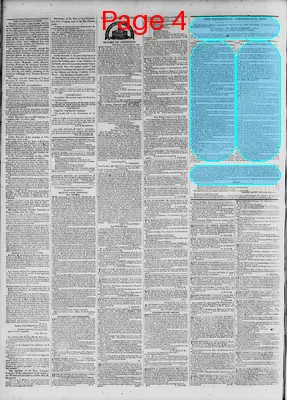
Editorial
February 15, 1840
The Madisonian
Washington, District Of Columbia
What is this article about?
The Madisonian prospectus from 1840 endorses Whig nominations of William Henry Harrison for president and John Tyler for vice president, listing 18 reasons opposing Martin Van Buren's re-election for promoting centralism, corruption, and executive overreach, contrasted with 18 reasons supporting Harrison as a principled Republican committed to constitutional limits and public service.
Clipping
OCR Quality
95%
Excellent
Full Text
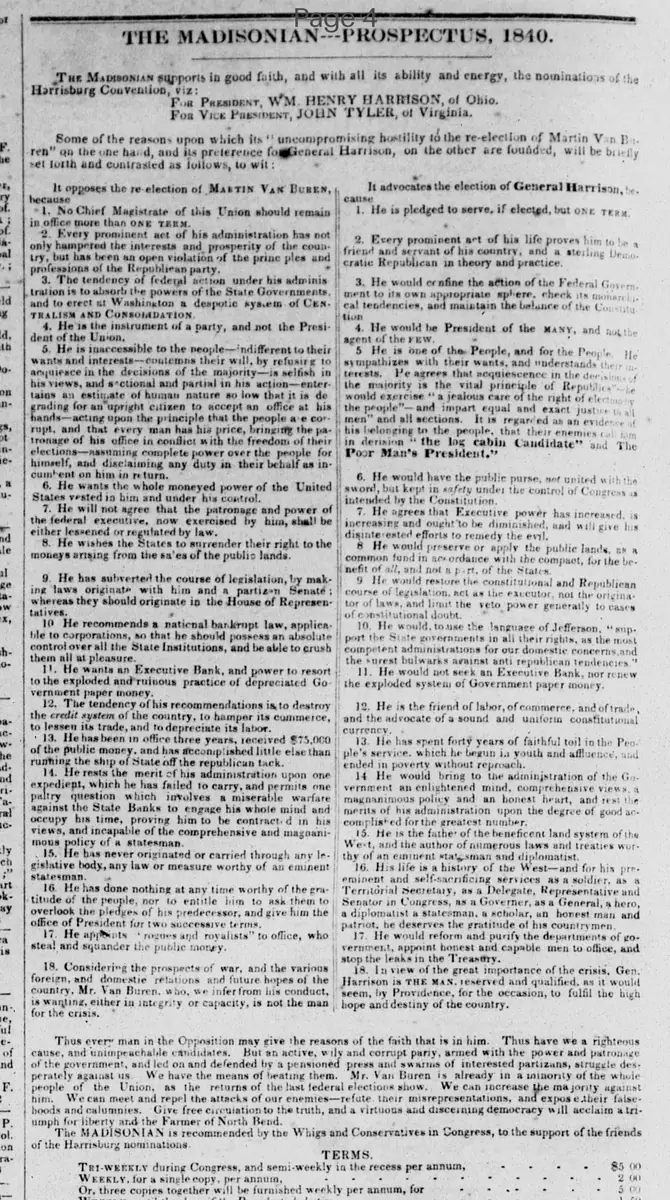
THE MADISONIAN---PROSPECTUS, 1840.
The Madisonian supports in good faith, and with all its ability and energy, the nominations of the Harrisburg Convention, viz:
FOR PRESIDENT. WM. HENRY HARRISON, of Ohio.
For Vice President, John Tyler, of Virginia.
Some of the reasons upon which its "uncompromising hostility to the re-election of Martin Van Buren" on the one hand, and its preference for General Harrison, on the other are founded, will be briefly set forth and contrasted as follows, to wit:
It opposes the re-election of Martin Van Buren, because
1. No Chief Magistrate of this Union should remain in office more than ONE TERM.
2. Every prominent act of his administration has not only hampered the interests and prosperity of the country, but has been an open violation of the principles and professions of the Republican party.
3. The tendency of federal action under his administration is to absorb the powers of the State Governments, and to erect at Washington a despotic system of CENTRALISM AND CONSOLIDATION
4. He is the instrument of a party, and not the President of the Union.
5. He is inaccessible to the people - indifferent to their wants and interests - contemns their will, by refusing to acquiesce in the decisions of the majority - is selfish in his views, and sectional and partial in his action - entertains an estimate of human nature so low that it is degrading for an upright citizen to accept an office at his hands - acting upon the principle that the people are corrupt, and that every man has his price, bringing the patronage of his office in conflict with the freedom of their elections - assuming complete power over the people for himself, and disclaiming any duty in their behalf as incumbent on him in return.
6. He wants the whole moneyed power of the United States vested in him and under his control.
7. He will not agree that the patronage and power of the federal executive, now exercised by him, shall be either lessened or regulated by law.
8. He wishes the States to surrender their right to the moneys arising from the sales of the public lands.
9. He has subverted the course of legislation, by making laws originate with him and a partisan Senate; whereas they should originate in the House of Representatives.
10. He recommends a national bankrupt law, applicable to corporations, so that he should possess an absolute control over all the State Institutions, and be able to crush them all at pleasure.
11. He wants an Executive Bank, and power to resort to the exploded and ruinous practice of depreciated Government paper money.
12. The tendency of his recommendations is to destroy the credit system of the country, to hamper its commerce, to lessen its trade, and to depreciate its labor.
13. He has been in office three years, received $75,000 of the public money, and has accomplished little else than running the ship of State off the republican tack.
14. He rests the merit of his administration upon one expedient, which he has failed to carry, and permits one paltry question which involves a miserable warfare against the State Banks to engage his whole mind and occupy his time, proving him to be contracted in his views, and incapable of the comprehensive and magnanimous policy of a statesman.
15. He has never originated or carried through any legislative body, any law or measure worthy of an eminent statesman.
16. He has done nothing at any time worthy of the gratitude of the people, nor to entitle him to ask them to overlook the pledges of his predecessor, and give him the office of President for two successive terms.
17. He appoints rogues and royalists to office, who steal and squander the public money.
18. Considering the prospects of war, and the various foreign, and domestic "relations and future interests of the country, Mr. Van Buren, who, we infer from his conduct, is wanting, either in integrity or capacity, is not the man
It advocates the election of General Harrison, because
1. He is pledged to serve, if elected, but one TERM
2. Every prominent act of his life proves him to be a friend and servant of his country, and a sterling Democratic Republican in theory and practice.
3. He would confine the action of the Federal Government to its own appropriate sphere, check its monarchical tendencies, and maintain the balance of the Constitution
4. He would be President of the Many, and not the agent of the Few.
5. He is one of the People, and for the People He sympathizes with their wants, and understands their interests. He agrees that acquiescence in the decision of the majority is the vital principle of Republics. He would exercise "a jealous care of the right of election the people" - and impart equal and exact justice to all men" and all sections. It is regarded as an evidence of his belonging to the people, that their enemies call him in derision "the Log cabin Candidate" and The "Poor Man's President."
6. He would have the public purse, not united with the sword, but kept in safety under the control of Congress as intended by the Constitution.
7. He agrees that Executive power has increased, is increasing and ought to be diminished, and will give his disinterested efforts to remedy the evil.
8. He would preserve or apply the public lands, as a common fund in accordance with the compact, for the benefit of all, and not a part, of the States.
9. He would restore the constitutional and Republican course of legislation, not as the executor, not the originator of laws, and limit the veto power generally to cases of constitutional doubt.
10. He would, to use the language of Jefferson, "support the State governments in all their rights, as the most competent administrations for our domestic concerns, and the surest bulwarks against anti republican tendencies"
11. He would not seek an Executive Bank, nor renew the exploded system of Government paper money.
12. He is the friend of labor, of commerce, and of trade, and the advocate of a sound and uniform constitutional currency.
13. He has spent forty years of faithful toil in the People's service, which he begun in youth and affluence, and ended in poverty without reproach.
14. He would bring to the administration of the Government an enlightened mind, comprehensive views, a magnanimous policy and an honest heart, and rest the merits of his administration upon the degree of good accomplished for the greatest number.
15. He is the father of the beneficent land system of the West, and the author of numerous laws and treaties worthy of an eminent statesman and diplomatist.
16. His life is a history of the West - and for his pre-eminent and self-sacrificing services as a soldier, as a Territorial Secretary, as a Delegate, Representative and Senator in Congress, as a Governor, as a General, a hero, a diplomatist a statesman, a scholar, an honest man and patriot, he deserves the gratitude of his countrymen.
17. He would reform and purify the departments of government, appoint honest and capable men to office, and stop the leaks in the Treasury.
18. In view of the great importance of the crisis, Gen. Harrison is THE MAN, reserved and qualified, as it would seem, by Providence, for the occasion, to fulfil the high hope and destiny of the country.
Thus every man in the Opposition may give the reasons of the faith that is in him. Thus have we a righteous cause, and unimpeachable candidates. But an active, wily and corrupt party, armed with the power and patronage of the government, and led on and defended by a pensioned press and swarms of interested partisans, struggle desperately against us We have the means of beating them. Mr. Van Buren is already in a minority of the whole people of the Union, as the returns of the last federal elections show. We can increase the majority against him. We can meet and repel the attacks of our enemies - refute their misrepresentations, and expose their falsehoods and calumnies. Give free circulation to the truth, and a virtuous and discerning democracy will acclaim a triumph for liberty and the Farmer of North Bend.
The MADISONIAN is recommended by the Whigs and Conservatives in Congress, to the support of the friends of the Harrisburg nominations
TERMS.
Tri-weekly during Congress, and semi-weekly in the recess per annum,
$5.00
The Madisonian supports in good faith, and with all its ability and energy, the nominations of the Harrisburg Convention, viz:
FOR PRESIDENT. WM. HENRY HARRISON, of Ohio.
For Vice President, John Tyler, of Virginia.
Some of the reasons upon which its "uncompromising hostility to the re-election of Martin Van Buren" on the one hand, and its preference for General Harrison, on the other are founded, will be briefly set forth and contrasted as follows, to wit:
It opposes the re-election of Martin Van Buren, because
1. No Chief Magistrate of this Union should remain in office more than ONE TERM.
2. Every prominent act of his administration has not only hampered the interests and prosperity of the country, but has been an open violation of the principles and professions of the Republican party.
3. The tendency of federal action under his administration is to absorb the powers of the State Governments, and to erect at Washington a despotic system of CENTRALISM AND CONSOLIDATION
4. He is the instrument of a party, and not the President of the Union.
5. He is inaccessible to the people - indifferent to their wants and interests - contemns their will, by refusing to acquiesce in the decisions of the majority - is selfish in his views, and sectional and partial in his action - entertains an estimate of human nature so low that it is degrading for an upright citizen to accept an office at his hands - acting upon the principle that the people are corrupt, and that every man has his price, bringing the patronage of his office in conflict with the freedom of their elections - assuming complete power over the people for himself, and disclaiming any duty in their behalf as incumbent on him in return.
6. He wants the whole moneyed power of the United States vested in him and under his control.
7. He will not agree that the patronage and power of the federal executive, now exercised by him, shall be either lessened or regulated by law.
8. He wishes the States to surrender their right to the moneys arising from the sales of the public lands.
9. He has subverted the course of legislation, by making laws originate with him and a partisan Senate; whereas they should originate in the House of Representatives.
10. He recommends a national bankrupt law, applicable to corporations, so that he should possess an absolute control over all the State Institutions, and be able to crush them all at pleasure.
11. He wants an Executive Bank, and power to resort to the exploded and ruinous practice of depreciated Government paper money.
12. The tendency of his recommendations is to destroy the credit system of the country, to hamper its commerce, to lessen its trade, and to depreciate its labor.
13. He has been in office three years, received $75,000 of the public money, and has accomplished little else than running the ship of State off the republican tack.
14. He rests the merit of his administration upon one expedient, which he has failed to carry, and permits one paltry question which involves a miserable warfare against the State Banks to engage his whole mind and occupy his time, proving him to be contracted in his views, and incapable of the comprehensive and magnanimous policy of a statesman.
15. He has never originated or carried through any legislative body, any law or measure worthy of an eminent statesman.
16. He has done nothing at any time worthy of the gratitude of the people, nor to entitle him to ask them to overlook the pledges of his predecessor, and give him the office of President for two successive terms.
17. He appoints rogues and royalists to office, who steal and squander the public money.
18. Considering the prospects of war, and the various foreign, and domestic "relations and future interests of the country, Mr. Van Buren, who, we infer from his conduct, is wanting, either in integrity or capacity, is not the man
It advocates the election of General Harrison, because
1. He is pledged to serve, if elected, but one TERM
2. Every prominent act of his life proves him to be a friend and servant of his country, and a sterling Democratic Republican in theory and practice.
3. He would confine the action of the Federal Government to its own appropriate sphere, check its monarchical tendencies, and maintain the balance of the Constitution
4. He would be President of the Many, and not the agent of the Few.
5. He is one of the People, and for the People He sympathizes with their wants, and understands their interests. He agrees that acquiescence in the decision of the majority is the vital principle of Republics. He would exercise "a jealous care of the right of election the people" - and impart equal and exact justice to all men" and all sections. It is regarded as an evidence of his belonging to the people, that their enemies call him in derision "the Log cabin Candidate" and The "Poor Man's President."
6. He would have the public purse, not united with the sword, but kept in safety under the control of Congress as intended by the Constitution.
7. He agrees that Executive power has increased, is increasing and ought to be diminished, and will give his disinterested efforts to remedy the evil.
8. He would preserve or apply the public lands, as a common fund in accordance with the compact, for the benefit of all, and not a part, of the States.
9. He would restore the constitutional and Republican course of legislation, not as the executor, not the originator of laws, and limit the veto power generally to cases of constitutional doubt.
10. He would, to use the language of Jefferson, "support the State governments in all their rights, as the most competent administrations for our domestic concerns, and the surest bulwarks against anti republican tendencies"
11. He would not seek an Executive Bank, nor renew the exploded system of Government paper money.
12. He is the friend of labor, of commerce, and of trade, and the advocate of a sound and uniform constitutional currency.
13. He has spent forty years of faithful toil in the People's service, which he begun in youth and affluence, and ended in poverty without reproach.
14. He would bring to the administration of the Government an enlightened mind, comprehensive views, a magnanimous policy and an honest heart, and rest the merits of his administration upon the degree of good accomplished for the greatest number.
15. He is the father of the beneficent land system of the West, and the author of numerous laws and treaties worthy of an eminent statesman and diplomatist.
16. His life is a history of the West - and for his pre-eminent and self-sacrificing services as a soldier, as a Territorial Secretary, as a Delegate, Representative and Senator in Congress, as a Governor, as a General, a hero, a diplomatist a statesman, a scholar, an honest man and patriot, he deserves the gratitude of his countrymen.
17. He would reform and purify the departments of government, appoint honest and capable men to office, and stop the leaks in the Treasury.
18. In view of the great importance of the crisis, Gen. Harrison is THE MAN, reserved and qualified, as it would seem, by Providence, for the occasion, to fulfil the high hope and destiny of the country.
Thus every man in the Opposition may give the reasons of the faith that is in him. Thus have we a righteous cause, and unimpeachable candidates. But an active, wily and corrupt party, armed with the power and patronage of the government, and led on and defended by a pensioned press and swarms of interested partisans, struggle desperately against us We have the means of beating them. Mr. Van Buren is already in a minority of the whole people of the Union, as the returns of the last federal elections show. We can increase the majority against him. We can meet and repel the attacks of our enemies - refute their misrepresentations, and expose their falsehoods and calumnies. Give free circulation to the truth, and a virtuous and discerning democracy will acclaim a triumph for liberty and the Farmer of North Bend.
The MADISONIAN is recommended by the Whigs and Conservatives in Congress, to the support of the friends of the Harrisburg nominations
TERMS.
Tri-weekly during Congress, and semi-weekly in the recess per annum,
$5.00
What sub-type of article is it?
Partisan Politics
Constitutional
Economic Policy
What keywords are associated?
Harrison Nomination
Van Buren Opposition
Whig Prospectus
1840 Election
Presidential Campaign
Republican Principles
Federal Centralism
Executive Power
What entities or persons were involved?
William Henry Harrison
John Tyler
Martin Van Buren
Harrisburg Convention
Whigs
Conservatives
Editorial Details
Primary Topic
Support For William Henry Harrison And Opposition To Martin Van Buren In 1840 Presidential Election
Stance / Tone
Strongly Pro Harrison And Anti Van Buren
Key Figures
William Henry Harrison
John Tyler
Martin Van Buren
Harrisburg Convention
Whigs
Conservatives
Key Arguments
Opposes Van Buren For Seeking More Than One Term
Criticizes Van Buren For Violating Republican Principles And Promoting Centralism
Accuses Van Buren Of Being Inaccessible And Sectional
Supports Harrison For Pledging One Term Only
Praises Harrison As A True Republican Who Would Maintain Constitutional Balance
Highlights Harrison's Sympathy For The People And Commitment To Majority Rule
Advocates Harrison For Reforming Executive Power And Preserving State Rights