Thank you for visiting SNEWPapers!
Sign up free
Morning Star
Limerick, York County, Maine
What is this article about?
Journal entry by E. Mack from Dover, May 23, 1837, recounting departure for foreign mission amid observations of local drunkenness, and arguing that foreign heathen suffer greater spiritual and physical miseries from idolatry than New England's intemperate, justifying missionary efforts abroad while not neglecting home reforms.
Merged-components note: Continuation of the foreign mission agent's journal across pages, combining editorial reflection with mission report; resulting label editorial as dominant content.
Clippings
1 of 2
OCR Quality
Full Text
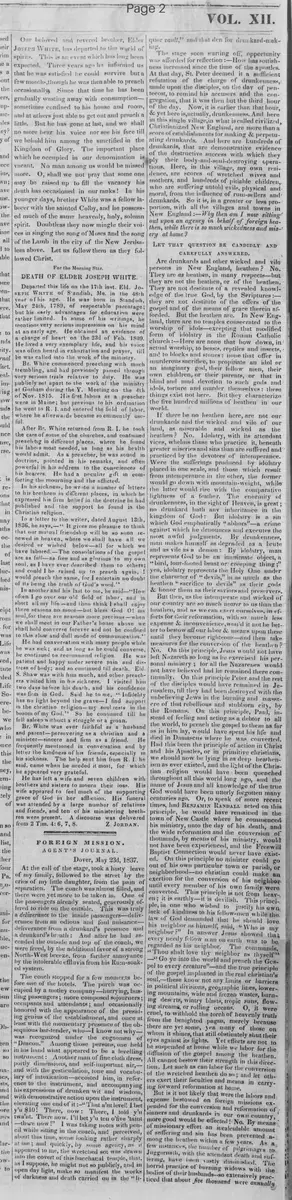
AGENT'S JOURNAL.
Dover, May 23d, 1837.
At the call of the stage, took a hasty leave of my family, followed to the street by the cries of my little daughter, from the pain of separation. The coach was almost filled, and there were yet more to be taken in. One of the passengers already seated, generously offered to ride on the outside. This was truly a deliverance to the inside passengers—deliverance from an odious and foul nuisance—deliverance from a drunkard's presence and a drunkard's breath: And after he had ascended the outside and top of the coach, we were freed, by the additional favor of a strong North-West breeze, from farther annoyance by the intolerable effluvia from his Rum-soaked system.
The coach stopped for a few moments before one of the hotels. The porch was occupied by a motley company—hurrying, bustling passengers; more composed sojourners; occupants and attendants; and occasionally honored with the appearance of the presiding genius of the establishment, and once at least with the momentary presence of the obsequious bar-tender, who—I know not why—was recognized under the cognomen of "Deacon." Among those persons, one held in his hand what appeared to be a levelling instrument: Another man of fine cloth dress, portly dimensions, and self-important air,—and with the gesticulation, tone and vocabulary of intoxication—accosted him, in reference to the instrument, and accompanying his expressions of drunken wit and wisdom, with demonstrative action upon the instrument, elevating one end of it: "That a'nt level! I bet y'u l0! There, now: There, I told y'u twa'nt. There now. I'll bet y'u ten o'five 'taint —there now!" I was taking notes with pencil while sitting in the coach, and perceived, about this time, some looking rather sharply at me; and quickly, by some agency, as it appeared to me, the wretched sot was drawn into the covert of this baccharal temple, that, as I suppose, he might not so publicly, and in open day light, make so manifest the works of darkness and death carried on in the "liquor vault," and that den for drunkard-making.
The stage soon starting off, opportunity was afforded for reflection:—How has sottishness increased since the time of the apostles. At that day, St. Peter deemed it a sufficient refutation of the charge of drunkenness, made upon the disciples, on the day of pentecost, to remind his accusers and the congregation, that it was then but the third hour of the day. Now, it is earlier than that hour, & yet here is, actually, drunkenness. And here in this single village, in what is called civilized, Christianized New England, are more than a score of establishments for making & perpetuating drunkards. And here are hundreds of drunkards, that are demonstrative evidence of the destructive success with which they ply their body-and-soul-destroying operations. Here, in this village, my own residence, are scores of wretched wives and mothers, and hundreds of pitiable children, who are suffering untold evils, physical and moral, from the influence of rum-sellers and drunkards. So it is, in a greater or less proportion, with all the villages and towns in New England:—Why then am I now setting out upon an agency in behalf of foreign heathen, while there is so much wickedness and misery at home?
LET THAT QUESTION BE CANDIDLY AND CAREFULLY ANSWERED.
Are drunkards and other wicked and vile persons in New England, heathen? No. They are as heathen, in many respects—but they are not the heathen, or of the heathen. They are not destitute of a revealed knowledge of the true God, by the Scriptures:—they are not destitute of the offers of the gospel and of the means of grace therein afforded. But the heathen are. In New England, there are no temples consecrated to the worship of idols—excepting that modified form of idolatry in the Roman Catholic church:—Here are none that bow down, in actual worship, to beasts, reptiles and insects, and to blocks and stones: none that offer in murderous sacrifice, to propitiate an idol or an imaginary god, their fellow men, their own children, or their parents, or that in blind and mad devotion to such gods and idols, torture and murder themselves: these things exist not here. But they characterize the five hundred millions of heathen in our world.
If there be no heathen here, are not our drunkards and the wicked and vile of our land, as miserable and wicked as the heathen? No. Idolatry, with its attendant vices, whelms those who practice it, beneath greater miseries and sins than are suffered and practiced by the devotees of intemperance. Were the sufferings produced by idolatry placed in one scale, and those which result from intemperance in the other, the former would go down with mountain-weight, while the latter would rise with the comparative lightness of a feather. The enormity of drunkenness, in the sight of Heaven, is great; no drunkard hath any inheritance in the kingdom of God: But idolatry is a sin which God emphatically "abhors"—a crime against which he denounces and executes the most awful judgments. By drunkenness, man makes himself as degraded as a brute and as vile as a demon: By idolatry, man represents God to be an inanimate object, a "bird, four-footed beast or creeping thing;" yea, idolatry represents the Holy One under the character of "devils," in as much as the heathen "sacrifice to devils" as their gods & honor them as their saviors and preservers.
But then, as the intemperate and wicked of our country are so much nearer to us than the heathen, and as we can exert ourselves, in efforts for their reformation, with so much less expense & inconvenience, wouldn't it not be better to bestow all our labor & means upon these until they become righteous—and then take measures for the conversion of the heathen? No. On this principle, Jesus would not have left Nazareth so long as he exercised his personal ministry; for all the Nazarenes would not have believed had he remained there continually. On this principle Peter and the rest of the disciples would have remained in Jerusalem, till they had been destroyed with the unbelieving Jews in the burning and massacre of that rebellious and stubborn city, by the Romans. On this principle, Paul, instead of feeling and acting as a debtor to all the world, to preach the gospel to them as far as in him lay, would have spent his life and died in Damascus where he was converted. Had this been the principle of action in Christ and his Apostles, or in primitive christians, we should now be lying in as deep heathenism as ever existed, and the light of the Christian religion would have been quenched throughout all this world long ago, and the name of Jesus and all knowledge of the true God would have been utterly forgotten many centuries ago. Or, to speak of more recent times, had Benjamin Randall acted on this principle, he would have remained in the town of New Castle where he commenced his ministry, unto the day of his death, and the wide reformation and the conversion of thousands, by means of his ministry, would not have been experienced, and the Freewill Baptist Connection would never have existed. On this principle no minister could go out of his own particular town or parish, or neighborhood—no christian could make an exertion for the conversion of his neighbor until every member of his own family were converted. This principle is not from heaven; it is earthly—it is devilish. This principle, in one who wished to justify his own lack of kindness to his fellow-men while the law of God demanded that he should love his neighbor as himself, said, "Who is my neighbor?" In answer Jesus showed that every needy fellow man on earth was to be regarded as his neighbor. The commands, "Thou shalt love thy neighbor as thyself" —"Go ye into the world and preach the Gospel to every creature"—and the true principle of the gospel implanted in the real christian's soul,—these know not any limits or barriers in political divisions, geographic lines, lowering mountains, wide and frozen wastes, burning deserts, wintry blasts, tropic suns, flowing streams, or rolling oceans. O, it were cruel, to withhold the torch of heavenly truth from the benighted pagan, merely because there are yet some, yea many of those on whom it shines, that still obstinately shut their eyes against its light. Yet efforts are not to be suspended at home while we labor for the diffusion of the gospel among the heathen. All cannot bestow their strength in this direction. Let such as can labor for the conversion of the wretched heathen do so; and let others exert their faculties and means in carrying forward reformation at home.
But is it not likely that were the labors and expense bestowed on foreign missions expended for the conversion and reformation of sinners and drunkards in our own country, more good would be effected! No. By means of missionary effort an incalculable amount of suffering and sin has been prevented among the heathen within a few years. As a few instances, the number of pilgrimages to Juggernath, with the attendant death and suffering, have been vastly diminished. The horrid practice of burning widows with the bodies of their husbands—so extensively practiced that about five thousand were annually
VOL. XII.
burned in Hindostan—has now become abolished. Several populous islands in the Pacific have become entirely converted from idolatry and saved from the attendant blood-shed, degradation and viciousness. They were drunkards: But now, by the influence of the Gospel, they have become temperate, and gone beyond even New England in the Temperance Reformation: while our authorities license unprincipled men to poison and vitiate and madden their neighbors by selling intoxicating drinks, the rulers on some of these Islands so lately given up to every excess, now, by the influence of the Gospel, have been brought to enact laws prohibiting this traffic among them. When some foreigners applied to the king of one of these Islands for permission to sell ardent spirits, he replied :-- "You may give ardent spirits to horses and to hogs, but to men you shall not give them." Thus it appears that even in respect to temperance alone, moral effort is most profitably expended, in some portion, among the heathen. And in view of the awful nature of Idolatry in itself considered-in view of the countless and dreadful sins produced by it- in view of the incalculable amount of temporal misery and death resulting from it- in view of the immutable truth that "no idolater can inherit the kingdom of God"-and in view of the power of the gospel to overthrow Idolatry—let me go and labor in this heavenly cause—roll swift ye wheels that move me forward to the labors of this field-and attend each effort in this cause. O God of all Grace, with holy motive and with glorious success.
E. Mack.
What sub-type of article is it?
What keywords are associated?
What entities or persons were involved?
Editorial Details
Primary Topic
Defense Of Foreign Missions Over Exclusive Focus On Domestic Intemperance
Stance / Tone
Strong Advocacy For Foreign Missionary Work
Key Figures
Key Arguments