Thank you for visiting SNEWPapers!
Sign up free
Atlanta Daily World
Atlanta, Fulton County, Georgia
What is this article about?
Carter Wesley reports on a Conference of Deans of Southern Graduate Schools discussing disparities in graduate education for Negroes in the South. Dr. W.D. Funkhouser highlights inadequate funding, lack of advanced degrees, and the impact of the Gaines decision, urging equal opportunities through conferences rather than lawsuits.
Clipping
OCR Quality
Full Text
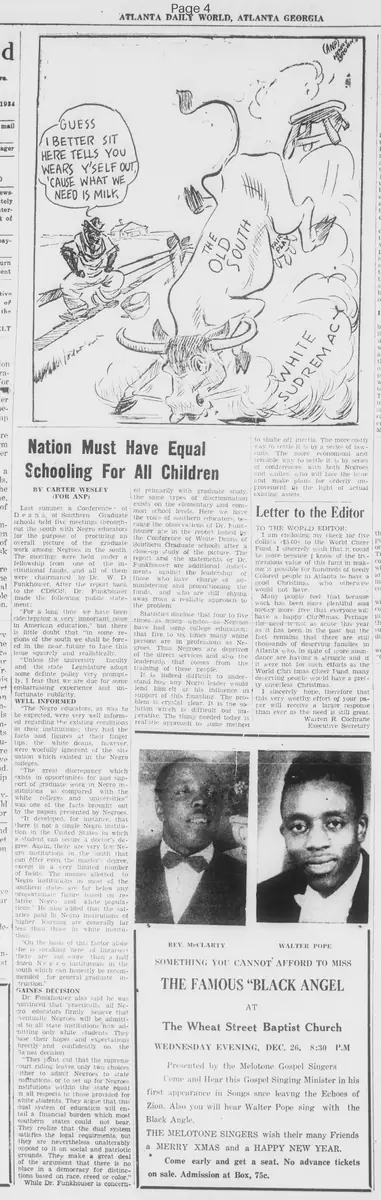
Nation Must Have Equal Schooling For All Children
BY CARTER WESLEY
(FOR ANP)
Last summer a Conference of Deans of Southern Graduate schools held five meetings throughout the south with Negro educators for the purpose of procuring an overall picture of the graduate work among Negroes in the south. The meetings were held under a fellowship from one of the institutional funds, and all of them were chairmaned by Dr. W. D. Funkhouser. After the report back to the CDSGS, Dr. Funkhouser made the following public statement:
"For a long time we have been sidestepping a very important issue in American education," but there is little doubt that "in some regions of the south we shall be forced in the near future to face this issue squarely and realistically.
"Unless the university faculty and the state legislature adopt some definite policy very promptly, I fear that we are due for some embarrassing experience and unfortunate publicity.
WELL INFORMED
"The Negro educators, as was to be expected, were very well informed regarding the existing conditions in their institutions; they had the facts and figures at their finger tips; the white deans, however, were woefully ignorant of the situation which existed in the Negro colleges.
"The great discrepancy which exists in opportunities for and support of graduate work in Negro institutions as compared with the white colleges and universities" was one of the facts brought out by the papers presented by Negroes.
"It developed, for instance, that there is not a single Negro institution in the United States in which a student can secure a doctor's degree. Again, there are very few Negro institutions in the south that can offer even the master's degree, except in a very limited number of fields. The monies allotted to Negro institutions in most of the southern states are far below any proportionate figure based on relative Negro and white populations." He also added that the salaries paid in Negro institutions of higher learning are generally far less than those in white institutions.
"On the basis of this factor alone he is speaking here of libraries) there are not more than a half dozen Negro institutions in the south which can honestly be recommended for general graduate instruction."
GAINES DECISION
Dr. Funkhouser also said he was convinced that 'practically all Negro educators firmly believe that eventually Negroes will be admitted to all state institutions now admitting only white students. They base their hopes and expectations directly and confidently on the Gaines decision.
"They point out that the supreme court ruling leaves only two choices either to admit Negroes to state institutions, or to set up for Negroes institutions within the state equal in all respects to those provided for white students. They argue that this dual system of education will entail a financial burden which most southern states could not bear.
They realize that the dual system satisfies the legal requirements, but they are nevertheless unalterably opposed to it on social and patriotic grounds. They make a great deal of the argument that there is no place in a democracy for distinctions based on race, creed or color."
While Dr. Funkhouser is concerned primarily with graduate study, the same types of discrimination exists on the elementary and common school levels. Here we have the voice of southern educators, because the observations of Dr. Funkhouser are in the report issued by the Conference of White Deans of Southern Graduate schools after a close-up study of the picture. The report and the statements of Dr. Funkhouser are additional indictments against the leadership of those who have charge of administering and proportioning the funds, and who are still shying away from a realistic approach to the problem.
Statistics disclose that four to five times as many whites as Negroes have had some college education; that five to six times many white persons are in professions as Negroes. Thus Negroes are deprived of the direct services and also the leadership that comes from the training of these people.
It is indeed difficult to understand how any Negro leader would lend himself or his influence in support of this finagling. The problem is crystal clear. It is the solution which is difficult but imperative. The thing needed today is realistic approach to some method to shake off inertia. The more costly way to settle it is by a series of law-suits. The more economical and sensible way to settle it is by series of conferences with both Negroes and whites, who will face the issue and make plans for orderly improvement in the light of actual existing assets.
What sub-type of article is it?
What keywords are associated?
What entities or persons were involved?
Where did it happen?
Domestic News Details
Primary Location
Southern United States
Event Date
Last Summer
Key Persons
Outcome
disparities in funding, facilities, and degree offerings for negro institutions; call for conferences to address inequalities rather than lawsuits; reference to gaines decision pressuring equal admission or separate but equal facilities.
Event Details
Conference of Deans of Southern Graduate Schools held meetings with Negro educators to assess graduate work in Negro institutions. Dr. Funkhouser reported significant discrepancies in opportunities, support, salaries, and libraries compared to white institutions. No Negro institution offers doctoral degrees, few offer master's. Negro educators expect admission to white state institutions based on Gaines decision, opposing dual system on social and patriotic grounds. Similar discrimination exists at lower education levels. Statistics show fewer educated Negroes, impacting leadership. Advocates realistic conferences for improvement.