Thank you for visiting SNEWPapers!
Sign up free
Gazette Of The United States, & Philadelphia Daily Advertiser
Philadelphia, Philadelphia County, Pennsylvania
What is this article about?
Publication of diplomatic correspondence between French Minister J.H. Fauchet and US Secretary of State Edmund Randolph, defending US neutrality, treaty obligations with France, and responses to British commercial depredations during the 1790s wars.
Clipping
OCR Quality
Full Text
RELATIVE TO THE AFFAIRS OF
FRANCE AND THE UNITED STATES.
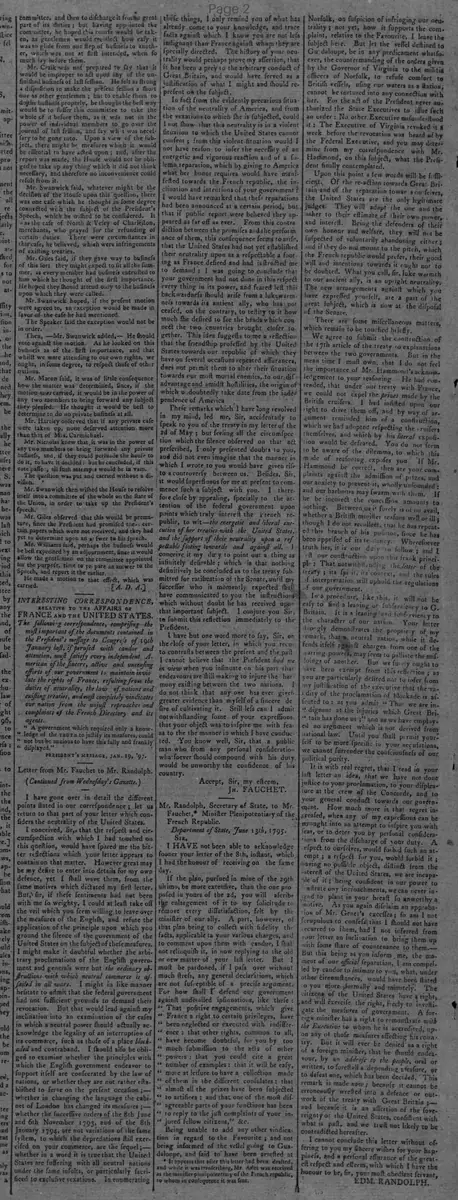
The following correspondence, comprising the most important of the documents contained in the President's message to Congress of 19th January last, if perused with candor and attention, must satisfy every independent American of the sincere, active and unceasing efforts of our government to maintain inviolate the rights of France, resulting from the duties of neutrality, the law of nations and existing treaties, and most completely vindicates our nation from the unjust reproaches and complaints of the French Directory and its agents.
"A government which required only a knowledge of the truth to justify its measures, could not but be anxious to have this fully and frankly displayed."
PRESIDENT'S MESSAGE, JAN. 19, '97.
Letter from Mr. Fauchet to Mr. Randolph.
(Continued from Wednesday's Gazette.)
I have gone over in detail the different points stated in our correspondence; let us return to that part of your letter which considers the neutrality of the United States.
I conceived, sir, that the respect and circumspection with which I had touched on this question, would have spared me the bitter reflections which your letter appears to contain on that matter. However great may be my desire to enter into details for my own defence, yet I shall waive them, from the same motives which dictated my first letter.
But, sir, if these sentiments had not been with me so weighty, I could at least take off the veil which you seem willing to leave over the measures of the English, and refute the application of the principle upon which you ground the silence of the government of the United States on the subject of these measures.
I might make it doubtful whether the arbitrary proclamations of the English government and generals were but the ordinary obstructions with which neutral commerce is assailed in all wars. I might in like manner hesitate to admit that the federal government had not sufficient grounds to demand their revocation. But that would lead against my inclination into an examination of the cases in which a neutral power should actually acknowledge the legality of an interruption of its commerce, such as those of a place blockaded and contraband. I should also be obliged to examine whether the principles with which the English government endeavor to support itself are consecrated by the law of nations, or whether they are not rather established to serve on the present occasion;—whether in changing the language the cabinet of London has changed its measures;—whether the successive orders of the 8th June and 6th November 1793, and of the 8th January 1794, are not variations of the same system, to which the depredations still exercised on your commerce, are the sequel; whether in a word it is true that the United States are suffering with all neutral nations under the same insults, or particularly sacrificed to exclusive vexations. In enumerating these things, I only remind you of what has already come to your knowledge, and trace facts against which I know you are not less indignant than France against whom they are especially directed. The history of your neutrality would perhaps prove my assertion, that it has been a prey to the arbitrary conduct of Great Britain, and would have served as a justification of what I might and should represent on the subject.
In fact from the evidently precarious situation of the neutrality of America, and from the vexations to which she is subjected, could I not shew that this neutrality is in a violent situation to which the United States cannot consent; from this violent situation would I not have reason to infer the necessity of an energetic and vigorous reaction and of a solemn reparation, which by giving to America what her honor requires would have manifested towards the French republic, the inclination and intentions of your government?
I would have remarked that these reparations had been announced at a certain period, but that if public report were believed they appeared as far off as ever. From this contradiction between the promises and the performance of them, this consequence seems to arise, that the United States had not yet established their neutrality upon so respectable a footing as France desired and had instructed me to demand: I was going to conclude that your government had not done in this respect every thing in its power, and feared lest this backwardness should arise from a lukewarmness towards its ancient ally, who has not ceased, on the contrary, to testify to it how much she desired to see the bands which connect the two countries brought closer together. This idea suggests to me a reflection that the friendship professed by the United States towards our republic of which they have on several occasions repeated assurances, does not permit them to alter their situation towards our most mortal enemies, to our disadvantage and amidst hostilities, the origin of which undoubtedly take date from the independence of America.
These remarks which I have long revolved in my mind, led me, Sir, accidentally to speak to you of the treaty in my letter of the 2d of May; but feeling all the circumspection which the silence observed on that act prescribed, I only presented doubts to you, and did not even imagine that the manner in which I wrote to you would have given rise to a controversy between us. Besides, Sir, it would be superfluous for me at present to commence such a subject with you. I therefore close by appealing, specially to the attention of the federal government upon points which truly interest the French republic, to wit—the energetic and liberal execution of her treaties with the United States, and the support of their neutrality upon a respectable footing towards and against all. I conceive it my duty to point out a thing as infinitely desirable; which is that nothing definitively be concluded as to the treaty submitted for ratification of the Senate, until my successor who is momentarily expected shall have communicated to you the instructions which without doubt he has received upon that important subject. I conjure you Sir, to submit this reflection immediately to the President.
I have but one word more to say, Sir, on the close of your letter, in which you recur to contrasts between the present and the past. I cannot believe that the President had me in view when you insinuate on his part that endeavours are still making to injure the harmony existing between the two nations. I do not think that any one has ever given greater evidence than myself of a sincere desire of cultivating it. Still less can I admit notwithstanding some of your expressions, that your object was to inspire me with fear as to the manner in which I have conducted. You know well, Sir, that a public man who from any personal consideration whatsoever should compound with his duty would be unworthy the confidence of his country.
Accept, Sir, my esteem,
J. H. FAUCHET.
Mr. Randolph, Secretary of State, to Mr. Fauchet, Minister Plenipotentiary of the French Republic.
Department of State, June 13th, 1795.
SIR,
I HAVE not been able to acknowledge sooner your letter of the 8th, instant, which I had the honour of receiving on the same day.
If the plan, pursued in mine of the 29th ultimo, be more extensive, than the one proposed in yours of the 2d, you will ascribe the enlargement of it to my solicitude to remove every dissatisfaction, felt by the minister of our ally. A part, however, of that plan being to collect with fidelity the facts, applicable to your various charges, and to comment upon them with candor, I shall not relinquish it, in now replying to the old or new matter of your last letter. But I must be pardoned, if I pass over without much stress, any general declarations, which are not susceptible of a precise argument.
For how shall I defend our government against undetailed insinuations, like these: "That positive engagements, which give
"France a right to certain privileges, have
"been neglected or executed with indiffer-
"ence: that other rights, common to all,
"have become doubtful, for you by too
"much submission to the acts of other
"powers: that you could cite a great
"number of examples: that it will be easy,
"more at leisure to have a collection made
"of them in the different consulates: that
"almost all the prizes have been subjected
"to artifices: and that one of the most dis-
"agreeable parts of your functions has been
"to reply to the just complaints of your in-
"jured fellow citizens," &c.
Being unable to add any other vindication in regard to the Favourite; and not being informed of the vessel going to Guadaloupe, and said to have been arrested at Norfolk, on suspicion of infringing our neutrality; nor yet, how it supports the complaint, relative to the Favourite, I leave the subject here. But let the vessel destined to Guadaloupe, be in any predicament whatsoever, the countermanding of the orders given by the Governor of Virginia to the militia officers of Norfolk, to refuse comfort to British vessels, using our waters as a station; cannot be tortured into any connection with her. For the act of the President never authorized the State Executives to issue such an order: No other Executive misunderstood it: The Executive of Virginia revoked it a week before the revocation was heard of by the Federal Executive, and you may determine from my correspondence with Mr. Hammond, on this subject, what the President finally contemplated.
Upon this point a few words will be sufficient. Of the re-action towards Great Britain—and of the reparation towards ourselves, the United States are the only legitimate judges. They will adapt the one and the other to their estimate of their own power, and interest. Being the defenders of their own honour and welfare, they will not be suspected of voluntarily abandoning either; and if they do not mount to the pitch, which the French republic would prefer, their good will and intentions towards it ought not to be doubted. What you call, sir, lukewarmness to our ancient ally, is an upright neutrality. The new arrangements against which you have expressed yourself, are a part of the great subject, which is now at the disposal of the Senate.
There are some miscellaneous matters, which remain to be touched briefly.
We agree to submit the construction of the 17th article of the treaty to explanations between the two governments. But in the mean time I must own, that I do not feel the importance of Mr. Hammond's acknowledgement to your reasoning. He had contended, that under our treaty with France, we could not expel the prizes made by the British cruisers. I had insisted upon our right to drive them off, and by way of argument reminded him of a construction, which we had adopted respecting the cruisers themselves, and which by his literal exposition would be defeated. You do not seem to be aware of the dilemma, to which this mode of reasoning exposes you. If Mr. Hammond be correct, then are your complaints against the admission of prizes, and our anxiety to prevent it, wholly unfounded: and our harbours may swarm with them. If he be incorrect the conclusion amounts to, nothing. Between us surely is of no avail, whether a British minister reasons well or ill; though I do not recollect, that he has repeated this branch of his position, since he has been apprised of its tendency. Wherever truth lies, it is our duty to follow it; and I state our construction upon this frank principle: That notwithstanding the letter of the treaty; its spirit, its context, and the rules of interpretation will uphold the regulations of our government.
In a procedure, like his, it will not be easy to find a leaning or subserviency to G. Britain. It is a leaning and subserviency to the character of our nation. Your letter strongly demonstrates the propriety of my remark, that a neutral nation, while it defends itself against charges from one of the warring powers, may seem to palliate the misdoings of another. But we surely ought to have been exempt from this reflection; as you are particularly desired not to infer from my justification of the executive that the validity of the proclamation of blockade is assented to: as you admit "That we are in-
"dignant at the injuries which Great Bri-
"tain has done us;" and as we have employed no argument which is not derived from national law. Until you shall permit yourself to be more specific in your accusations, we cannot surrender the consciousness of our political purity.
It is with real regret, that I read in your last letter an idea, that we have not done justice to your proclamation, to your displeasure at the crew of the Concorde, and to your general conduct towards our government. How much more is that regret increased, when any of my expressions can be wrought into an attempt to inspire you with fear, or to deter you by personal considerations from the discharge of your duty. A respect to ourselves, would forbid such an attempt; a respect for you, would forbid it; having no private object, distinct from the interest of the United States, we are incapable of it; being confident in our power to frustrate any encroachments, we can never intend to plant in your breast so unworthy a motive. As you again disclaim an approbation of Mr. Genet's excesses; so am I not scrupulous to confess that I should not have recurred to them, had I not inferred from your letter an inclination to bring them up with some share of countenance to them. But this being as you inform me, the moment of our official separation, I am compelled by candor to intimate to you, what, under other circumstances, would have been stated to you more formally and minutely. The citizens of the United States have a right, and will exercise the right, freely to investigate the measures of government. A foreign minister has a right to remonstrate with the Executive to whom he is accredited, upon any of those measures affecting his country. But it will ever be denied as a right of a foreign minister, that he should endeavour, by an address to the people, oral or written, to forestall a depending measure, or to defeat one, which has been decided. This remark is made now; because it cannot be erroneously wrested into a defence or outwork of the treaty with Great Britain; and because it is an assertion of the sovereignty of the United States, consistent with what is past, and we trust not likely to be contradicted hereafter.
I cannot conclude this letter without offering to you my sincere wishes for your happiness, and a personal assurance of the greatest respect and esteem, with which I have the honour to be, sir, your most obedient servant,
EDM. RANDOLPH.
What sub-type of article is it?
What keywords are associated?
What entities or persons were involved?
Where did it happen?
Foreign News Details
Primary Location
France
Event Date
June 13th, 1795
Key Persons
Outcome
diplomatic defense of us neutrality and treaty execution; no specific resolutions or casualties reported.
Event Details
Exchange of letters between French Minister Fauchet and US Secretary Randolph addressing US neutrality, British commercial depredations, treaty obligations with France, and responses to French complaints about US conduct toward Britain.