Thank you for visiting SNEWPapers!
Sign up free
The National Intelligencer And Washington Advertiser
Washington, District Of Columbia
What is this article about?
Trial proceedings of Aaron Burr on misdemeanor indictment for providing means of a military expedition against Mexico at Blennerhassett's island. Includes testimony from Morris B. Belknap on letters and plans, legal arguments on evidence admissibility, and acquittal by jury on September 15.
Merged-components note: This is a continuous report on the trial of Aaron Burr, spanning pages 1 and 2 with sequential reading order. The second component was labeled domestic_news but fits better as part of the overall story.
Clippings
1 of 2
OCR Quality
Full Text
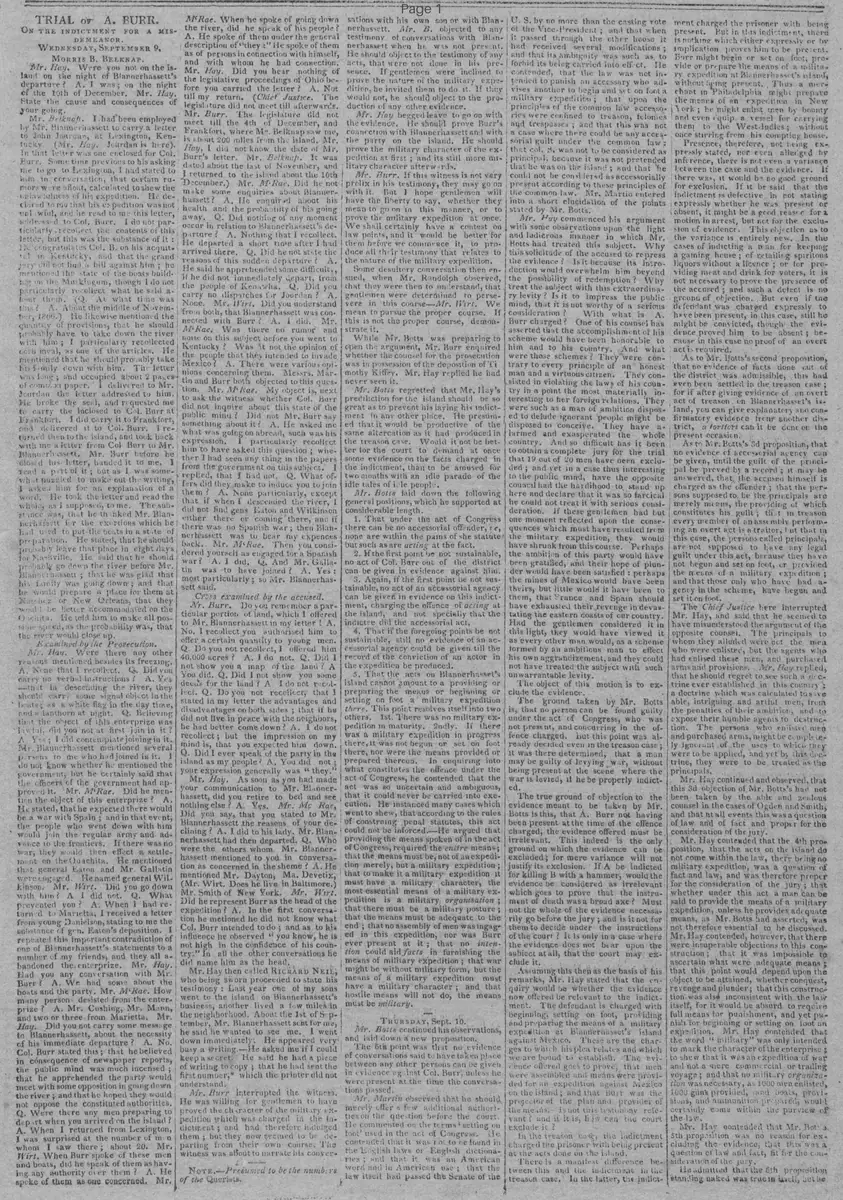
ON THE INDICTMENT FOR A MISDEMEANOR.
WEDNESDAY, SEPTEMBER 9.
MORRIS B. BELKNAP.
Mr. Hay. Were you not on the island on the night of Blennerhassett's departure? A. I was; on the night of the 10th of December. Mr. Hay. State the cause and consequences of your going.
Mr. Belknap. I had been employed by Mr. Blennerhassett to carry a letter to John Jourdan, at Lexington, Kentucky (Mr. Hay. Jourdan is here), in that letter was one enclosed for Col. Burr. Some time previous to his asking me to go to Lexington, I had stated to him in conversation, that certain rumors were afloat, calculated to show the unlawfulness of his expedition. He declared to me that his expedition was not unlawful, and he read to me this letter, addressed to Col. Burr. I do not particularly recollect the contents of this letter, but this was the substance of it: He congratulates Col. B. on his acquittal in Kentucky, and that the grand jury did not find a bill against him; he mentioned the state of the boats building on the Muskingum, though I do not particularly recollect what he said about them. (Q. At what time was this? A. About the middle of November, 1806.) He likewise mentioned the quantity of provisions, that he should probably have to take down the river with him; I particularly recollected corn meal, as one of the articles. He mentioned that he should probably take his family down with him. The letter was long; and occupied about 2 pages of common paper. I delivered to Mr. Jourdan the letter addressed to him. He broke the seal, and requested me to carry the enclosed to Col. Burr at Frankfort. I did carry it to Frankfort, and delivered it to Col. Burr. I returned then to the island, and took back with me a letter from Col. Burr to Mr. Blennerhassett. Mr. Burr before he closed his letter, handed it to me, I read a part of it; but as I was somewhat puzzled to make out the writing, I asked him for an explanation of a word. He took the letter and read the whole, as I supposed, to me. The substance was, that he thanked Mr. Blennerhassett for the exertions which he had used to put the boats in a state of preparation. He stated, that he should probably leave that place in eight days for Nashville. He said that he should probably go down the river before Mr. Blennerhassett; that he was glad that his family was going down; and that he would prepare a place for them at Natchez or New Orleans, that they would be better accommodated on the citadel. He told him to make all possible speed, as the probability was, that the river would close up.
Examined by the Prosecution.
Mr. Hay. Were there any other reasons mentioned besides its freezing. A. None that I recollect. Q. Did you carry no verbal instructions? A. Yes - that in descending the river, they should carry some signal object in the boats; as a white flag in the day time, and a lantern at night. Q. Believing that the object of this enterprize was lawful, did you not at first join in it? A. Yes: I did contemplate joining in it. Mr. Blennerhassett mentioned several persons to me who had joined in it. I do not know whether he mentioned the government, but he certainly said that the officers of the government had approved it. Mr. M'Rae. Did he mention the object of this enterprize? A. He stated, that he expected there would be a war with Spain; and in that event, the people who went down with him would join the regular army and advance to the frontiers. If there was no war, they would then effect a settlement on the Washita. He mentioned that general Eaton and Mr. Gallatin were engaged. He named general Wilkinson. Mr. Wirt. Did you go down with him? A. I did not. Q. What prevented you? A. When I had returned to Marietta, I received a letter from young Danielson, stating to me the substance of gen. Eaton's deposition. I repeated this important contradiction of one of Blennerhassett's statements to a number of my friends, and they all abandoned the enterprize. Mr. Hay. Had you any conversation with Mr. Burr? A. We had some about the boats and the party. Mr. M'Rae. How many persons desisted from the enterprize? A. Mr. Cushing, Mr. Mann, and two or three from Marietta. Mr. Hay. Did you not carry some message to Blennerhassett, about the necessity of his immediate departure? A. No. Col. Burr stated this; that he believed in consequence of newspaper reports, the public mind was much incensed; that he apprehended the party would meet with some opposition in going down the river; and that he hoped they would not oppose the constituted authorities. Q. Were there any men preparing to depart when you arrived on the island? A. When I returned from Lexington, I was surprised at the number of men whom I saw there; about 20. Mr. Wirt. When Burr spoke of these men and boats, did he speak of them as having any authority over them? A. He spoke of them as one concerned, Mr.
M'Rae. When he spoke of going down the river, did he speak of his people? A. He spoke of them under the general description of "they." He spoke of them as of persons in connection with himself, and with whom he had connection.
Mr. Hay. Did you hear nothing of the legislative proceedings of Ohio before you carried the letter? A. Not till my return. (Chief Justice. The legislature did not meet till afterwards. Mr. Burr. The legislature did not meet till the 4th of December, and Frankfort, where Mr. Belknap saw me, is about 200 miles from the island. Mr. Hay, I did not know the date of Mr. Burr's letter. Mr. Belknap. It was dated about the last of November, and I returned to the island about the 10th December.) Mr. M'Rae. Did he not make some enquiries about Blennerhassett? A. He enquired about his health and the probability of his going away. Q. Did nothing of any moment occur in relation to Blennerhassett's departure? A. Nothing that I recollect. He departed a short time after I had arrived there. Q. Did he not state the reasons of this sudden departure? A. He said he apprehended some difficulty, if he did not immediately depart, from the people of Kanawha. Q. Did you carry no dispatches for Jourdan? A. None. Mr. Wirt. Did you understand from both, that Blennerhassett was connected with Burr? A. I did. Mr. M'Rae. Was there no rumor and noise on this subject before you went to Kentucky? Was it not the opinion of the people that they intended to invade Mexico? A. There were various opinions concerning them. Messrs. Martin and Burr both objected to this question, Mr. M'Rae. My object is, next to ask the witness whether Col. Burr did not enquire about this state of the public mind? Did not Mr. Burr say something about it? A. He asked me what was going on abroad, such was his expression. I particularly recollect him to have asked this question; whether I had seen any thing in the papers from the government on this subject. I replied, that I had not. Q. What offers did they make to induce you to join them? A. None particularly, except that if when I descended the river, I did not find gens. Eaton and Wilkinson either there or coming there, and if there was no Spanish war; then Blennerhassett was to bear my expences back. Mr. M'Rae. Then you considered yourself as engaged for a Spanish war? A. I did. (Q. And Mr. Gallatin was to have joined? A. Yes: most particularly; so Mr. Blennerhassett said.)
Cross examined by the accused.
Mr. Burr. Do you remember a particular portion of land, which I offered to Mr. Blennerhassett in my letter? A. No. I recollect you authorised him to offer a certain quantity to young men. Q. Do you not recollect, I offered him 40,000 acres? A. I do not. Q. Did I not show you a map of the land? A. You did. Q. Did I not show you some deeds for the land? A. I do not recollect. Q. Do you not recollect, that I stated in my letter the advantages and disadvantages on both sides; that if he did not live in peace with the neighbors, he had better come down? A. I do not recollect; but the impression on my mind is, that you expected him down. Q. Did I ever speak of the party in the island as my people? A. You did not; your expression generally was "they."
Mr. Hay. As soon as you had made your communication to Mr. Blennerhassett, did you retire to bed and see nothing else? A. Yes. Mr. M'Rae, Did you say, that you stated to Mr. Blennerhassett the reasons of your declining? A. I did to his lady. Mr. Blennerhassett had then departed. Q. Who were the others whom Mr. Blennerhassett mentioned to you in conversation as concerned in the scheme? A. He mentioned Mr. Dayton, Maj. Devereux, (Mr. Wirt. Does he live in Baltimore.) Mr. Smith of New York. Mr. Wirt. Did he represent Burr as the head of the expedition? A. In the first conversation he mentioned he did not know what Col. Burr intended to do; and as to his influence he observed "you know, he is not high in the confidence of his country." In all the other conversations he did name him as the head.
Mr. Hay then called RICHARD NEIL; who being sworn proceeded to state his testimony: Last year one of my sons went to the island on Blennerhassett's business, another lived a few miles in the neighborhood. About the 1st of September, Mr. Blennerhassett sent for me, he said he wanted to see me. I went down immediately: He appeared very busy at writing. He asked me if I could keep a secret. He said he had a piece of writing to copy: that he had sent the first number,* which the printer did not understand,
Mr. Burr interrupted the witness. He was willing for gentlemen to have proved the character of the military expedition which was charged in the indictment: and had therefore indulged them; but they now seemed to be departing from their own course. The witness was about to narrate his conversations with his own son or with Blennerhassett. Mr. B. objected to any testimony of conversations with Blennerhassett when he was not present. He should object to the testimony of any acts, that were not done in his presence. If gentlemen were inclined to prove the nature of the military expedition, he invited them to do it. If they would not, he should object to the production of any other evidence.
Mr. Hay begged leave to go on with the evidence. He should prove Burr's connection with Blennerhassett and with the party on the island. He should prove the military character of the expedition at first; and its still more military character afterwards.
Mr. Burr. If this witness is not very prolix in his testimony, they may go on with it. But I hope gentlemen will have the liberty to say, whether they mean to go on in this manner, or to prove the military expedition at once. We shall certainly have a contest on law points, and it would be better for them before we commence it, to produce all their testimony that relates to the nature of the military expedition.
Some desultory conversation then ensued, when Mr. Randolph observed, that they were then to understand, that gentlemen were determined to persevere in this course--Mr. Hay. We mean to pursue the proper course. If this is not the proper course, demonstrate it.
While Mr. Botts was preparing to open the argument, Mr. Burr enquired whether the counsel for the prosecution was in possession of the deposition of Timothy Kiffey. Mr. Hay replied he had never seen it.
Mr. Botts regretted that Mr. Hay's predilection for the island should be so great as to prevent his having his indictment in any other place. He presumed that it would be productive of the same altercation as it had produced in the treason case. Would it not be better for the court to demand at once some evidence on the facts charged in the indictment, than to be amused for two months with an idle parade of the idle tales of idle people.
Mr. Botts laid down the following general positions, which he supported at considerable length.
I. That under the act of Congress there can be no accessorial offender, i.e. none are within the pains of the statute but such as are acting at the fact.
2. If the first point be not sustainable, no act of Col. Burr out of the district can be given in evidence against him.
3. Again, if the first point be not sustainable, no act of an accessorial agency can be given in evidence on this indictment, charging the offence of acting at the island, and not specially that the indictee did the accessorial act.
4. That if the foregoing points be not sustainable, still no evidence of an accessorial agency could be given till the record of the conviction of an actor in the expedition be produced.
5. That the acts on Blennerhassett's island cannot amount to a providing or preparing the means or beginning or setting on foot a military expedition there. This point resolves itself into two others. 1st. There was no military expedition in maturity. 2ndly. If there was a military expedition in progress there, it was not begun or set on foot there, nor were the means provided or prepared thereon. In enquiring into what constitutes the offence under the act of Congress, he contended that the act was so uncertain and ambiguous, that it could never be carried into execution. He instanced many cases which went to shew, that according to the rules of construing penal statutes, this act could not be enforced. He argued that providing the means spoken of in the act of Congress, required the entire means; that the means must be, not of an expedition merely, but a military expedition; that to make it a military expedition it must have a military character, the most essential means of a military expedition is a military organisation; that there must be a military posture; that the means must be adequate to the end; that no assembly of men was engaged in this expedition, nor was Burr ever present at it; that no intention could aid facts in furnishing the means of military expedition; that war might be without military form, but the means of a military expedition must have a military character; and that hostile means will not do, the means must be military.
THURSDAY, Sept. 10.
Mr. Botts continued his observations, and laid down a new proposition.
The 6th point was that no evidence of conversations said to have taken place between any other persons can be given in evidence against Col. Burr, unless he were present at the time the conversations passed.
Mr. Martin observed that he should merely offer a few additional authorities on the question before the court. He commented on the terms 'setting on foot' used in the act of Congress. He contended that it was not to be found in the English laws or English dictionaries: and that it was an American word and in American use; that the law itself had passed the Senate of the U. S. by no more than the casting vote of the Vice President: and that when it passed through the other house it had received several modifications; and that its ambiguity was such as to forbid its being carried into effect. He contended, that the law was not intended to punish an accessary who advises another to begin and set on foot a military expedition: that upon the principles of the common law accessories were confined to treason, felonies and trespasses; and that this was not a case where there could be any accessorial guilt under the common law: that col. B. was not to be considered as principal, because it was not pretended that he was on the island: and that he could not be considered as accessorially present according to these principles of the common law. Mr. Martin entered into a short elucidation of the points stated by Mr. Botts.
Mr. Hay commenced his argument with some observations upon the light and ludicrous manner in which Mr. Botts had treated this subject. Why this solicitude of the accused to repress the evidence? Is it because its introduction would overwhelm him beyond the possibility of redemption? Why treat the subject with this extraordinary levity? Is it to impress the public mind, that it is not worthy of a serious consideration? With what is A. Burr charged? One of his counsel has asserted that the accomplishment of his scheme would have been honorable to him and to his country. And what were those schemes? They were contrary to every principle of an honest man and a virtuous citizen. They consisted in violating the laws of his country in a point the most materially interesting to her foreign relations. They were such as a man of ambition disposed to delude ignorant people might be disposed to conceive. They have alarmed and exasperated the whole country. And so difficult has it been to obtain a complete jury for the trial that 19 out of 20 men have been excluded; and yet in a case thus interesting to the public mind, have the opposite counsel had the hardihood to stand up here and declare that it was so farcical he could not treat it with serious consideration. If these gentlemen had but one moment reflected upon the consequences which must have resulted from the military expedition, they would have shrunk from this course. Perhaps the ambition of this party would have been gratified, and their hope of plunder would have been satisfied: perhaps the mines of Mexico would have been theirs, but little would it have been to them, that France and Spain should have exhausted their revenge in devastating the eastern coasts of our country. Had the gentlemen considered it in this light, they would have viewed it as every other man would, as a scheme formed by an ambitious man to effect his own aggrandizement, and they could not have treated the subject with such unwarrantable levity.
The object of this motion is to exclude the evidence.
The ground taken by Mr. Botts is, that no person can be found guilty under the act of Congress, who was not present, and concurring in the offence charged. But this point was already decided even in the treason case; it was there determined, that a man may be guilty of levying war, without being present at the scene where the war is levied, if he be properly indicted.
The true ground of objection to the evidence meant to be taken by Mr. Botts is this, that A. Burr not having been present at the time of the offence charged, the evidence offered must be irrelevant. This indeed is the only ground on which the evidence can be excluded; for mere variance will not justify its exclusion. If A be indicted for killing B with a hammer, would the evidence be considered as irrelevant which goes to prove that the instrument of death was a broad axe? Must not the whole of the evidence necessarily go before the jury; and is it not for them to decide under the instructions of the court? It is only in a case where the evidence does not bear upon the subject at all, that the court may exclude it.
Assuming this then as the basis of his remarks, Mr. Hay stated that the enquiry would be whether the evidence now offered be relevant to the indictment. The defendant is charged with beginning, setting on foot, providing and preparing the means of a military expedition at Blennerhassett's island against Mexico. These are the charges to which his plea relates and which we are bound to establish. The evidence offered goes to prove, that men were assembled and means were provided for an expedition against Mexico on the island; and that Burr was the projector of the plan and provider of the means. Is not this testimony relevant? and if it is, how can the court exclude it?
In the treason case, the indictment charged the prisoner with being present at the acts done on the island. There is a manifest difference between this and the indictment in the treason case. In the latter, the indictment charged the prisoner with being present. But in this indictment, there is nothing which either expressly or by implication proves him to be present. Burr might begin or set on foot, provide or prepare the means of a military expedition at Blennerhassett's island, without being present. Thus a merchant in Philadelphia might prepare the means of an expedition in New York; he might enlist men by bounty and even equip a vessel for carrying them to the West-Indies: without once stirring from his counting house. Presence, therefore, not being expressly stated, nor even alleged by inference, there is not even a variance between the case and the evidence. If there was, it would be no good ground for exclusion. If it be said that the indictment is defective in not stating expressly whether he was present or absent, it might be a good reason for a motion in arrest, but not for the exclusion of evidence. This objection as to the variance is entirely new. In the cases of indicting a man for keeping a gaming house: of retailing spirituous liquors without a licence: or for providing meat and drink for voters, it is not necessary to prove the presence of the accused; and such a defect is no ground of objection. But even if the defendant was charged expressly to have been present, in this case, still he might be convicted, though the evidence proved him to be absent: because in this case no proof of an overt act is required.
As to Mr. Botts's second proposition, that no evidence of facts done out of the district was admissible, this had even been settled in the treason case; for if after giving evidence of an overt act of treason, on Blennerhassett's island, you can give explanatory and confirmatory evidence from another district, a fortiori can it be done on the present occasion.
As to Mr. Botts's 3d proposition, that no evidence of accessorial agency can be given, until the guilt of the principal be proved by a record; it may be answered, that, the accused himself is charged as the offender: that the persons supposed to be the principals are merely means, the providing of which constitutes his guilt; that in treason every member of an assembly performing an overt act is a traitor, but that in this case, the persons called principals are not supposed to have any legal guilt under this act, because they have not begun and set on foot, or provided the means of a military expedition; and that those only who have had agency in the scheme, have begun and set it on foot.
The Chief Justice here interrupted Mr. Hay, and said that he seemed to have misunderstood the argument of the opposite counsel. The principals to whom they alluded were not the men who were enlisted, but the agents who had enlisted these men, and purchased arms and provisions. Mr. Hay replied, that he should regret to see such a doctrine ever established in this country a doctrine which was calculated to save able, intriguing and artful men, from the penalties of their ambition, and to expose their humble agents to destruction. The persons who enlisted men and purchased arms, might be completely ignorant of the uses to which they were to be applied, and yet by this doctrine, they were to be treated as the principals.
Mr. Hay continued and observed, that this 3d objection of Mr. Botts's had not been taken by the able and zealous counsel in the cases of Ogden and Smith and that at all events this was a question of law and of fact and proper for the consideration of the jury.
Mr. Hay contended that the 4th proposition, that the acts on the island do not come within the law, there being no military expedition, was a question of fact and law, and was therefore proper for the consideration of the jury; that whether under this act a man can be said to provide the means of a military expedition, unless he provides adequate means, as Mr. Botts had asserted, was not therefore essential to be discussed. Mr. Hay contended, however, that there were insuperable objections to this construction; that it was impossible to ascertain what were adequate means; that this point would depend upon the object to be attained, whether conquest, revenge and plunder; that this construction was also inconsistent with the law itself, for it would be absurd to require full means for punishment, and yet punish for beginning or setting on foot an expedition. Mr. Hay contended that the word "military" was only intended to mark the character of the enterprise; to shew that it was an expedition of war and not a mere commercial or trading voyage; and that no military organization was necessary, as 1000 men enlisted, 1000 guns provided, and boats, provisions, and ammunition prepared would certainly come within the purview of the law.
Mr. Hay contended that Mr. Botts's 5th proposition was no reason for excluding the evidence, that this was a question of law and fact, fit for the consideration of the jury. He admitted that the 6th proposition standing naked was true in itself, but he
The rope ended that if there was a connexion between the parties, that the acts and confessions of one were evidence against the other; that this principle was settled in Hardy's, Thelwell's, and Tooke's cases; and that in the present case, the evidence of the connection of Blannerhassett was already before the jury; and that he was prepared to adduce additional testimony. See Trial of Smith and Ogden, page 102.
(On Friday Mr. Martin offered a few additional authorities. He was followed by Mr. McRae: and afterwards by Mr. Wirt, who spoke two hours. Mr. Randolph continued the argument for one hour.)
TUESDAY, SEPTEMBER 15.
Mr. Hay said that the counsel for the prosecution would attempt to go on as well as they could; and that they would attempt to introduce no evidence which interfered with the court. He should state what he conceived to be a summary of that opinion. Mr. Hay stated one or two propositions, when the opposite counsel objected to this course. Mr. Martin suggested whether it would not be better to introduce particular points of testimony, or the court then to determine upon their admissibility. After some conversation, Mr. Hay called up Mr. Neale. Q. Were you on the island, on the night of Blannerhassett's departure? A. I was not; I left it about the 20th of August. Jno. McDowell was then called: when Mr. Hay observed that this witness was introduced for the purpose of proving an interview between him and the accused at the mouth of Cumberland river, when the accused stated to him the object of his expedition. Mr. Burr charged, that he understood this was offered as corroborative or auxiliary testimony. Auxiliary to what? They ought first to demonstrate that he did commit the acts on the island, that were laid in the indictment. Why do they thus attempt to prove acts, alone in Kentucky out of the district? Some argument ensued on this point; when Mr. Hay observed, that he considered the terms "providing, and providing means," as the direct and operative terms of the law; he would prove that means for a military expedition had been provided at the island; and the question was, who did provide them: he would undertake to deduce from circumstances to the complete satisfaction of the jury, that Mr. Burr was the provider. These circumstances were satisfactory to his mind, and he thought they would be equally so to them.
Chief Justice. If you have any testimony about providing the means at the island, let it be produced.
Mr. Dudley Woodbridge was then called up, whose testimony we have already retailed in the Enquirer. He now gave a particular history of his contract with Mr. Burr, the building of the boats and the preparing of provisions. The prosecution interrogated him particularly about the corn which Mr. Blannerhassett had purchased on his island, and attempted to show that in this transaction he acted under the powers of the firm. The opposite counsel asked him, whether this purchase of corn had ever been carried into the company's books. A. No. Whether the partnership accounts were settled? A. Yes.
Peter Taylor was then interrogated about the corn purchased by Blannerhassett on the island. He said that this corn was kiln dried on the island; then carried to the mills on the Muskingum and the Kanawha; that the meal was brought back to the island; but he was not certain whether any had been carried away by Burr's party.
Mr. Hay at length arose. He said, he perceived very distinctly that he could not proceed in his evidence without meeting the opinion of the court. That opinion had removed the great and most effective part of his testimony; that under such circumstances, he could not support the prosecution; he was willing therefore to enter a Nolle Prosequi and he quoted Foster, p. 327-8. to show, that after jury was impanelled, it was within the discretion of the court to admit that practice; that he was led to this mode of proceeding by the consideration that the law under which the indictment was laid, was vague in its terms, and as yet undecided, and that this course might permit him to resume the prosecution at some future day, should any substantive testimony occur. The opposite counsel objected to this proceeding; that it was contrary to the uniform practice of the courts; that it was the right of the jury to give a verdict; that the consequences of this proceeding would be the delay of justice to the accused, to whom the constitution had awarded the benefit of a speedy trial. They attempted to show that the principle from Foster did not apply. Mr. Hay was perfectly willing to submit it to the court. The Chief Justice declared that the attorney could not enter a nolle prosequi.
The jury then retired with the indictment, and after an absence of about 20 minutes, Mr. Orris Payne, their foreman, returned a verdict of "Not Guilty".
Mr. Hay then announced the course which he was now to pursue; Mr. Burr was not yet discharged from his recognizance for the misdemeanor; that it was his intention to move for his commitment to that place for trial where the military expedition is said to have been completed; that he should combine in the same motion Messrs. Smith and Blannerhassett, and that he should have no difficulty in entering a nolle prosequi to their trials for a misdemeanor. Mr. Burr requested the attorney to allege the place where the act is said to have been committed. Mr.
What sub-type of article is it?
What themes does it cover?
What keywords are associated?
What entities or persons were involved?
Where did it happen?
Story Details
Key Persons
Location
Blennerhassett's Island
Event Date
September 9 15, 1807
Story Details
Testimony of Morris B. Belknap details delivery of letters between Burr and Blennerhassett concerning boats, provisions, and expedition plans for potential war with Spain or settlement on Washita; mentions involvement of officials like Wilkinson and Eaton. Legal arguments by Botts, Martin, and Hay on evidence admissibility, accessorial liability, and interpretation of neutrality act. Prosecution attempts further witnesses but enters nolle prosequi attempt denied; jury returns not guilty verdict.