Thank you for visiting SNEWPapers!
Sign up free
Literary
January 4, 1822
The Rhode Island American, And General Advertiser
Providence, Providence County, Rhode Island
What is this article about?
Excerpt from President Dwight's travels describing New England Indian tribes (Pequods, Narragansetts, etc.), their physical traits, passions, attachments, and governance. Includes anecdote of an Indian repaying a settler's kindness years later after captivity.
Merged-components note: Continuation of the article 'THE INDIANS OF NEW-ENGLAND' from President Dwight's Travels; same topic and narrative flow across sequential reading orders.
Clipping
OCR Quality
95%
Excellent
Full Text
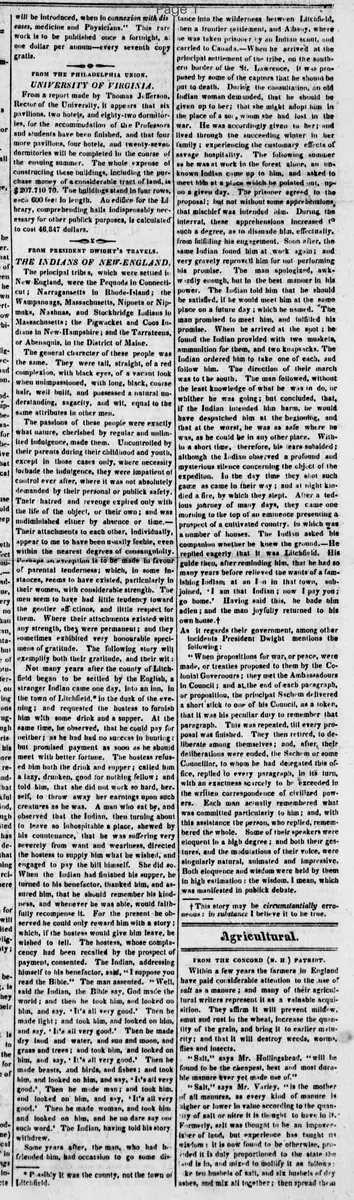
FROM PRESIDENT DWIGHT'S TRAVELS.
THE INDIANS OF NEW-ENGLAND.
The principal tribes, which were settled in New-England, were the Pequods in Connecticut; Narragansetts in Rhode-Island; the Wampanoags, Massachusetts, Nipnets or Nipmucks, Nashaways, and Stockbridge Indians in Massachusetts; the Pigwacket and Coos Indians in New-Hampshire; and the Tarrateens, or Abenaquis, in the District of Maine.
The general character of these people was the same. They were tall, straight, of a red complexion, with black eyes, of a vacant look when unimpassioned, with long, black, coarse hair, well built, and possessed a natural understanding, sagacity, and wit, equal to the same attributes in other men.
The passions of these people were exactly what nature, cherished by regular and unlimited indulgence, made them. Uncontrolled by their parents during their childhood and youth, except in those cases only, where necessity forbade the indulgence, they were impatient of control ever after, where it was not absolutely demanded by their personal or public safety.
Their hatred and revenge expired only with the life of the object, or their own; and was undiminished either by absence or time.
Their attachments to each other, individually, appear to me to have been usually feeble, even within the nearest degrees of consanguinity. Perhaps an exception is to be made in favour of parental tenderness; which, in some instanced, seems to have existed, particularly in their women, with considerable strength. The men seem to have had little tendency toward the gentler affections, and little respect for them. Where their attachments existed with any strength, they were permanent; and they sometimes exhibited very honourable specimen of gratitude. The following story will exemplify both their gratitude, and their wit:
Not many years after the county of Litchfield began to be settled by the English, a stranger Indian came one day into an inn, in the town of Litchfield,* in the dusk of the evening; and requested the hostess to furnish him with some drink and a supper. At the same time, he observed, that he could pay for neither; as he had had no success in hunting; but promised payment as soon as he should meet with better fortune. The hostess refused him both the drink and supper; called him a lazy, drunken, good for nothing fellow; and told him, that she did not work so hard, herself, to throw away her earnings upon such creatures as he was. A man who sat by, and observed that the Indian, then turning about to leave so inhospitable a place, shewed by his countenance, that he was suffering very severely from want and weariness, directed the hostess to supply him what he wished, and engaged to pay the bill himself. She did so.
When the Indian had finished his supper, he turned to his benefactor, thanked him, and assured him, that he should remember his kindness, and whenever he was able, would faithfully recompense it. For the present—he observed he could only reward him with a story; which, if the hostess would give him leave, he wished to tell. The hostess, whose complacency had been recalled by the prospect of payment, consented. The Indian, addressing himself to his benefactor, said, "I suppose you read the Bible." The man assented. "Well said the Indian, the Bible say, God made the world: and then he took him, and looked on him, and say, 'It's all very good.' Then he made light; and took him, and looked on him, and say, 'It's all very good.' Then he made dry land and water, and sun and moon, and grass and trees; and took him, and looked on him, and say, 'It's all very good.' Then he made beasts, and birds, and fishes: and took him, and looked on him, and say, 'It's all very good.' Then he made man; and took him, and looked on him, and say, 'It's all very good.' Then he made woman, and took him and looked on him, and he no dare say one such word.' The Indian, having told his story withdrew.
Some years after, the man, who had befriend him, had occasion to go some distance into the wilderness between Litchfield, then a frontier settlement, and Albany, where he was taken prisoner by an Indian scout, and carried to Canada. When he arrived at the principal settlement of the tribe, on the southside of the St. Lawrence, it was proposed by some of the captors that he should be put to death. During the consultation, an old Indian woman demanded, that he should be given up to her; that she might adopt him in the place of a son, whom she had lost in the war. He was accordingly given to her; and lived through the succeeding winter in her family; experiencing the customary effects of savage hospitality. The following summer as he was at work in the forest alone, an unknown Indian came up to him, and asked to meet him at a place which he pointed out, upon a given day. The prisoner agreed to the proposal; but not without some apprehensions that mischief was intended him. During the interval, these apprehensions increased to such a degree, as to dissuade him, effectually, from fulfilling his engagement. Soon after, the same Indian found him at work again; and very gravely reproved him for not performing his promise. The man apologized, awkwardly enough, but in the best manner in his power. The Indian told him that he should be satisfied, if he would meet him at the same place on a future day; which he named. The man promised to meet him, and fulfilled his promise. When he arrived at the spot; he found the Indian provided with two muskets, ammunition for them, and two knapsacks. The Indian ordered him to take one of each, and follow him. The direction of their march was to the south. The man followed, without the least knowledge of what he was to do, or whither he was going; but concluded, that, if the Indian intended him harm, he would have despatched him at the beginning, and that at the worst, he was as safe where he was, as he could be in any other place. Within a short time, therefore, his fears subsided; although the Indian observed a profound and mysterious silence concerning the object of the expedition. In the day time they shot such game as came in their way; and at night kindled a fire, by which they slept. After a tedious journey of many days, they came one morning to the top of an eminence presenting a prospect of a cultivated country, in which was a number of houses. The Indian asked his companion whether he knew the ground. He replied eagerly that it was Litchfield. His guide then, after reminding him, that he had so many years before relieved the wants of a famishing Indian; at an inn in that town, subjoined, 'I am that Indian; now I pay you; go home.' Having said this, he bade him adieu; and the man joyfully returned to his own house.
As it regards their government, among other incidents President Dwight mentions the following:
"When propositions for war, or peace, were made, or treaties proposed to them by the Colonial Governors; they met the Ambassadors in Council; and at the end of each paragraph, or proposition, the principal Sachem delivered a short stick to one of the Council, as a token, that it was his peculiar duty to remember that paragraph. This was repeated, till every proposal was finished. They then retired, to deliberate among themselves; and, after, their deliberations were ended, the Sachem or some Councillor, to whom he had delegated this office, replied to every paragraph, in its turn, with an exactness scarcely to be exceeded in the written correspondence of civilized powers. Each man actually remembered what was committed particularly to him; and, with this assistance the person, who replied, remembered the whole. Some of their speakers were eloquent in a high degree; and both their gestures, and the modulations of their voice, were singularly natural, animated and impressive. Both eloquence and wisdom were held by them in high estimation: the wisdom, I mean, which was manifested in public debate."
*Possibly it was the county, not the town of Litchfield.
† This story may be circumstantially erroneous: in substance I believe it to be true.
THE INDIANS OF NEW-ENGLAND.
The principal tribes, which were settled in New-England, were the Pequods in Connecticut; Narragansetts in Rhode-Island; the Wampanoags, Massachusetts, Nipnets or Nipmucks, Nashaways, and Stockbridge Indians in Massachusetts; the Pigwacket and Coos Indians in New-Hampshire; and the Tarrateens, or Abenaquis, in the District of Maine.
The general character of these people was the same. They were tall, straight, of a red complexion, with black eyes, of a vacant look when unimpassioned, with long, black, coarse hair, well built, and possessed a natural understanding, sagacity, and wit, equal to the same attributes in other men.
The passions of these people were exactly what nature, cherished by regular and unlimited indulgence, made them. Uncontrolled by their parents during their childhood and youth, except in those cases only, where necessity forbade the indulgence, they were impatient of control ever after, where it was not absolutely demanded by their personal or public safety.
Their hatred and revenge expired only with the life of the object, or their own; and was undiminished either by absence or time.
Their attachments to each other, individually, appear to me to have been usually feeble, even within the nearest degrees of consanguinity. Perhaps an exception is to be made in favour of parental tenderness; which, in some instanced, seems to have existed, particularly in their women, with considerable strength. The men seem to have had little tendency toward the gentler affections, and little respect for them. Where their attachments existed with any strength, they were permanent; and they sometimes exhibited very honourable specimen of gratitude. The following story will exemplify both their gratitude, and their wit:
Not many years after the county of Litchfield began to be settled by the English, a stranger Indian came one day into an inn, in the town of Litchfield,* in the dusk of the evening; and requested the hostess to furnish him with some drink and a supper. At the same time, he observed, that he could pay for neither; as he had had no success in hunting; but promised payment as soon as he should meet with better fortune. The hostess refused him both the drink and supper; called him a lazy, drunken, good for nothing fellow; and told him, that she did not work so hard, herself, to throw away her earnings upon such creatures as he was. A man who sat by, and observed that the Indian, then turning about to leave so inhospitable a place, shewed by his countenance, that he was suffering very severely from want and weariness, directed the hostess to supply him what he wished, and engaged to pay the bill himself. She did so.
When the Indian had finished his supper, he turned to his benefactor, thanked him, and assured him, that he should remember his kindness, and whenever he was able, would faithfully recompense it. For the present—he observed he could only reward him with a story; which, if the hostess would give him leave, he wished to tell. The hostess, whose complacency had been recalled by the prospect of payment, consented. The Indian, addressing himself to his benefactor, said, "I suppose you read the Bible." The man assented. "Well said the Indian, the Bible say, God made the world: and then he took him, and looked on him, and say, 'It's all very good.' Then he made light; and took him, and looked on him, and say, 'It's all very good.' Then he made dry land and water, and sun and moon, and grass and trees; and took him, and looked on him, and say, 'It's all very good.' Then he made beasts, and birds, and fishes: and took him, and looked on him, and say, 'It's all very good.' Then he made man; and took him, and looked on him, and say, 'It's all very good.' Then he made woman, and took him and looked on him, and he no dare say one such word.' The Indian, having told his story withdrew.
Some years after, the man, who had befriend him, had occasion to go some distance into the wilderness between Litchfield, then a frontier settlement, and Albany, where he was taken prisoner by an Indian scout, and carried to Canada. When he arrived at the principal settlement of the tribe, on the southside of the St. Lawrence, it was proposed by some of the captors that he should be put to death. During the consultation, an old Indian woman demanded, that he should be given up to her; that she might adopt him in the place of a son, whom she had lost in the war. He was accordingly given to her; and lived through the succeeding winter in her family; experiencing the customary effects of savage hospitality. The following summer as he was at work in the forest alone, an unknown Indian came up to him, and asked to meet him at a place which he pointed out, upon a given day. The prisoner agreed to the proposal; but not without some apprehensions that mischief was intended him. During the interval, these apprehensions increased to such a degree, as to dissuade him, effectually, from fulfilling his engagement. Soon after, the same Indian found him at work again; and very gravely reproved him for not performing his promise. The man apologized, awkwardly enough, but in the best manner in his power. The Indian told him that he should be satisfied, if he would meet him at the same place on a future day; which he named. The man promised to meet him, and fulfilled his promise. When he arrived at the spot; he found the Indian provided with two muskets, ammunition for them, and two knapsacks. The Indian ordered him to take one of each, and follow him. The direction of their march was to the south. The man followed, without the least knowledge of what he was to do, or whither he was going; but concluded, that, if the Indian intended him harm, he would have despatched him at the beginning, and that at the worst, he was as safe where he was, as he could be in any other place. Within a short time, therefore, his fears subsided; although the Indian observed a profound and mysterious silence concerning the object of the expedition. In the day time they shot such game as came in their way; and at night kindled a fire, by which they slept. After a tedious journey of many days, they came one morning to the top of an eminence presenting a prospect of a cultivated country, in which was a number of houses. The Indian asked his companion whether he knew the ground. He replied eagerly that it was Litchfield. His guide then, after reminding him, that he had so many years before relieved the wants of a famishing Indian; at an inn in that town, subjoined, 'I am that Indian; now I pay you; go home.' Having said this, he bade him adieu; and the man joyfully returned to his own house.
As it regards their government, among other incidents President Dwight mentions the following:
"When propositions for war, or peace, were made, or treaties proposed to them by the Colonial Governors; they met the Ambassadors in Council; and at the end of each paragraph, or proposition, the principal Sachem delivered a short stick to one of the Council, as a token, that it was his peculiar duty to remember that paragraph. This was repeated, till every proposal was finished. They then retired, to deliberate among themselves; and, after, their deliberations were ended, the Sachem or some Councillor, to whom he had delegated this office, replied to every paragraph, in its turn, with an exactness scarcely to be exceeded in the written correspondence of civilized powers. Each man actually remembered what was committed particularly to him; and, with this assistance the person, who replied, remembered the whole. Some of their speakers were eloquent in a high degree; and both their gestures, and the modulations of their voice, were singularly natural, animated and impressive. Both eloquence and wisdom were held by them in high estimation: the wisdom, I mean, which was manifested in public debate."
*Possibly it was the county, not the town of Litchfield.
† This story may be circumstantially erroneous: in substance I believe it to be true.
What sub-type of article is it?
Essay
What themes does it cover?
Moral Virtue
Political
Friendship
What keywords are associated?
New England Indians
Native Tribes
Gratitude
Sachem Council
Indian Character
What entities or persons were involved?
From President Dwight's Travels.
Literary Details
Title
The Indians Of New England.
Author
From President Dwight's Travels.
Subject
Description Of New England Indian Tribes And Customs
Form / Style
Prose Essay With Embedded Anecdote
Key Lines
"Well Said The Indian, The Bible Say, God Made The World: And Then He Took Him, And Looked On Him, And Say, 'It's All Very Good.' Then He Made Light; And Took Him, And Looked On Him, And Say, 'It's All Very Good.' Then He Made Dry Land And Water, And Sun And Moon, And Grass And Trees; And Took Him, And Looked On Him, And Say, 'It's All Very Good.' Then He Made Beasts, And Birds, And Fishes: And Took Him, And Looked On Him, And Say, 'It's All Very Good.' Then He Made Man; And Took Him, And Looked On Him, And Say, 'It's All Very Good.' Then He Made Woman, And Took Him And Looked On Him, And He No Dare Say One Such Word.'
"I Am That Indian; Now I Pay You; Go Home."
When Propositions For War, Or Peace, Were Made, Or Treaties Proposed To Them By The Colonial Governors; They Met The Ambassadors In Council; And At The End Of Each Paragraph, Or Proposition, The Principal Sachem Delivered A Short Stick To One Of The Council, As A Token, That It Was His Peculiar Duty To Remember That Paragraph.