Thank you for visiting SNEWPapers!
Sign up free
Alexandria Gazette, Commercial And Political
Alexandria, Virginia
What is this article about?
A narrative from the Paris Spectator describes the execution of assassin Laumond at Place de Greve, reflecting on the crowd's fervor, historical executions at the site since 1310, and contrasts in French society, including a visit to the prisoner with Dr. M.
Merged-components note: Continuation of the same foreign news article 'From the Paris Spectator' across multiple columns, with sequential reading order and flowing text content
Clipping
OCR Quality
Full Text
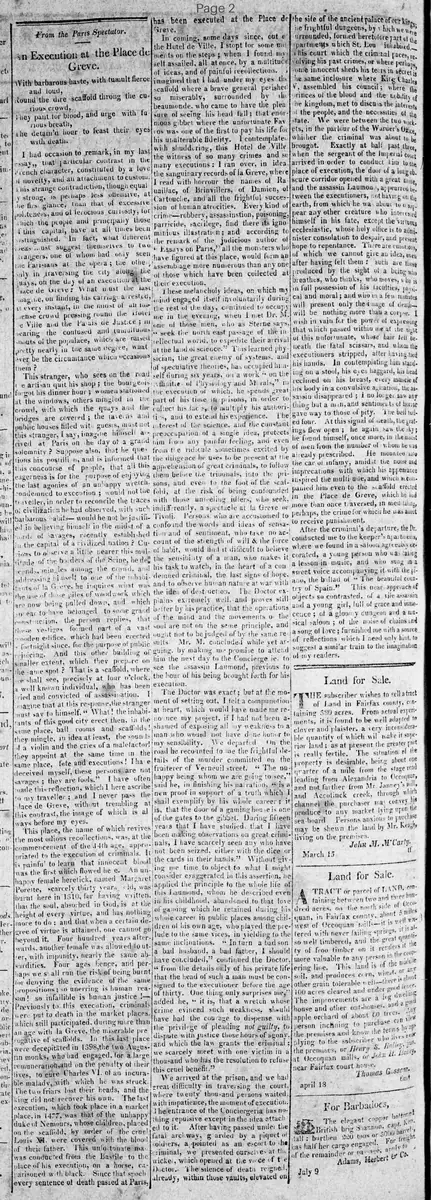
An Execution at the Place de Greve
With barbarous haste, with tumult fierce around the dire scaffold throng the curious crowd.
They pant for blood, and urge with furious breath in the detained hour to feast their eyes with deaths.
I had occasion to remark, in my last essay, that particular contrast in the French character, constituted by a love of novelty, and an attachment to custom. This strange contradiction, though equally strong, is perhaps less offensive, at first glance, than that of excessive politeness, and of ferocious curiosity, for which the people, and principally those of this capital, have at all times been distinguished. In fact, what different ideas must suggest themselves to two strangers, one of whom had only seen the Parisians at the opera; the other only in traversing the city along the quays, on the day of an execution at the Place de Greve? What must the last imagine, on finding his carriage arrested, at every instant, in the midst of an immense crowd pressing round the Hotel de Ville and the Palais de Justice; nearing the confused and tumultuous shouts of the populace, which, are raised pretty nearly in the same degree, whatever be the circumstance which occasions them?
This stranger, who sees on the road the artisan quit his shop; the bourgeois forget his dinner hour; women stationed at the windows, others mingled in the crowd, with which the quays and the bridges are covered; the taverns and public houses filled with guests, must not this stranger, I say, imagine himself arrived at Paris on the day of a grand solemnity? Suppose also, that he questions his postillion, and is informed that this concourse of people, that all this eagerness is for the purpose of enjoying the last agonies of an unhappy wretch, condemned to execution; would not the traveller, in order to reconcile the traces of civilization he had observed, with such barbarous habits--would he not be justified in believing himself in the midst of a horde of savages, recently established in the capital of a civilized nation? Curious to observe a little nearer this multitude on the borders of the Seine, he descends, mingles among the crowd, and addressing himself to one of the inhabitants of la Greve, he enquires what was the use of those piles of wood work which are now being pulled down, and which in ear to-have belonged to some grand construction, the person replies, that these vestiges formed part of a vast wooden edifice, which had been erected fortnight since, for the purpose of public rejoicing. And this other building of smaller extent, which they prepare on the same spot? That is a scaffold, where we shall see, precisely at four o'clock, a well known individual, who has been tried and convicted of assassination. I imagine that at this response,the stranger must say to himself. "What! the inhabitants of this good city erect then, in the same place, ball rooms and scaffolds! they mingle, in idea at least, the sounds of a violin and the cries of a malefactor! they appoint at the same time in the same place, fete and executions! I have deceived myself, these persons are not savages; they are fools." I have often made this reflection, which I here ascribe to my traveller; and I never pass the Place de Greve, without trembling at this contrast, the image of which is always before my eyes.
This place, the name of which revives the most odious recollections, was, at the commencement of the 14th age, appropriated to the execution of criminals. It is painful to learn that innocent blood was the first which flowed here. An unhappy female heretick, named Margaret Porete, scarcely thirty years old, was burnt here in 1310, for having written, that the soul, absorbed in God, is at the height of every virtue, and has nothing more to do : and that when a certain degree of virtue is attained, one cannot go beyond it. Four hundred years afterwards, another female was allowed to utter, with impunity, nearly the same absurdities. Four ages hence, and perhaps we shall run the risk of being burnt for denying the evidence of the same propositions; so unerring is human reason! so infallible is human justice!--
Previously to this execution, criminals were put to death in the market places, which still participated, during more than an age with la Greve, the miserable prerogative of scaffolds. In this last place were decapitated in 1398,the two Augustinian monks, who had engaged, for a large remuneration,and on the penalty of their lives, to cure Charles VI. of an incurable malady, with which he was struck. The two friars lost their heads, and the king did not recover his own. The last execution, which took place in a market place,in 1477, was that of the unhappy duke of Nemours, whose children, placed on the scaffold, by order of the cruel Louis XI. were covered with the blood of their father. This unfortunate man was conducted from the Bastile to the place of his execution, on a horse, caparisoned with black. Since that epoch every sentence of death passed at Paris,
has been executed at the Place de Greve.
In coming, some days since, out of the Hotel de Ville, I stopt for some moments on the steps ; when I found myself assailed, all at once, by a multitude of ideas, and of painful recollections. I imagined that I had under my eyes the scaffold where a brave general perished so miserably, surrounded by the beaumonde, who came to have the pleasure of seeing his head fall; that enormous gibbet where the unfortunate Favras was one of the first to pay his life for his unalterable fidelity. I contemplated with shuddering, this Hotel de Ville the witness of so many crimes and so many executions: I ran over, in idea, the sanguinary records of la Greve, where I read with horrour the names of Ravaillac, of Brinvilliers, of Damien, of Cartouche, and all the frightful succession of human atrocities. Every kind of crime--robbery, assassination, poisoning, parricide, sacrilege, find there its ignominious illustration; and according to the remark of the judicious author of "Essays on Paris,"all the monsters who have figured at this place, would form an assemblage more numerous than any one of those which have been collected at their execution.
These melancholy ideas, on which my mind engaged itself involuntarily during the rest of the day, continued to occupy me in the evening, when I met Dr. M. one of those men, who as Sterne says . seek the north east passage of the intellectual world, to expedite their arrival at the land of science." This learned physician, the great enemy of systems, and of speculative theories, has occupied himself during six years, on a work "on the Affinities of Physiology and Morals," in the execution of which, he spends great part of his time in prisons, in order to collect his facts, to multiply his authorities, and to extend his experience. The interest of the science, and the constant preoccupation of a single idea, protects him from any painful feeling, and even from the ridicule sometimes excited by the diligence he uses to be present at the apprehension of great criminals, to follow them before the tribunals, into the prisons, and even to the foot of the scaffold, at the risk of being confounded with those unfeeling idlers, who seek, indifferently, a spectacle at la Greve or Tivoli. Persons who are accustomed to confound the words and ideas of sensation and of sentiment, who take no account of the strength of will & the force of habit, would find it difficult to believe the sensibility of a man, who makes it his task to watch, in the heart of a condemned criminal, the last signs of hope, and to observe human nature at war with the idea of destruction. The Doctor explains extremely well, and proves still better by his practice, that the operations of the mind and the movements of the soul are not on the same principle, and ought not to be judged of by the same results Mr. M. concluded while yet arguing, by making me promise to attend him the next day to the Conciergerie ie. to see the assassin Laumond, previous to the hour of his being brought forth for his execution.
The Doctor was exact: but at the moment of setting out, I felt a commotion at heart, which would have made me renounce my project, if I had not been ashamed of exposing all my weakness to a man who would not have done honor to my sensibility. We departed On the road he recounted to me the frightful details of the murder committed on the fruiterer of Verneuil street. " The unhappy being whom we are going to see,'" said he, in finishing his narration, " is a new proof in support of a truth which I shall exemplify by his whole career ; it is, that the door of a gaming house is one of the gates to the gibbet. During fifteen years that I have studied, that I have been making observations on great criminals, I have scarcely seen any who have not been seized, either with the dice or the cards in their hands."' Without giving me time to object to what I might consider exaggerated in this assertion, he applied the principle to the whole life of this Laumond, whom he described even in his childhood, abandoned to that love of gaming which he retained during his whole career in public places among children of his own age, who played the prelude to the same vices, in yielding to the same inclinations. " In turn a bad son a bad husband, a bad father, I should have concluded," continued the Doctor. " from the details only of his private life that the head of such a man must be consigned to the executioner before the age of thirty. One thing only surprises me," added he. " it is, that a wretch whose crime evinced such weakness, should have had the courage to dispense with the privilege of pleading not guilty, to dispute with justice those hours of agony. and which the law grants the criminal; we scarcely meet with one victim in a thousand who has the resolution to refuse this cruel benefit."
We arrived at the prison, and we had great difficulty in traversing the court, where twenty thousand persons waited with impatience, the moment of execution. The entrance of the Conciergerie has nothing repulsive except in the idea attached to it. After having passed under the fatal arch way, guarded by a piquet of soldiers, appointed as an escort to the criminal, we presented ourselves at the wicket, which opened at the voice of the Doctor. The silence of death reigned, already, within those vaults, elevated on
the site of the ancient palace of our kings; the frightful dungeons, by which we were surrounded, formed heretofore part of the apartments which St. Louis inhabited.--
This court which the criminal paces, revolving his past crimes, or where perhaps, one innocent sheds his tears in secret is the same inclosure where King Charles V, assembled his council; where the princes of the blood and the nobility of the kingdom, met to discuss the interests of the people, and the necessities of the state. We were between the two wickets, in the parlour of the Warder's Office, whither the criminal was about to be brought. Exactly at half past three, when the sergeant of the Imperial court arrived in order to conduct him to the place of execution, the door of a long obscure corridor opened with a great noise, and the assassin Laumond, appeared between the executioners, not having on the earth, from which he was about to disappear any other creature who interested himself in his fate, except the virtuous ecclesiastic, whose holy office is to administer consolation to despair, and present hope to repentance. There are emotions, of which we cannot give an idea, even after having felt them : such are those produced by the sight of a being who breathes, who thinks, who moves, who is in full possession of his faculties, physical and moral ; and who in a few minutes will present only the image of death-- will be nothing more than a corpse. I wish in vain for the power of expressing that which passed within me at the sight of this unfortunate, whose hair fell beneath the fatal scissors, and whom the executioners stripped, after having tied his hands. In contemplating him standing on a stool, his eyes haggard, his head reclined on his breast, every muscle of his body in a convulsive agitation, the assassin disappeared ; I no longer saw anything but a man, and sentiments of horror gave way to those of pity. The bell tolled four. At this signal of death, the gratings flew open ; he again saw the sky; he found himself, once more, in the midst of men from the number of whom he was already proscribed. He mounted into the car of infamy, amidst the noise and imprecations with which his appearance inspired the multitude, and which accompanied him even to the scaffold erected in the Place de Greve, which he had more than once traversed, in meditating, perhaps, the crime for which he was about to receive punishment.
After the criminal's departure. the Dr. conducted me to the keeper's apartments, where we found in a saloon agreeably decorated, a young person who was taking a lesson in music, and who sung in a sweet voice accompanying it with the piano, the ballad of " The beautiful country of Spain." This near approach of objects so contrasted, of a vile assassin and a young girl, full of grace and innocence; of a gloomy dungeon and a musical saloon ; of the noise of chains and a song of love ; furnished me with a source of reflections which I need only hint. to suggest a similar train to the imagination of my readers.
What sub-type of article is it?
What keywords are associated?
What entities or persons were involved?
Where did it happen?
Foreign News Details
Primary Location
Place De Greve, Paris
Key Persons
Outcome
execution of laumond for assassination
Event Details
The assassin Laumond, convicted of murdering a fruiterer in Verneuil street, is executed at four o'clock at Place de Greve amid a large crowd. The narrator, accompanied by Dr. M., visits him in Conciergerie prison beforehand, observing his final moments and the historical significance of the execution site.