Thank you for visiting SNEWPapers!
Sign up free
Letter to Editor
July 31, 1841
The Congregational Observer
Hartford, New Haven, Hartford County, New Haven County, Connecticut
What is this article about?
A theological essay arguing that entire sanctification is attainable in this life through faith in divine grace, critiquing resolutions and divines like Drs. Woods and Pond who deem it contrary to scripture, supported by biblical commands and promises.
Clipping
OCR Quality
95%
Excellent
Full Text
Communicated.
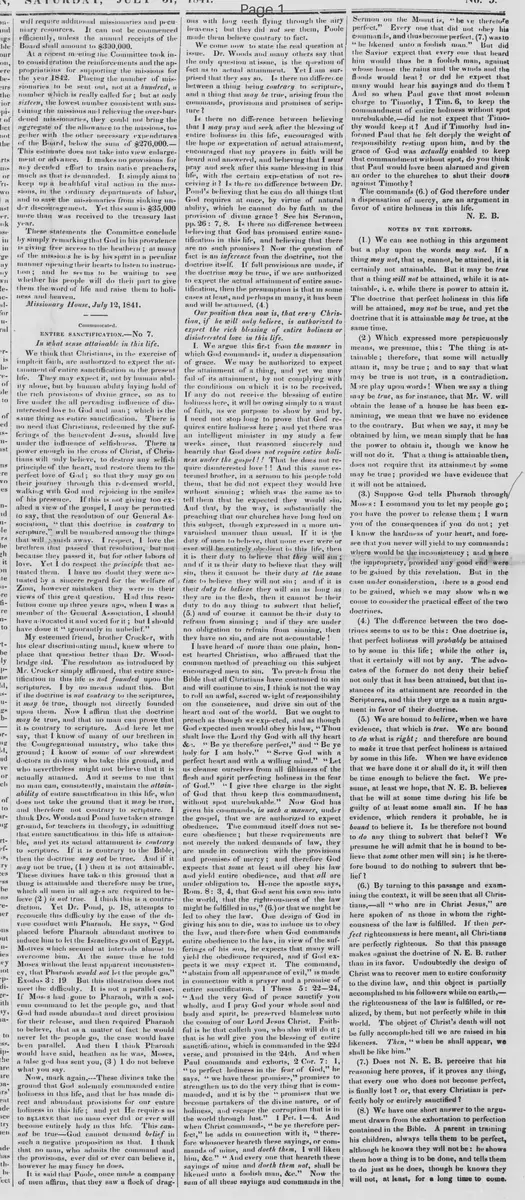
ENTIRE SANCTIFICATION.—NO 7.
In what sense attainable in this life.
We think that Christians, in the exercise of implicit faith, are authorized to expect the attainment of entire sanctification in the present life. They may expect it, not by human ability alone, but by human ability laying hold of the rich provisions of divine grace, so as to live under the all-pervading influence of disinterested love to God and man; which is the same thing as entire sanctification. There is no need that Christians, redeemed by the sufferings of the benevolent Jesus, should live under the influence of selfishness. There is power enough in the cross of Christ, if Christians will only believe, to destroy any selfish principle of the heart, and restore them to the perfect love of God; so that they may go on their journey through this redeemed world, walking with God and rejoicing in the smiles of his presence. If this is not giving too exalted a view of the gospel, I may be permitted to say, that the resolution of our General Association, "that this doctrine is contrary to scripture," will be numbered among the things that will vanish away. I respect, I love the brethren that passed that resolution, but not because they passed it, but for other labors of love. Yet I do respect the principle that actuated them. I have no doubt they were actuated by a sincere regard for the welfare of Zion, however mistaken they were in their views of this great question. Had this resolution come up three years ago, when I was a member of the General Association, I should have advocated it and voted for it; but I should have done it "ignorantly in unbelief."
My esteemed friend, brother Crocker, with his clear discriminating mind, knew where to place that question better than Dr. Woodbridge did. The resolution as introduced by Mr. Crocker simply affirmed, that entire sanctification in this life is not founded upon the scriptures. I by no means admit this. But if the doctrine is not contrary to the scriptures, it may be true, though not directly founded upon them. Now I affirm that the doctrine may be true, and that no man can prove that it is contrary to scripture. And here let me say, that I know of many of our brethren in the Congregational ministry, who take this ground; I know of some of our shrewdest doctors in divinity who take this ground, and who nevertheless might not believe that it is actually attained. And it seems to me that no man can, consistently, maintain the attainability of entire sanctification in this life, who does not take the ground that it may be true, and therefore not contrary to scripture. I think Drs. Woods and Pond have taken strange ground, for teachers in theology, in admitting that entire sanctification in this life is attainable, and yet its actual attainment is contrary to scripture. If it is contrary to the Bible, then the doctrine may not be true. And if it may not be true, then it is not attainable. These divines have taken this ground that a thing is attainable and therefore may be true, which all men in all ages are required to believe is not true. I think this is a contradiction. Yet Dr. Pond, p. 18, attempts to reconcile this difficulty by the case of the divine conduct with Pharaoh. He says, "God placed before Pharaoh abundant motives to induce him to let the Israelites go out of Egypt. Motives which seemed at intervals almost to overcome him. At the same time he told Moses without the least apparent inconsistency, that Pharaoh would not let the people go." Exodus 3: 19 But this illustration does not meet the difficulty. It is not a parallel case. If Moses had gone to Pharaoh, with a solemn command to let the people go, and that God had made abundant and direct provision for their release, and then required Pharaoh to believe, that as a matter of fact he would never let the people go, the case would have been parallel. And then I think Pharaoh would have said, heathen as he was, Moses, a false god has sent you, I do not believe what you say.
Now, mark again,—These divines take the ground that God solemnly commanded entire holiness in this life, and that he has made direct and abundant provisions for our entire holiness in this life; and yet He requires us to believe that no man ever did or ever will become entirely holy in this life. This cannot be true—God cannot demand belief in such a negative proposition as that. I think that no man, who admits the command and the provisions, ever did or ever can believe it however he may fancy he does.
It is said that Poole, once made a company of men affirm, that they saw a flock of dragons with long teeth flying through the airy heavens; but they did not see them, Poole made them believe contrary to fact.
We come now to state the real question at issue. Dr. Woods and many others say that the only question at issue, is the question of fact as to actual attainment. Yet I am surprised that they say so. Is there no difference between a thing being contrary to scripture, and a thing that may be true, arising from the commands, provisions and promises of scripture?
Is there no difference between believing that I may pray and seek after the blessing of entire holiness in this life, encouraged with the hope or expectation of actual attainment, encouraged that my prayers in faith will be heard and answered, and believing that I must pray and seek after this same blessing in this life, with the certain expectation of not receiving it? Is there no difference between Dr. Pond's believing that he can do all things that God requires at once, by virtue of natural ability, which he cannot do by faith in the provision of divine grace? See his Sermon, pp. 26: 7, 8. Is there no difference between believing that God has promised entire sanctification in this life, and believing that there are no such promises? Now the question of fact is an inference from the doctrine, not the doctrine itself. If full provisions are made, if the doctrine may be true, if we are authorized to expect the actual attainment of entire sanctification, then the presumption is that in some cases at least, and perhaps in many, it has been and will be attained.
Our position then now is, that every Christian, if he will only believe, is authorized to expect the rich blessing of entire holiness or disinterested love in this life.
I. We argue this first from the manner in which God commands it, under a dispensation of grace. We may be authorized to expect the attainment of a thing, and yet we may fail of its attainment, by not complying with the conditions on which it is to be received. If any do not receive the blessing of entire holiness here, it will be owing simply to a want of faith, as we purpose to show by and by.
I need not stop long to prove that God requires entire holiness here; and yet there was an intelligent minister in my study a few weeks since, that reasoned sincerely and heartily that God does not require entire holiness under the gospel!! That he does not require disinterested love !! And this same esteemed brother, in a sermon to his people told them, that he did not expect they would live without sinning; which was the same as to tell them that he expected they would sin. And that, by the way, is substantially the preaching that our churches have long had on this subject, though expressed in a more unvarnished manner than usual. If it is the duty of men to believe, that none ever were or ever will be entirely obedient in this life, then it is their duty to believe that they will sin; and if it is their duty to believe that they will sin, then it cannot be their duty at the same time to believe they will not sin; and if it is their duty to believe they will sin as long as they are in the flesh, then it cannot be their duty to do anything to subvert that belief, and of course it cannot be their duty to refrain from sinning; and if they are under no obligation to refrain from sinning, then they have no sin, and are not accountable !
I have heard of more than one plain, honest hearted Christian, who affirmed that the common method of preaching on this subject encouraged men to sin. To preach from the Bible that all Christians have continued to sin and will continue to sin, I think is not the way to roll an awful, sacred weight of responsibility on the conscience, and drive sin out of the heart and out of the world. But we ought to preach as though we expected, and as though God expected men would obey his law, "Thou shalt love the Lord thy God with all thy heart &. "Be ye therefore perfect," and "Be ye holy for I am holy." "Serve God with a perfect heart and with a willing mind." "Let us cleanse ourselves from all filthiness of the flesh and spirit perfecting holiness in the fear of God." "I give thee charge in the sight of God that thou keep this commandment, without spot unrebukable." Now God has given his commands, in such a manner, under the gospel, that we are authorized to expect obedience. The command itself does not secure obedience; but these requirements are not merely the naked demands of law, they are made in connection with the provisions and promises of mercy; and therefore God expects that some at least will obey his law and yield entire obedience, and that all are under obligation to. Hence the apostle says, Rom. 8: 3, 4, that God sent his own son into the world, that the righteousness of the law might be fulfilled in us," or that we might be led to obey the law. One design of God in giving his son to die, was to induce us to obey the law, and therefore when God commands entire obedience to the law, in view of the sufferings of his son, he expects that many will yield the obedience required, and if God expects it we may expect it. The command, "abstain from all appearance of evil," is made in connection with a prayer and a promise of entire sanctification. 1 Thess 5: 22-24, "And the very God of peace sanctify you wholly, and I pray God your whole soul and body and spirit, be preserved blameless unto the coming of our Lord Jesus Christ. Faithful is he that calleth you, who also will do it; that is he will give you the blessing of entire sanctification, which is commanded in the 22d verse, and promised in the 24th. And when Paul commands and exhorts, 2 Cor. 7: 1, "to perfect holiness in the fear of God," he says, "we have these promises," promises to strengthen us to do the very thing that is commanded, and it is by the "promises that we become partakers of the divine nature, or of holiness, and escape the corruption that is in the world through lust." 1 Pet. 1-4. And when Christ commands, "be ye therefore perfect," he adds in connection with it, "therefore whosoever heareth these sayings, or commands of mine, and doeth them, I will liken him, &c." "And every one that heareth these sayings of mine and doeth them not, shall be likened unto a foolish man, &c." Now the sum of all these sayings and commands in the Sermon on the Mount is, "be ye therefore perfect." Every one that did not obey his commands, and thus become perfect, was to "be likened unto a foolish man." But did the Savior expect that every one that heard him would thus be a foolish man, against whose house the rains and the winds and the floods would beat? or did he expect that many would hear his sayings and do them?
And so when Paul gave that most solemn charge to Timothy, 1 Tim. 6, to keep the commandment of entire holiness without spot unrebukable,—did he not expect that Timothy would keep it? And if Timothy had informed Paul that he felt deeply the weight of responsibility resting upon him, and by the grace of God was actually enabled to keep that commandment without spot, do you think that Paul would have been alarmed and given an order to the churches to shut their doors against Timothy?
The commands of God therefore under a dispensation of mercy, are an argument in favor of entire holiness in this life.
N. E. B.
ENTIRE SANCTIFICATION.—NO 7.
In what sense attainable in this life.
We think that Christians, in the exercise of implicit faith, are authorized to expect the attainment of entire sanctification in the present life. They may expect it, not by human ability alone, but by human ability laying hold of the rich provisions of divine grace, so as to live under the all-pervading influence of disinterested love to God and man; which is the same thing as entire sanctification. There is no need that Christians, redeemed by the sufferings of the benevolent Jesus, should live under the influence of selfishness. There is power enough in the cross of Christ, if Christians will only believe, to destroy any selfish principle of the heart, and restore them to the perfect love of God; so that they may go on their journey through this redeemed world, walking with God and rejoicing in the smiles of his presence. If this is not giving too exalted a view of the gospel, I may be permitted to say, that the resolution of our General Association, "that this doctrine is contrary to scripture," will be numbered among the things that will vanish away. I respect, I love the brethren that passed that resolution, but not because they passed it, but for other labors of love. Yet I do respect the principle that actuated them. I have no doubt they were actuated by a sincere regard for the welfare of Zion, however mistaken they were in their views of this great question. Had this resolution come up three years ago, when I was a member of the General Association, I should have advocated it and voted for it; but I should have done it "ignorantly in unbelief."
My esteemed friend, brother Crocker, with his clear discriminating mind, knew where to place that question better than Dr. Woodbridge did. The resolution as introduced by Mr. Crocker simply affirmed, that entire sanctification in this life is not founded upon the scriptures. I by no means admit this. But if the doctrine is not contrary to the scriptures, it may be true, though not directly founded upon them. Now I affirm that the doctrine may be true, and that no man can prove that it is contrary to scripture. And here let me say, that I know of many of our brethren in the Congregational ministry, who take this ground; I know of some of our shrewdest doctors in divinity who take this ground, and who nevertheless might not believe that it is actually attained. And it seems to me that no man can, consistently, maintain the attainability of entire sanctification in this life, who does not take the ground that it may be true, and therefore not contrary to scripture. I think Drs. Woods and Pond have taken strange ground, for teachers in theology, in admitting that entire sanctification in this life is attainable, and yet its actual attainment is contrary to scripture. If it is contrary to the Bible, then the doctrine may not be true. And if it may not be true, then it is not attainable. These divines have taken this ground that a thing is attainable and therefore may be true, which all men in all ages are required to believe is not true. I think this is a contradiction. Yet Dr. Pond, p. 18, attempts to reconcile this difficulty by the case of the divine conduct with Pharaoh. He says, "God placed before Pharaoh abundant motives to induce him to let the Israelites go out of Egypt. Motives which seemed at intervals almost to overcome him. At the same time he told Moses without the least apparent inconsistency, that Pharaoh would not let the people go." Exodus 3: 19 But this illustration does not meet the difficulty. It is not a parallel case. If Moses had gone to Pharaoh, with a solemn command to let the people go, and that God had made abundant and direct provision for their release, and then required Pharaoh to believe, that as a matter of fact he would never let the people go, the case would have been parallel. And then I think Pharaoh would have said, heathen as he was, Moses, a false god has sent you, I do not believe what you say.
Now, mark again,—These divines take the ground that God solemnly commanded entire holiness in this life, and that he has made direct and abundant provisions for our entire holiness in this life; and yet He requires us to believe that no man ever did or ever will become entirely holy in this life. This cannot be true—God cannot demand belief in such a negative proposition as that. I think that no man, who admits the command and the provisions, ever did or ever can believe it however he may fancy he does.
It is said that Poole, once made a company of men affirm, that they saw a flock of dragons with long teeth flying through the airy heavens; but they did not see them, Poole made them believe contrary to fact.
We come now to state the real question at issue. Dr. Woods and many others say that the only question at issue, is the question of fact as to actual attainment. Yet I am surprised that they say so. Is there no difference between a thing being contrary to scripture, and a thing that may be true, arising from the commands, provisions and promises of scripture?
Is there no difference between believing that I may pray and seek after the blessing of entire holiness in this life, encouraged with the hope or expectation of actual attainment, encouraged that my prayers in faith will be heard and answered, and believing that I must pray and seek after this same blessing in this life, with the certain expectation of not receiving it? Is there no difference between Dr. Pond's believing that he can do all things that God requires at once, by virtue of natural ability, which he cannot do by faith in the provision of divine grace? See his Sermon, pp. 26: 7, 8. Is there no difference between believing that God has promised entire sanctification in this life, and believing that there are no such promises? Now the question of fact is an inference from the doctrine, not the doctrine itself. If full provisions are made, if the doctrine may be true, if we are authorized to expect the actual attainment of entire sanctification, then the presumption is that in some cases at least, and perhaps in many, it has been and will be attained.
Our position then now is, that every Christian, if he will only believe, is authorized to expect the rich blessing of entire holiness or disinterested love in this life.
I. We argue this first from the manner in which God commands it, under a dispensation of grace. We may be authorized to expect the attainment of a thing, and yet we may fail of its attainment, by not complying with the conditions on which it is to be received. If any do not receive the blessing of entire holiness here, it will be owing simply to a want of faith, as we purpose to show by and by.
I need not stop long to prove that God requires entire holiness here; and yet there was an intelligent minister in my study a few weeks since, that reasoned sincerely and heartily that God does not require entire holiness under the gospel!! That he does not require disinterested love !! And this same esteemed brother, in a sermon to his people told them, that he did not expect they would live without sinning; which was the same as to tell them that he expected they would sin. And that, by the way, is substantially the preaching that our churches have long had on this subject, though expressed in a more unvarnished manner than usual. If it is the duty of men to believe, that none ever were or ever will be entirely obedient in this life, then it is their duty to believe that they will sin; and if it is their duty to believe that they will sin, then it cannot be their duty at the same time to believe they will not sin; and if it is their duty to believe they will sin as long as they are in the flesh, then it cannot be their duty to do anything to subvert that belief, and of course it cannot be their duty to refrain from sinning; and if they are under no obligation to refrain from sinning, then they have no sin, and are not accountable !
I have heard of more than one plain, honest hearted Christian, who affirmed that the common method of preaching on this subject encouraged men to sin. To preach from the Bible that all Christians have continued to sin and will continue to sin, I think is not the way to roll an awful, sacred weight of responsibility on the conscience, and drive sin out of the heart and out of the world. But we ought to preach as though we expected, and as though God expected men would obey his law, "Thou shalt love the Lord thy God with all thy heart &. "Be ye therefore perfect," and "Be ye holy for I am holy." "Serve God with a perfect heart and with a willing mind." "Let us cleanse ourselves from all filthiness of the flesh and spirit perfecting holiness in the fear of God." "I give thee charge in the sight of God that thou keep this commandment, without spot unrebukable." Now God has given his commands, in such a manner, under the gospel, that we are authorized to expect obedience. The command itself does not secure obedience; but these requirements are not merely the naked demands of law, they are made in connection with the provisions and promises of mercy; and therefore God expects that some at least will obey his law and yield entire obedience, and that all are under obligation to. Hence the apostle says, Rom. 8: 3, 4, that God sent his own son into the world, that the righteousness of the law might be fulfilled in us," or that we might be led to obey the law. One design of God in giving his son to die, was to induce us to obey the law, and therefore when God commands entire obedience to the law, in view of the sufferings of his son, he expects that many will yield the obedience required, and if God expects it we may expect it. The command, "abstain from all appearance of evil," is made in connection with a prayer and a promise of entire sanctification. 1 Thess 5: 22-24, "And the very God of peace sanctify you wholly, and I pray God your whole soul and body and spirit, be preserved blameless unto the coming of our Lord Jesus Christ. Faithful is he that calleth you, who also will do it; that is he will give you the blessing of entire sanctification, which is commanded in the 22d verse, and promised in the 24th. And when Paul commands and exhorts, 2 Cor. 7: 1, "to perfect holiness in the fear of God," he says, "we have these promises," promises to strengthen us to do the very thing that is commanded, and it is by the "promises that we become partakers of the divine nature, or of holiness, and escape the corruption that is in the world through lust." 1 Pet. 1-4. And when Christ commands, "be ye therefore perfect," he adds in connection with it, "therefore whosoever heareth these sayings, or commands of mine, and doeth them, I will liken him, &c." "And every one that heareth these sayings of mine and doeth them not, shall be likened unto a foolish man, &c." Now the sum of all these sayings and commands in the Sermon on the Mount is, "be ye therefore perfect." Every one that did not obey his commands, and thus become perfect, was to "be likened unto a foolish man." But did the Savior expect that every one that heard him would thus be a foolish man, against whose house the rains and the winds and the floods would beat? or did he expect that many would hear his sayings and do them?
And so when Paul gave that most solemn charge to Timothy, 1 Tim. 6, to keep the commandment of entire holiness without spot unrebukable,—did he not expect that Timothy would keep it? And if Timothy had informed Paul that he felt deeply the weight of responsibility resting upon him, and by the grace of God was actually enabled to keep that commandment without spot, do you think that Paul would have been alarmed and given an order to the churches to shut their doors against Timothy?
The commands of God therefore under a dispensation of mercy, are an argument in favor of entire holiness in this life.
N. E. B.
What sub-type of article is it?
Religious
Persuasive
Philosophical
What themes does it cover?
Religion
Morality
What keywords are associated?
Entire Sanctification
Christian Holiness
Divine Grace
Scriptural Commands
Theological Debate
Congregational Ministry
Gospel Provisions
Moral Obedience
What entities or persons were involved?
N. E. B.
Letter to Editor Details
Author
N. E. B.
Main Argument
christians are authorized by scripture to expect and attain entire sanctification in this life through faith in divine grace and provisions, contrary to claims by some divines and associations that it is unattainable or against scripture; biblical commands and promises support its possibility.
Notable Details
Critiques General Association Resolution
References Drs. Woods, Pond, And Mr. Crocker
Cites Exodus 3:19, Romans 8:3 4, 1 Thessalonians 5:22 24, 2 Corinthians 7:1, 1 Peter 1:4, Sermon On The Mount, 1 Timothy 6
Analogy To Pharaoh's Case
Reference To Poole's Illusion Experiment