Thank you for visiting SNEWPapers!
Sign up free
Letter to Editor
March 6, 1849
The Daily Union
Washington, District Of Columbia
What is this article about?
JNO. M. McCALLA, head of a government bureau, defends against congressional charges of office misconduct causing delays in army payments, blaming Congress for withholding authority over clerks and resources, leading to injustices for soldiers, widows, and officers. Dated March 1, 1849.
Clipping
OCR Quality
95%
Excellent
Full Text
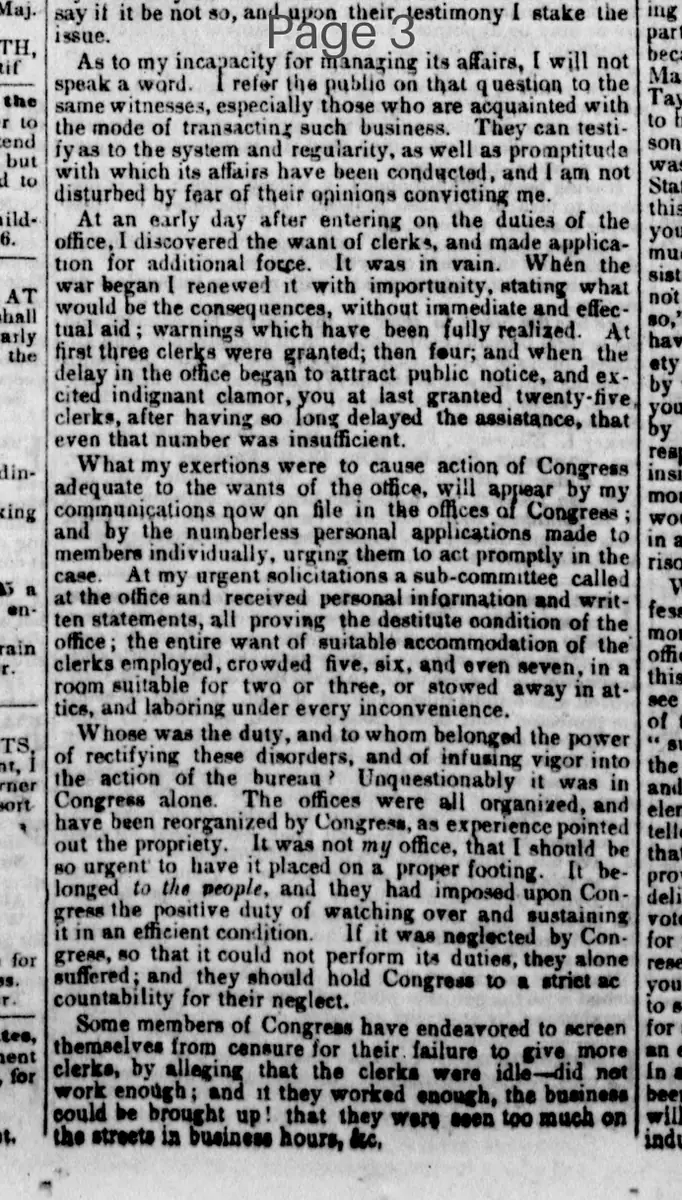
In reply, I have assured them that while a small number would doubtless be found in every bureau who ought to be removed, yet the body of the clerks were hard-working and faithful men: that if Congress would clothe me with power over my own clerks, I would be responsible for their official conduct—that as I had neither the power of removal nor appointment, nor of punishment for offences against official regulations, I would not be held responsible for their misconduct.
And what have been the consequences of this almost criminal neglect on your part? The whole business of the office is thrown back, every branch of it in arrear, and getting worse, as I repeatedly predicted it would be without the promptest assistance. The just claims of the army are grievously delayed, if not refused. The maimed and sick soldier who has fought and suffered for his country must wait for his scanty arrears of pay, no matter how necessitous may be his condition. The widow and orphans, or the aged father or mother, oppressed at once with grief and poverty, are delayed in receiving the hard-earned pittance purchased by the blood of their staff and stay. The officer who has led them in the field, and who labors under complicated pecuniary and property responsibilities, must see his settlements deferred until, often, his patience exhausted, he bitterly condemns his government for its injustice.
In all these cases, the censure naturally falls upon the office in which the injustice is perpetrated, and unless otherwise informed, the head of the bureau is denounced. To this denunciation, mistaken and unjust as it may be, you have given color and sanction in your place in Congress by charging me with being the criminal cause. I think you will find it necessary to defend yourself and your associates from just complaints of being the guilty party, when the public shall learn the facts.
That the House of Representatives knew of the existence of the embarrassments in my office is proven by the joint resolution which it passed directing a preference to be given to the claims of widows and orphans. The poor soldier himself was thus to be put off indefinitely—the poor father or mother, no matter how early their cases might have been presented, were to stand aside until the hundreds, if not thousands, of preferred cases should be disposed of. Now, sir, I call upon you to answer to these postponed claimants, and all others, why, having full power to do so, you did not provide for the rapid settlement of them all?
When I inform you, that if that joint resolution shall pass the Senate, it will cause a delay of such postponed cases for many months, the community will see the extraordinary neglect of which it is the evidence, and the injustice it exhibits towards large classes of equally meritorious claimants with those provided for.
I am happy to know, and bear testimony to the fact, that a large number of your House of both parties are innocent of the wrongs of which I complain. They have sustained all my calls, have voted supplies, and are in no way justly censurable for the present condition of things. Whilst you, and the majority of your associates, were out, or in, electioneering to make a President, you had no time to examine into such small matters as the providing means for paying small sums of money to the widows or parents of soldiers, or the soldiers themselves, of a war which, as a party, you denounced. It is too late for you now to come forward with loud pretensions to an anxious care for those whose complaints would never have been heard had you provided the means, who alone had the power to do it, for answering their most meritorious demands.
Having, as I believe, fully acquitted myself of the charges preferred, and shown where the fault of injustice lies, I will take my leave of you after one or two further remarks. Your attack I consider peculiarly little, under the circumstances. You saw me abused in the press, and heard me denounced by individual claimants; and although you knew me to be innocent, you assail me before the public in a privileged place, and for the base motive of screening yourself from your share of the odium which you knew you deserved, or a baser political and personal intrigue for office. The chivalry and the honesty of such an act I hope are peculiar to yourself, and that no western State at least can find a parallel.
JNO. M. McCALLA.
March 1, 1849.
And what have been the consequences of this almost criminal neglect on your part? The whole business of the office is thrown back, every branch of it in arrear, and getting worse, as I repeatedly predicted it would be without the promptest assistance. The just claims of the army are grievously delayed, if not refused. The maimed and sick soldier who has fought and suffered for his country must wait for his scanty arrears of pay, no matter how necessitous may be his condition. The widow and orphans, or the aged father or mother, oppressed at once with grief and poverty, are delayed in receiving the hard-earned pittance purchased by the blood of their staff and stay. The officer who has led them in the field, and who labors under complicated pecuniary and property responsibilities, must see his settlements deferred until, often, his patience exhausted, he bitterly condemns his government for its injustice.
In all these cases, the censure naturally falls upon the office in which the injustice is perpetrated, and unless otherwise informed, the head of the bureau is denounced. To this denunciation, mistaken and unjust as it may be, you have given color and sanction in your place in Congress by charging me with being the criminal cause. I think you will find it necessary to defend yourself and your associates from just complaints of being the guilty party, when the public shall learn the facts.
That the House of Representatives knew of the existence of the embarrassments in my office is proven by the joint resolution which it passed directing a preference to be given to the claims of widows and orphans. The poor soldier himself was thus to be put off indefinitely—the poor father or mother, no matter how early their cases might have been presented, were to stand aside until the hundreds, if not thousands, of preferred cases should be disposed of. Now, sir, I call upon you to answer to these postponed claimants, and all others, why, having full power to do so, you did not provide for the rapid settlement of them all?
When I inform you, that if that joint resolution shall pass the Senate, it will cause a delay of such postponed cases for many months, the community will see the extraordinary neglect of which it is the evidence, and the injustice it exhibits towards large classes of equally meritorious claimants with those provided for.
I am happy to know, and bear testimony to the fact, that a large number of your House of both parties are innocent of the wrongs of which I complain. They have sustained all my calls, have voted supplies, and are in no way justly censurable for the present condition of things. Whilst you, and the majority of your associates, were out, or in, electioneering to make a President, you had no time to examine into such small matters as the providing means for paying small sums of money to the widows or parents of soldiers, or the soldiers themselves, of a war which, as a party, you denounced. It is too late for you now to come forward with loud pretensions to an anxious care for those whose complaints would never have been heard had you provided the means, who alone had the power to do it, for answering their most meritorious demands.
Having, as I believe, fully acquitted myself of the charges preferred, and shown where the fault of injustice lies, I will take my leave of you after one or two further remarks. Your attack I consider peculiarly little, under the circumstances. You saw me abused in the press, and heard me denounced by individual claimants; and although you knew me to be innocent, you assail me before the public in a privileged place, and for the base motive of screening yourself from your share of the odium which you knew you deserved, or a baser political and personal intrigue for office. The chivalry and the honesty of such an act I hope are peculiar to yourself, and that no western State at least can find a parallel.
JNO. M. McCALLA.
March 1, 1849.
What sub-type of article is it?
Persuasive
Political
What themes does it cover?
Military War
Politics
Economic Policy
What keywords are associated?
Army Payments
Congressional Neglect
Office Delays
Soldiers Claims
Widows Pensions
Bureaucratic Injustice
What entities or persons were involved?
Jno. M. Mccalla
Letter to Editor Details
Author
Jno. M. Mccalla
Main Argument
mccalla defends his bureau's performance against congressional accusations, arguing that delays in settling army claims stem from congress's refusal to grant him authority over clerks or provide adequate resources, shifting blame to legislative neglect.
Notable Details
Reference To Joint Resolution Prioritizing Widows And Orphans
Criticism Of Electioneering Over Office Duties
Accusation Of Political Intrigue