Thank you for visiting SNEWPapers!
Sign up free
Atlanta Daily World
Atlanta, Fulton County, Georgia
What is this article about?
Will Wright, a Black zoo worker convicted of assaulting a white girl in 1936 Atlanta, recounts his terror on death row at Milledgeville prison, prepared for electrocution but granted a stay eight minutes before execution due to a flawed juror, securing a new trial after 19 months.
Clipping
OCR Quality
Full Text
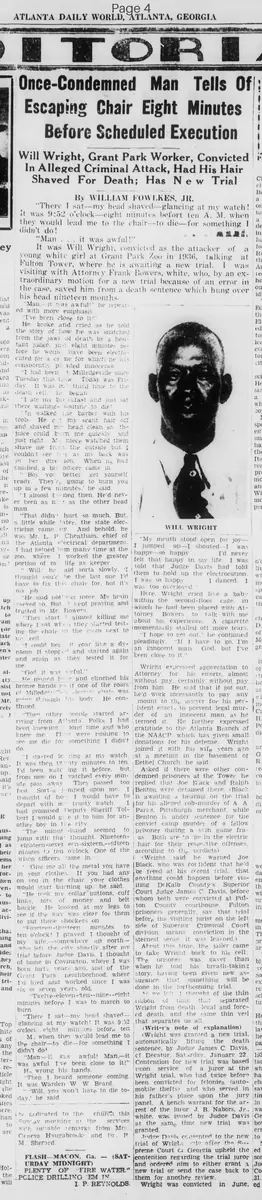
Will Wright, Grant Park Worker, Convicted In Alleged Criminal Attack, Had His Hair Shaved For Death; Has New Trial
By WILLIAM FOWLKES, JR.
"There I sat-my head shaved-glancing at my watch! It was 9:52 o'clock-eight minutes before ten A. M. when they would lead me to the chair--to die-for something I didn't do!
"Man . . . it was awful!"
It was Will Wright, convicted as the attacker of a young white girl at Grant Park Zoo in 1936, talking at Fulton Tower, where he is awaiting a new trial.
He was visiting with Attorney Frank Bowers, white, who, by an extraordinary motion for a new trial because of an error in the case, saved him from a death sentence which hung over his head nineteen months.
"Man . . . it was awful!" he repeated with more emphasis.
He broke and cried as he told the story of how he was snatched from the jaws of death by a hesitant judge just eight minutes before he would have been electrocuted for a crime for which he has consistently pleaded innocence.
"I had been to Milledgeville since Tuesday this week. Today was Friday. It was ninth and one to the death cell I behind.
I ate my breakfast and just sat there waiting- waiting to die!
In walked the barber with his tools. He cut my scant hair off and shaved my head clean so that juice could burn me quick and just right. My niece watched them shave me from the outside but I couldn't see her as my back was in her direction. When he had finished, a big officer came in.
'Boy, you better get yourself ready. They're going to burn you up in a few minutes,' he said.
I almost kneeled then. He'd never been as mean as the other head man.
"That didn't hurt so much. But, a little while later, the state electrician came by. And behold, he was Mr. L. P. Cheatham, chief of the Atlanta electrical department I had helped him many time at the zoo, where I worked the greater portion of my life as keeper.
'Will,' he said sorta slowly, 'I thought you'd be the last one I'd have to fix this chair for, but it's my job.'
He said not much more. My brain ached so. But I kept praying and trusted in Mr. Bowers.
They started almost killing me where I sat when they started testing the chair in the room next to my cell.
I could hear it roar like a dynamo. It stopped and started again and again as they tested it for me.
"God, it was awful."
He paused here and clinched his bronze hands as if one of the roars of Milledgeville's electric chair was going through his body. He continued.
"Then other people started arriving from Atlanta. Folks I had been knowing a long time and who knew me. They were rushing to see me die for something I didn't do.
I started looking at my watch. It was then twenty minutes to ten. I'd been watching it before, but from now on I watched every minute pass away. They passed too fast. Sorta jumped upon me. I thought of how I would have to depart with my trusty watch. I had promised deputy Sheriff Tolbert I would give it to him for another boy in the city.
The minute-hand seemed to jump with that thought. Nineteen-eighteen-seventeen-sixteen,--fifteen minutes to ten o'clock. One of the prison officers came in.
'Give me all the metal you have in your clothes. If you had any on you in the chair, your clothes would start burning up,' he said.
He took my collar buttons, cuff links, bits of money and belt buckle. He looked at my legs to see if the way was clear for them to put those shockers on.
"Fourteen-thirteen minutes to ten o'clock! I prayed. I thought of my wife,--somewhere up north-who left the city shortly after my trial before Judge Davis. I thought of home in Covington, where I was born forty years ago, and of the Grant Park neighborhood, where I'd lived and worked since I was six or seven years old.
"Twelve-eleven-ten--nine--eight minutes before I was to march to burn.
There I sat-my head shaved-glancing at my watch! It was 9:52 o'clock eight minutes before ten A. M. when they would lead me to the chair-to die-for something I didn't do!
"Man-it was awful! Man.-it was awful! I've been close to it!"
He wrung his hands.
…Then I heard someone coming. It was Warden W. W. Beard.
'Will, you won't have to die today,' he said.
"My mouth stood open for joy-I jumped up-I shouted-I was happy-so happy I'd never felt that happy in my life. I was told that Judge Davis had told them to hold up the electrocution. I was so happy I danced. I was too overjoyed.
Here, Wright cried like a baby within the second-floor cage, in which he had been placed with Attorney Bowers to talk with me about his experience. A cigarette momentarily stalled off more tears.
"I hope to get out," he continued pleadingly. "If I have to go, I'm an innocent man God, but I've been close to it."
Wright expressed appreciation to Attorney Bowers for his efforts, almost without pay, certainly without pay from him. He said that if he got out, he'd work incessantly to pay any amount to the lawyer for his persistent effort to prevent legal murder of an innocent man, as he termed it. He further expressed gratitude to the Atlanta Branch of the NAACP which has given small donations for his defense. Wright joined it with his wife years ago at a meeting in the basement of Bethel Church, he said.
Asked if there were other condemned prisoners at the Tower, he replied that Joe Black and Ralph Benton were detained there. (Black is awaiting a hearing on the trial for his alleged rob-murder of A. A. Parks, Pittsburgh merchant, while Benton is under sentence for the convict camp murder of a fellow prisoner during a skin game fracas. Both are to die in the electric chair for their respective offenses, according to the verdicts.)
Wright said he warned Joe Black, who was confident that he'd be freed at his recent trial, that anything could happen before visiting DeKalb County's Superior Court Judge James C. Davis, before whom both were convicted at Fulton County courthouse. Fulton prisoners generally, say that trial before the visiting jurist on the left side of Superior Criminal Court division means conviction in the sternest sense, it was learned.
About this time, the jailer came to take Wright back to his cell. The prisoner was graver than when he told his breath-taking story, having been given new assurance that something will be done in the forthcoming trial.
As we left I thought of the thin ribbon of time that separated Wright from death legal and forced death, and the same thin veil that separates us all.
(Writer's note of explanation)
(Wright was granted a new trial, automatically lifting the death sentence, by Judge James C. Davis, of Decatur, Saturday, January 22.
Contention for new trial was based upon service of a juror at the Wright trial, who had twice before been convicted for felonies (automobile thefts) and who served in his father's place upon the jury panel. A bench warrant for the arrest of the juror J. B. Nabors, Jr., white, was issued by Judge Davis at the same time new trial was granted.
Judge Davis consented to the new trial of Wright only after the Supreme Court of Georgia upheld the contention regarding the trial juror and ordered him to either grant a new trial or send the case back to them for another review.
Wright was convicted in June, 1936, for the alleged criminal attack of a 12-year-old white girl, in which he maintains innocence. He has made three trips to the electric chair at Milledgeville, only to be saved by some legal move, the last time of which is described by him in the preceding paragraphs. He was denied clemency once by the Georgia Prison Commission and by both Governor Talmadge and Governor Rivers. The case twice went to the Supreme Court of Georgia.
New trial for the once-condemned man is scheduled to take place sometime during the sitting of Judge Davis at Fulton Superior Court which commences January 31. The exact date will be announced later.)
What sub-type of article is it?
What themes does it cover?
What keywords are associated?
What entities or persons were involved?
Where did it happen?
Story Details
Key Persons
Location
Atlanta, Georgia; Milledgeville State Prison; Grant Park Zoo; Fulton Tower
Event Date
June 1936 (Conviction); January 22 (New Trial Granted)
Story Details
Will Wright, convicted in 1936 for an alleged attack on a girl at Grant Park Zoo, describes his harrowing experience on death row at Milledgeville, where he was shaved and prepared for electrocution just eight minutes before the scheduled time, only to be spared by a last-minute stay from Judge Davis due to a juror's disqualification, leading to a new trial.