Thank you for visiting SNEWPapers!
Sign up free
Editorial
February 11, 1792
Gazette Of The United States
New York, New York County, New York
What is this article about?
An editorial critiques the fickleness of public opinion and press writings on the new federal government, highlighting shifting criticisms from its adoption, amendments, salaries, debt funding, Quaker petitions, to the Indian war, defending Congress against inconsistent accusations.
Clipping
OCR Quality
95%
Excellent
Full Text
ORIGINAL COMMUNICATIONS.
The people have seldom cause to fear that accusers of their government will be wanting. The risk is, that a sudden and passionate censure will be passed upon their rulers. The pleasure of the people is often opposed to their interest. Public men are at least apt enough to yield to the love of popularity. The greater danger is that they will want firmness when great things are to be obtained by disregarding little ones.
It concerns the people therefore to deal out their censure sparingly; and never till enquiry has first been had. In that case, many men who possess virtue, but want firmness, will dare to serve the public faithfully.
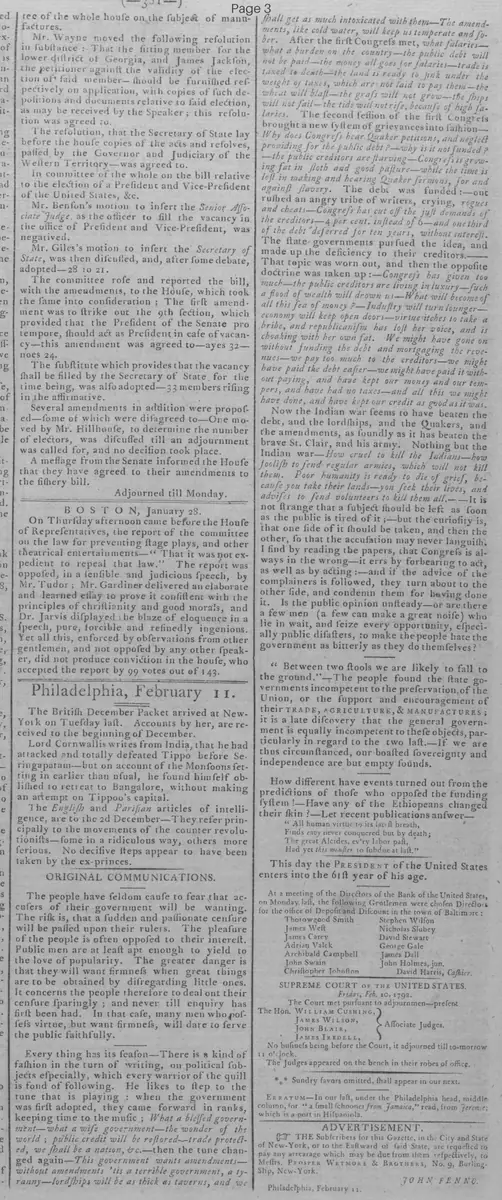
Every thing has its season—There is a kind of fashion in the turn of writing, on political subjects especially, which every warrior of the quill is fond of following. He likes to step to the tune that is playing: when the government was first adopted, they came forward in ranks, keeping time to the music; What a blessed government—what a wise government—the wonder of this world; public credit will be restored—trade protected, we shall be a nation, &c.—then the tune changed again—This government wants amendments—without amendments 'tis a terrible government, a tyranny—lordships will be as thick as taverns, and we shall get as much intoxicated with them—The amendments, like cold water, will keep us temperate and sober. After the first Congress met, what salaries—what a burden on the country—the public debt will not be paid—the money all goes for salaries—trade is taxed to death—the land is ready to sink under the weight of taxes, which are not laid to pay them—the wheat will blast—the grass will not grow—the ships will not sail—the tide will not rise, because of high salaries. The second session of the first Congress brought a new system of grievances into fashion—Why does Congress hear Quaker petitions, and neglect providing for the public debt?—why is it not funded?—the public creditors are starving—Congress is growing fat in sloth and good pasture—while the time is lost in making and hearing Quaker sermons, or an end again slavery. The debt was funded:—out rushed an angry tribe of writers, crying, rogues and cheats—Congress has cut off the just demands of the creditors—4 per cent. instead of 6—and one third of the debt deferred for ten years, without interest. The state governments pursued the idea, and made up the deficiency to their creditors.—That topic was worn out, and then the opposite doctrine was taken up:—Congress has given too much—the public creditors are living in luxury—such a flood of wealth will drown us—What will become of all this Sea of money?—Industry will turn lounger—economy will keep open doors—virtue itches to take a bribe, and republicanism has lost her voice, and is choking with her own fat. We might have gone on without funding the debt and mortgaging the revenues—we pay too much to the creditors—we might have paid the debt easier—we might have paid it without paying, and have kept our money and our tempers, and have had no taxes—and all this we might have done, and have kept our credit as good as it was.
Now the Indian war seems to have beaten the debt, and the lordships, and the Quakers, and the amendments, as soundly as it has beaten the brave St. Clair, and his army. Nothing but the Indian war—How cruel to kill the Indians—how foolish to send regular armies, which will not kill them. Poor humanity is ready to die of grief, because you take their lands—you seek their lives, and advises to send volunteers to kill them all.—It is not strange that a subject should be left as soon as the public is tired of it;—but the curiosity is, that one side of it should be taken, and then the other, so that the accusation may never languish.
I find by reading the papers, that Congress is always in the wrong—it errs by forbearing to act, as well as by acting:—and if the advice of the complainers is followed, they turn about to the other side, and condemn them for having done it. Is the public opinion unsteady—or are there a few men (a few can make a great noise) who lie in wait, and seize every opportunity, especially public disasters, to make the people hate the government as bitterly as they do themselves?
"Between two stools we are likely to fall to the ground."—The people found the state governments incompetent to the preservation, of the Union, or the support and encouragement of their TRADE, AGRICULTURE, & MANUFACTURES; it is a late discovery that the general government is equally incompetent to these objects, particularly in regard to the two last.—If we are thus circumstanced, our boasted sovereignty and independence are but empty sounds.
How different have events turned out from the predictions of those who opposed the funding system!—Have any of the Ethiopians changed their skin?—Let recent publications answer—
"All human virtue to its latest breath,
Finds envy never conquered but by death;
The great Alcides, ev'ry labor past,
Had yet this monster to subdue at last."
The people have seldom cause to fear that accusers of their government will be wanting. The risk is, that a sudden and passionate censure will be passed upon their rulers. The pleasure of the people is often opposed to their interest. Public men are at least apt enough to yield to the love of popularity. The greater danger is that they will want firmness when great things are to be obtained by disregarding little ones.
It concerns the people therefore to deal out their censure sparingly; and never till enquiry has first been had. In that case, many men who possess virtue, but want firmness, will dare to serve the public faithfully.
Every thing has its season—There is a kind of fashion in the turn of writing, on political subjects especially, which every warrior of the quill is fond of following. He likes to step to the tune that is playing: when the government was first adopted, they came forward in ranks, keeping time to the music; What a blessed government—what a wise government—the wonder of this world; public credit will be restored—trade protected, we shall be a nation, &c.—then the tune changed again—This government wants amendments—without amendments 'tis a terrible government, a tyranny—lordships will be as thick as taverns, and we shall get as much intoxicated with them—The amendments, like cold water, will keep us temperate and sober. After the first Congress met, what salaries—what a burden on the country—the public debt will not be paid—the money all goes for salaries—trade is taxed to death—the land is ready to sink under the weight of taxes, which are not laid to pay them—the wheat will blast—the grass will not grow—the ships will not sail—the tide will not rise, because of high salaries. The second session of the first Congress brought a new system of grievances into fashion—Why does Congress hear Quaker petitions, and neglect providing for the public debt?—why is it not funded?—the public creditors are starving—Congress is growing fat in sloth and good pasture—while the time is lost in making and hearing Quaker sermons, or an end again slavery. The debt was funded:—out rushed an angry tribe of writers, crying, rogues and cheats—Congress has cut off the just demands of the creditors—4 per cent. instead of 6—and one third of the debt deferred for ten years, without interest. The state governments pursued the idea, and made up the deficiency to their creditors.—That topic was worn out, and then the opposite doctrine was taken up:—Congress has given too much—the public creditors are living in luxury—such a flood of wealth will drown us—What will become of all this Sea of money?—Industry will turn lounger—economy will keep open doors—virtue itches to take a bribe, and republicanism has lost her voice, and is choking with her own fat. We might have gone on without funding the debt and mortgaging the revenues—we pay too much to the creditors—we might have paid the debt easier—we might have paid it without paying, and have kept our money and our tempers, and have had no taxes—and all this we might have done, and have kept our credit as good as it was.
Now the Indian war seems to have beaten the debt, and the lordships, and the Quakers, and the amendments, as soundly as it has beaten the brave St. Clair, and his army. Nothing but the Indian war—How cruel to kill the Indians—how foolish to send regular armies, which will not kill them. Poor humanity is ready to die of grief, because you take their lands—you seek their lives, and advises to send volunteers to kill them all.—It is not strange that a subject should be left as soon as the public is tired of it;—but the curiosity is, that one side of it should be taken, and then the other, so that the accusation may never languish.
I find by reading the papers, that Congress is always in the wrong—it errs by forbearing to act, as well as by acting:—and if the advice of the complainers is followed, they turn about to the other side, and condemn them for having done it. Is the public opinion unsteady—or are there a few men (a few can make a great noise) who lie in wait, and seize every opportunity, especially public disasters, to make the people hate the government as bitterly as they do themselves?
"Between two stools we are likely to fall to the ground."—The people found the state governments incompetent to the preservation, of the Union, or the support and encouragement of their TRADE, AGRICULTURE, & MANUFACTURES; it is a late discovery that the general government is equally incompetent to these objects, particularly in regard to the two last.—If we are thus circumstanced, our boasted sovereignty and independence are but empty sounds.
How different have events turned out from the predictions of those who opposed the funding system!—Have any of the Ethiopians changed their skin?—Let recent publications answer—
"All human virtue to its latest breath,
Finds envy never conquered but by death;
The great Alcides, ev'ry labor past,
Had yet this monster to subdue at last."
What sub-type of article is it?
Partisan Politics
Economic Policy
War Or Peace
What keywords are associated?
Public Opinion
Government Criticism
Debt Funding
Indian War
Congress Actions
Political Writing
Quaker Petitions
What entities or persons were involved?
Congress
State Governments
Public Creditors
Quakers
St. Clair
Indians
Editorial Details
Primary Topic
Fickleness Of Public And Press Criticism Of The Federal Government
Stance / Tone
Defensive Of Government Against Inconsistent Accusations
Key Figures
Congress
State Governments
Public Creditors
Quakers
St. Clair
Indians
Key Arguments
Public Censure Should Be Sparing And Based On Enquiry To Allow Virtuous Men To Serve Faithfully
Political Writing Follows Fashions, Shifting From Praise To Criticism Of The New Government
Criticisms Evolved From Amendments And Salaries To Debt Funding And Quaker Petitions
Opposition To Debt Funding Flipped To Complaints Of Overpayment
Current Focus On Indian War Shows Same Pattern Of Alternating Accusations
Congress Is Condemned For Both Action And Inaction By Complainers
State Governments Proved Incompetent; Now Federal Government Is Similarly Criticized
Events Contradict Predictions Of Funding System Opponents