Thank you for visiting SNEWPapers!
Sign up free
Editorial
June 19, 1944
The Daily Alaska Empire
Juneau, Juneau County, Alaska
What is this article about?
The editorial highlights U.S. national savings rising from $13.6B in 1941 to $33.6B last year, outpacing 54% income growth, and urges redirecting some savings to current war payments to mitigate future inflation risks from cash reserves, much in War Bonds.
Clipping
OCR Quality
98%
Excellent
Full Text
FIGURES ON SAVINGS
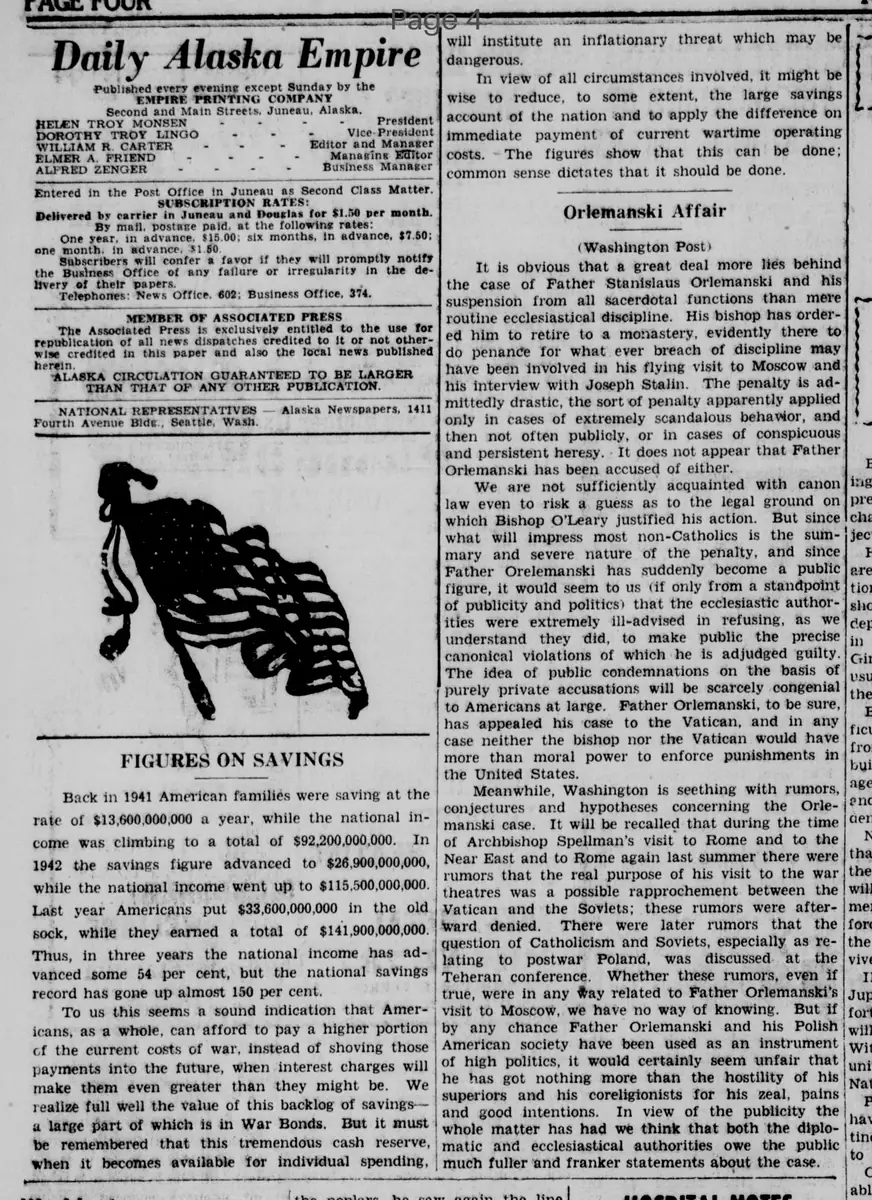
Back in 1941 American families were saving at the rate of $13,600,000,000 a year, while the national income was climbing to a total of $92,200,000,000. In 1942 the savings figure advanced to $26,900,000,000, while the national income went up to $115,500,000,000. Last year Americans put $33,600,000,000 in the old sock, while they earned a total of $141,900,000,000.
Thus, in three years the national income has advanced some 54 per cent, but the national savings record has gone up almost 150 per cent.
To us this seems a sound indication that Americans, as a whole, can afford to pay a higher portion of the current costs of war, instead of shoving those payments into the future, when interest charges will make them even greater than they might be. We realize full well the value of this backlog of savings-- a large part of which is in War Bonds. But it must be remembered that this tremendous cash reserve, when it becomes available for individual spending, will institute an inflationary threat which may be dangerous.
In view of all circumstances involved, it might be wise to reduce, to some extent, the large savings account of the nation and to apply the difference on immediate payment of current wartime operating costs. The figures show that this can be done; common sense dictates that it should be done.
Back in 1941 American families were saving at the rate of $13,600,000,000 a year, while the national income was climbing to a total of $92,200,000,000. In 1942 the savings figure advanced to $26,900,000,000, while the national income went up to $115,500,000,000. Last year Americans put $33,600,000,000 in the old sock, while they earned a total of $141,900,000,000.
Thus, in three years the national income has advanced some 54 per cent, but the national savings record has gone up almost 150 per cent.
To us this seems a sound indication that Americans, as a whole, can afford to pay a higher portion of the current costs of war, instead of shoving those payments into the future, when interest charges will make them even greater than they might be. We realize full well the value of this backlog of savings-- a large part of which is in War Bonds. But it must be remembered that this tremendous cash reserve, when it becomes available for individual spending, will institute an inflationary threat which may be dangerous.
In view of all circumstances involved, it might be wise to reduce, to some extent, the large savings account of the nation and to apply the difference on immediate payment of current wartime operating costs. The figures show that this can be done; common sense dictates that it should be done.
What sub-type of article is it?
Economic Policy
What keywords are associated?
National Savings
Wartime Costs
Inflation Threat
War Bonds
Economic Policy
What entities or persons were involved?
Americans
War Bonds
Editorial Details
Primary Topic
Increasing National Savings And Wartime Financing
Stance / Tone
Advocacy For Reducing Savings To Fund Current War Costs
Key Figures
Americans
War Bonds
Key Arguments
National Income Rose 54% From 1941 To Last Year
National Savings Increased 150% In Same Period
High Savings Indicate Ability To Pay More Current War Costs
Reducing Savings Could Apply To Immediate Wartime Expenses
Large Savings Backlog Poses Future Inflationary Threat