Thank you for visiting SNEWPapers!
Sign up free
Story
September 26, 1916
Tonopah Daily Bonanza
Tonopah, Nye County, Nevada
What is this article about?
Civil War veteran I.S. Kelly speaks at a Manhattan, Nevada picture show, endorsing Republican assembly candidate Arthur Putney and national ticket Charles E. Hughes and Charles W. Fairbanks, while urging party loyalty and critiquing Democrats.
Clipping
OCR Quality
95%
Excellent
Full Text
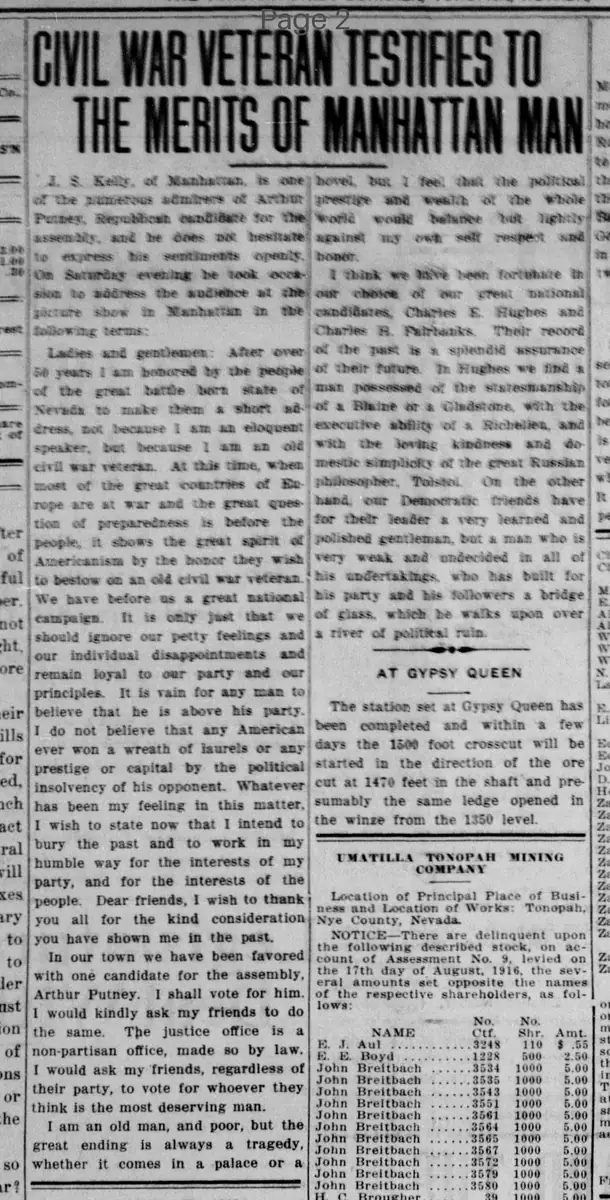
CIVIL WAR VETERAN TESTIFIES TO THE MERITS OF MANHATTAN MAN
I. S. Kelly, of Manhattan, is one of the numerous admirers of Arthur Putney, Republican candidate for the assembly, and he does not hesitate to express his sentiments openly.
On Saturday evening he took occasion to address the audience at the picture show in Manhattan in the following terms:
Ladies and gentlemen: After over 60 years I am honored by the people of the great battle born state of Nevada to make them a short address, not because I am an eloquent speaker, but because I am an old civil war veteran. At this time, when most of the great countries of Europe are at war and the great question of preparedness is before the people, it shows the great spirit of Americanism by the honor they wish to bestow on an old civil war veteran.
We have before us a great national campaign. It is only just that we should ignore our petty feelings and our individual disappointments and remain loyal to our party and our principles. It is vain for any man to believe that he is above his party. I do not believe that any American ever won a wreath of laurels or any prestige or capital by the political insolvency of his opponent. Whatever has been my feeling in this matter I wish to state now that I intend to bury the past and to work in my humble way for the interests of my party, and for the interests of the people. Dear friends, I wish to thank you all for the kind consideration you have shown me in the past.
In our town we have been favored with one candidate for the assembly, Arthur Putney. I shall vote for him. I would kindly ask my friends to do the same. The justice office is a non-partisan office, made so by law. I would ask my friends, regardless of their party, to vote for whoever they think is the most deserving man.
I am an old man, and poor, but the great ending is always a tragedy, whether it comes in a palace or a hovel. But I feel that the political prestige and wealth of the whole world would not balance out lightly against my own self respect and honor.
I think we have been fortunate in our choice of our great national candidates, Charles E. Hughes and Charles W. Fairbanks. Their record of the past is a splendid assurance of their future. In Hughes we find a man possessed of the statesmanship of a Blaine or a Gladstone with the executive ability of a Richelieu, and with the loving kindness and domestic simplicity of the great Russian philosopher, Tolstoy. On the other hand, our Democratic friends have for their leader a very learned and polished gentleman, but a man who is very weak and undecided in all of his undertakings who has built for his party and his followers a bridge of glass, which he walks upon over a river of political ruin.
I. S. Kelly, of Manhattan, is one of the numerous admirers of Arthur Putney, Republican candidate for the assembly, and he does not hesitate to express his sentiments openly.
On Saturday evening he took occasion to address the audience at the picture show in Manhattan in the following terms:
Ladies and gentlemen: After over 60 years I am honored by the people of the great battle born state of Nevada to make them a short address, not because I am an eloquent speaker, but because I am an old civil war veteran. At this time, when most of the great countries of Europe are at war and the great question of preparedness is before the people, it shows the great spirit of Americanism by the honor they wish to bestow on an old civil war veteran.
We have before us a great national campaign. It is only just that we should ignore our petty feelings and our individual disappointments and remain loyal to our party and our principles. It is vain for any man to believe that he is above his party. I do not believe that any American ever won a wreath of laurels or any prestige or capital by the political insolvency of his opponent. Whatever has been my feeling in this matter I wish to state now that I intend to bury the past and to work in my humble way for the interests of my party, and for the interests of the people. Dear friends, I wish to thank you all for the kind consideration you have shown me in the past.
In our town we have been favored with one candidate for the assembly, Arthur Putney. I shall vote for him. I would kindly ask my friends to do the same. The justice office is a non-partisan office, made so by law. I would ask my friends, regardless of their party, to vote for whoever they think is the most deserving man.
I am an old man, and poor, but the great ending is always a tragedy, whether it comes in a palace or a hovel. But I feel that the political prestige and wealth of the whole world would not balance out lightly against my own self respect and honor.
I think we have been fortunate in our choice of our great national candidates, Charles E. Hughes and Charles W. Fairbanks. Their record of the past is a splendid assurance of their future. In Hughes we find a man possessed of the statesmanship of a Blaine or a Gladstone with the executive ability of a Richelieu, and with the loving kindness and domestic simplicity of the great Russian philosopher, Tolstoy. On the other hand, our Democratic friends have for their leader a very learned and polished gentleman, but a man who is very weak and undecided in all of his undertakings who has built for his party and his followers a bridge of glass, which he walks upon over a river of political ruin.
What sub-type of article is it?
Biography
Historical Event
What themes does it cover?
Bravery Heroism
Moral Virtue
Justice
What keywords are associated?
Civil War Veteran
Political Endorsement
Arthur Putney
Hughes Fairbanks
Party Loyalty
What entities or persons were involved?
I. S. Kelly
Arthur Putney
Charles E. Hughes
Charles W. Fairbanks
Where did it happen?
Manhattan, Nevada
Story Details
Key Persons
I. S. Kelly
Arthur Putney
Charles E. Hughes
Charles W. Fairbanks
Location
Manhattan, Nevada
Story Details
Civil War veteran I. S. Kelly endorses Arthur Putney for assembly, urges party loyalty, praises Republican national candidates Hughes and Fairbanks, and critiques the Democratic leader.