Thank you for visiting SNEWPapers!
Sign up free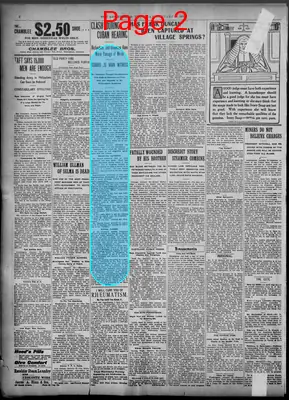
The Age Herald
Birmingham, Jefferson County, Alabama
What is this article about?
In a Washington hearing on Cuban reciprocity, beet sugar interests oppose concessions via testimony from Oxnard and others. Heated debate erupts between Reps. Richardson and Grosvenor over sugar trust influence on policy, with Oxnard denying reflection on President Roosevelt. Petition signed by 45+ members seeks protection for beet industry.
Clipping

OCR Quality
Full Text
OXNARD IS MAIN WITNESS
Mr. Grosvenor Thought His Statement Was Made as Reflection on President and Objected to Mr. Richardson's Questions.
Washington, January 22.-The hearing on Cuban reciprocity were resumed before the ways and means committee today. The beet sugar occupied most of the time being represented by Henry T. Oxnard, president of the American Beet Association, and by delegations from those states interested in the production of sugar from beets. The cane sugar interests of Louisiana also were represented and Chairman Payne arranged to give them a part of the time. At the outset Mr. Place, head of the Cuban delegation, made a statement. He had argued for free trade, he said, as that was the earnest wish of Cuba. But while this was the judgment of the Cuban people, he said, they deferred to the judgment of the American Congress to the whole situation. He added: "We want what you will grant, asking no more advantage nor as much as we are able to concede to your producers. Without suggestion as to limitations we leave to your statesmanship, the relations which are to prevail in the United States."
Mr. Oxnard severely criticised the American sugar trust and Havemeyer. Chairman Payne asked Mr. Oxnard as to the report he had suggested agreement with the Cubans.
Denied Any Agreement.
Mr. Oxnard answered that no such agreement had been made. There had been a discussion during which it was suggested that if Congress decided to grant concessions to Cuba it would be in the form of a rebate. He also denied that there was any trust in the beet sugar industry.
Representative Grosvenor of Ohio and Representative Richardson of Tennessee had a sharp exchange during Mr. Oxnard's examination.
Mr. Richardson referred to a statement by the witness that the sugar trust instigated the Cuban reciprocity movement. Reading from President Roosevelt's message recommending Cuban reciprocity. Mr. Richardson said:
"Do you mean to say that was instigated in any such way?"
Mr. Grosvenor intervened before the witness could answer: 'I denounce such proceedings," said he emphatically, "and I make a point of order against such questioning."
"Your denouncement does not amount to anything," replied Mr. Richardson; this witness asserts that the sugar trust instigated this movement in behalf of Cuba.
"It is a plain effort to get the witness to make an attack upon the President," declared Mr. Grosvenor.
"That is not true," rejoined Mr. Richardson.
Mr. Oxnard finally secured an opportunity to disclaim any purpose of reflecting on the President.
Millions Invested.
At the afternoon session Nathaniel Stewart presented the case of the Michigan beet sugar industry. He said that $7,700,000 was now invested, and this industry had grown up within three years. He argued that Congress had induced the investment and should not destroy it by granting concessions to Cuba.
C. D. Smith of Michigan Farmers' Institute appeared at the request of the government of Michigan to prevent the view of the farming interests engaged in raising beets. He spoke in opposition to Cuban concessions, as did F. P. Hathaway of Michigan and Herbert Myrick of Massachusetts.
While the hearing was going on a petition was circulated on the floor of the House requesting the ways and means committee to make no change in the tariff laws likely to be injuriously to effect the beet sugar industry. About forty-five Republicans, members of the Michigan, California, Indiana, Ohio, Kansas and other beet-producing states signed the petition. On the Democratic side the Louisiana members and Mr. Shafroth, of Colorado were among the signers. Those in charge of the petition expect to get 70 names before it is presented to the ways and means committee.
What sub-type of article is it?
What themes does it cover?
What keywords are associated?
What entities or persons were involved?
Where did it happen?
Story Details
Key Persons
Location
Washington
Event Date
January 22
Story Details
During a congressional hearing on Cuban reciprocity, Henry T. Oxnard testifies on beet sugar interests and criticizes the sugar trust. A sharp exchange occurs between Rep. Grosvenor of Ohio and Rep. Richardson of Tennessee over whether Oxnard's statements reflect on President Roosevelt. Afternoon session features arguments from Michigan beet sugar representatives against concessions to Cuba. A petition opposing changes harmful to beet sugar industry is circulated and signed by members.