Thank you for visiting SNEWPapers!
Sign up free
Staunton Spectator
Staunton, Virginia
What is this article about?
A massive flood struck the Ohio River in February 1832, causing unprecedented destruction along the valley from Wheeling to Cincinnati and beyond. Houses, bridges, farms, and warehouses were swept away, leading to immense property damage estimated over $100,000 in Wheeling alone, displacement of families, and at least one confirmed drowning.
Merged-components note: Continuation of the Ohio River flood article across pages, combining initial reports and additional intelligence.
Clippings
1 of 2
OCR Quality
Full Text
MARCH 2, 1832.
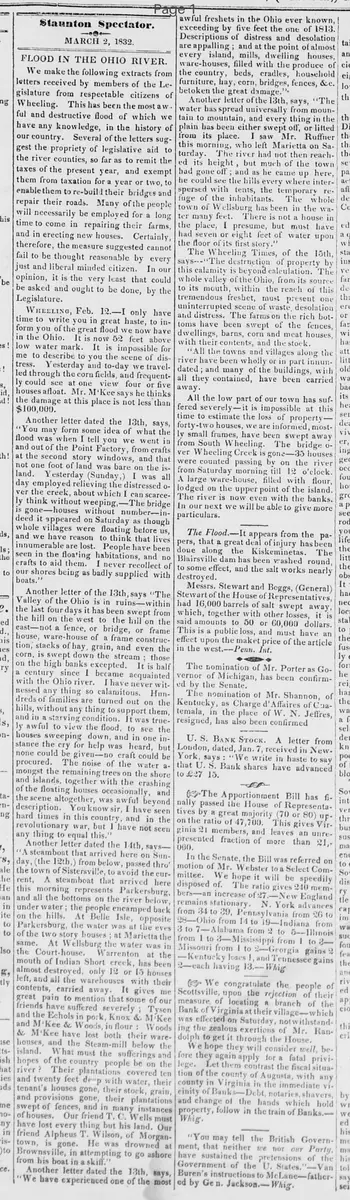
FLOOD IN THE OHIO RIVER.
We make the following extracts from letters received by members of the Legislature from respectable citizens of Wheeling. This has been the most awful and destructive flood of which we have any knowledge, in the history of our country. Several of the letters suggest the propriety of legislative aid to the river counties, so far as to remit the taxes of the present year, and exempt them from taxation for a year or two, to enable them to re-build their bridges and repair their roads. Many of the people will necessarily be employed for a long time to come in repairing their farms, and in erecting new houses. Certainly, therefore, the measure suggested cannot fail to be thought reasonable by every just and liberal minded citizen. In our opinion, it is the very least that could be asked and ought to be done, by the Legislature.
WHEELING, Feb. 12.--I only have time to write you in great haste, to inform you of the great flood we now have in the Ohio. It is now 52 feet above low water mark. It is impossible for me to describe to you the scene of distress. Yesterday and to-day we travelled through the corn fields, and frequently could see at one view four or five houses afloat. Mr. M'Kee says he thinks the damage at this place is not less than $100,000.
Another letter dated the 13th, says, "You may form some idea of what the flood was when I tell you we went in and out of the Point Factory, from crafts at the second story windows, and that not one foot of land was bare on the island. Yesterday (Sunday.) I was all day employed relieving the distressed over the creek, about which I can scarcely think without weeping,--The bridge is gone--houses without number--indeed it appeared on Saturday as though whole villages were floating before us, and we have reason to think that lives innumerable are lost. People have been seen in the floating habitations, and no crafts to aid them. I never recollect of our shores being as badly supplied with boats."
Another letter of the 13th, says "The Valley of the Ohio is in ruins--within the last four days it has been swept from the hill on the west to the hill on the east--not a fence, or bridge, or frame house, ware-house of a frame construction, stacks of hay, grain, and even the corn, is swept down the stream ; those on the high banks excepted. It is half a century since I became acquainted with the Ohio river. I have never witnessed any thing so calamitous. Hundreds of families are turned out on the hills, without any thing to support them, and in a starving condition. It was truly awful to view the flood, to see the houses sweeping down, and in one instance the cry for help was heard, but none could be given--no craft could be procured. The noise of the water amongst the remaining trees on the shore and islands, together with the crashing of the floating houses occasionally, and the scene altogether, was awful beyond description. You know sir, I have seen hard times in this country, and in the revolutionary war, but I have not seen any thing to equal this."
Another letter dated the 14th, says--"A steamboat that arrived here on Sunday, (the 12th,) from below, passed thro' the town of Sistersville, to avoid the current, A steamboat that arrived here this morning represents Parkersburg, and all the bottoms on the river below, under water ; the people encamped back on the hills. At Belle Isle, opposite Parkersburg, the water was at the eves of the two story houses ; at Marietta the same. At Wellsburg the water was in the Court-house. Warrenton at the mouth of Indian Short creek, has been almost destroyed, only 12 or 15 houses left, and all the warehouses with their contents, carried away. It gives me great pain to mention that some of our friends have suffered severely ; Tyson and the Echols in pork, Knox & M'Kee and M'Kee & Woods, in flour : Woods & M'Kee have lost both their warehouses, and the Steam-mill below the island. What must the sufferings and hopes of the country people be on the river? Their plantations covered ten and twenty feet deep with water, their tenant's houses gone, their stock, grain, and provisions gone, their plantations swept of fences, and in many instances of houses. Our friend T.C. Wells must have lost every thing but his land. Our friend Alpheus T. Wilson, of Morgantown, is gone. He was drowned at Brownsville, in attempting to go ashore from his boat in a skiff."
Another letter dated the 13th, says, "We have experienced one of the most awful freshets in the Ohio ever known, exceeding by five feet the one of 1813. Descriptions of distress and desolation are appalling ; and at the point of almost every island, mills, dwelling houses, ware-houses, filled with the produce of the country, beds, cradles, household furniture, hay, corn, bridges, fences, &c. betoken the great damage."
Another letter of the 13th, says, "The water has spread universally from mountain to mountain, and every thing in the plain has been either swept off, or lifted from its place. I saw Mr. Ruffner this morning, who left Marietta on Saturday. The river had not then reached its height , but much of the town had gone off ; and as he came up here, he could see the hills every where interspersed with tents, the temporary refuge of the inhabitants. The whole town of Wellsburg has been in the water many feet. There is not a house in the place, I presume, but must have had seven or eight feet of water upon the floor of its first story."
The Wheeling Times, of the 15th. says--"The destruction of property by this calamity is beyond calculation. The whole valley of the Ohio, from its source to its mouth, within the reach of this tremendous freshet, must present one uninterrupted scene of waste, desolation and distress. The farms on the rich bottoms have been swept of the fences, dwellings, barns, corn and meat houses, with their contents, and the stock.
"All the towns and villages along the river have been wholly or in part inundated; and many of the buildings, with all they contained, have been carried away.
All the low part of our town has suffered severely--it is impossible at this time to estimate the loss of property--forty-two houses, we are informed, mostly small frames, have been swept away from South Wheeling. The bridge over Wheeling Creek is gone--35 houses were counted passing by on the river from Saturday morning till 12 o'clock. A large ware-house, filled with flour, lodged on the upper point of the island. The river is now even with the banks. In our next we will be able to give more particulars."
The Flood.--It appears from the papers, that a great deal of injury has been done along the Kiskeminetas. The Blairsville dam has been washed round, to some effect, and the salt works nearly destroyed. Messrs. Stewart and Boggs, (General) Stewart of the House of Representatives, had 16,000 barrels of salt swept away, which, together with other losses, it is said amounts to 50 or 60,000 dollars. This is a public loss, and must have an effect upon the market price of the article in the west.--Penn. Int.
The Flood—Additional Intelligence.—The Beaver (Pa.) paper says that the rise in the Ohio and Beaver creek, was greater by seven or eight feet than ever was known before. Bridgewater, Sharon and Falls-town were all inundated. A great many light buildings were carried away. The loss of one individual, Stephen Stone, is estimated at near $10,000. The water was up to the ceiling in Gen. Lacock's house, and his stable and other out houses, fences and hay stacks, were carried away, and his valuable library destroyed.
The Maysville Monitor of the 17th says: "Maysville is believed to be one of the highest situations of any town on the Ohio, yet the water is now invading our streets to a considerable extent, being near seventy feet above low water mark, and at the time of writing this, the rise still continues. The extent of damage sustained by farmers and others on the river is immense, and without precedent in this part of the country. For several days stacks of small grain, and hay, have been floating past here in continued succession. Several frame buildings of considerable size have also passed down, moving on with the calm majesty peculiar to the great river which has swept them from their foundation."
A Cincinnati paper of the 14th says: Water-st. is navigable for boats of almost any tonnage. The destruction of property is immense; cellars filled with water—board-yards swept of every stick of timber—and some houses already on the move. The water was still on the rise, some people were moving from the first to the second stories—others from the second escaping in boats.
The Cincinnati Gazette of the 15th says "The river continues to rise, and individual distress is increased. We learn from below that the inhabitants of the lower part of Louisville have betaken themselves to the upper stories."
What sub-type of article is it?
What keywords are associated?
What entities or persons were involved?
Where did it happen?
Domestic News Details
Primary Location
Ohio River Valley
Event Date
February 12 17, 1832
Key Persons
Outcome
at least one drowning (alpheus t. wilson); hundreds of families displaced and starving; massive property destruction including over 40 houses swept away in wheeling, bridges gone, warehouses and mills lost, damages exceeding $100,000 in wheeling and $50-60,000 for stewart and boggs; towns like warrenton nearly destroyed; legislative aid suggested for tax relief.
Event Details
A catastrophic flood inundated the Ohio River valley, reaching 52-70 feet above low water mark, exceeding previous records. Entire villages, houses, farms, fences, bridges, and warehouses floated away; people rescued from second-story windows; distress scenes included cries for help unanswered due to lack of boats; impacts from Wheeling to Cincinnati, Louisville, Maysville, Parkersburg, Marietta, Wellsburg, and tributaries like Kiskeminetas and Beaver Creek.