Thank you for visiting SNEWPapers!
Sign up free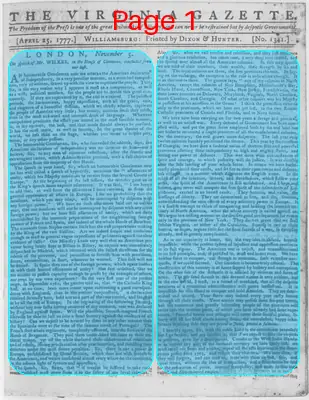
The Virginia Gazette
Richmond, Williamsburg, Richmond County, Virginia
What is this article about?
In a speech to the House of Commons on November 5, Mr. Wilkes defends the American Declaration of Independence, criticizes British war efforts against the 13 colonies, highlights hypocritical assurances of amity from European powers like France and Spain, and urges recalling fleets, repealing acts since 1763, and negotiating peace to restore the empire.
Clipping
OCR Quality
Full Text
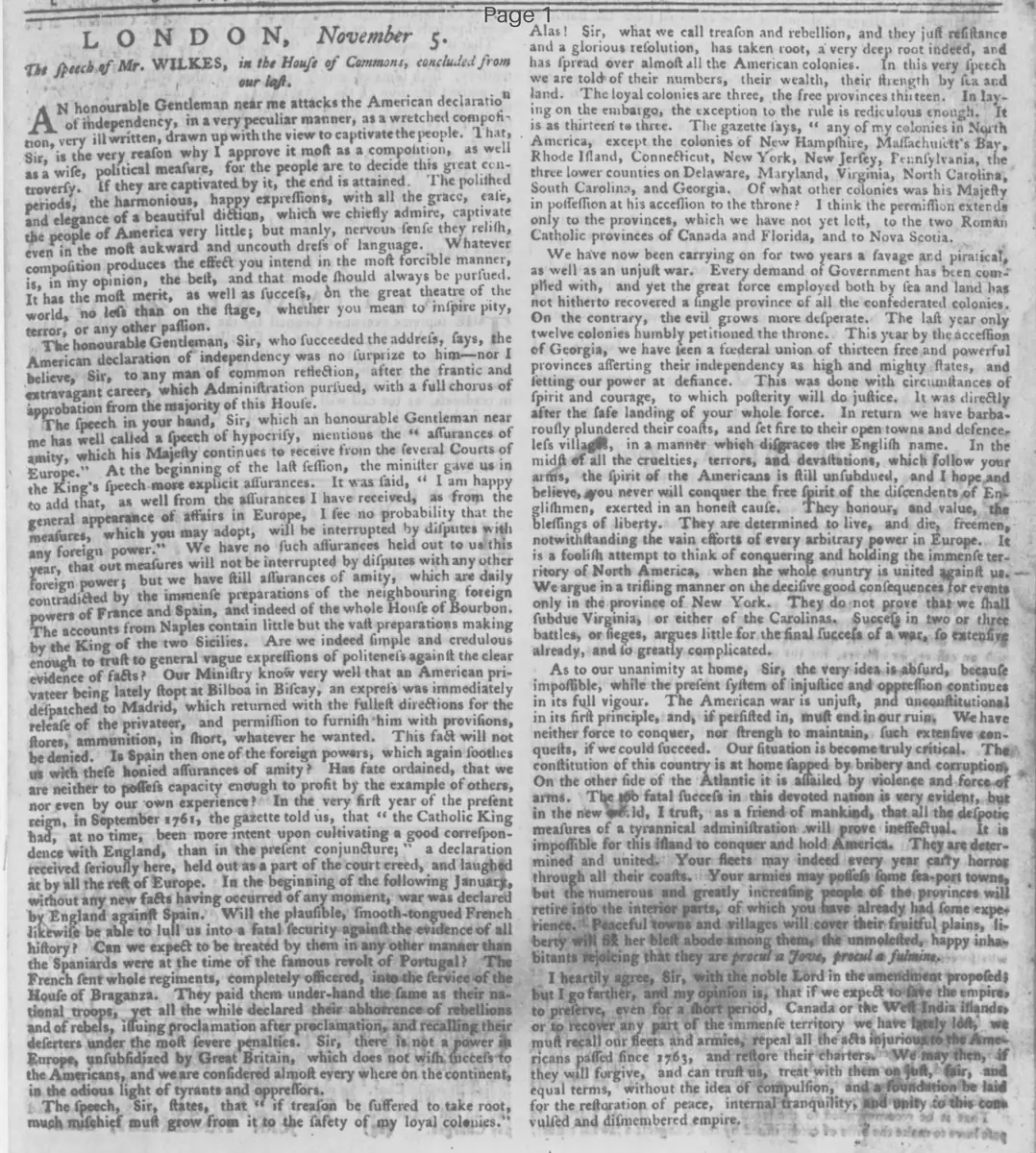
The speech of Mr. WILKES, in the House of Commons, concluded from our last.
No honourable Gentleman near me attacks the American declaration of independency, in a very peculiar manner, as a wretched composition, very ill written, drawn up with the view to captivate the people. That, Sir, as a wise, is the political measure, for the people are to decide this great controversy. The very reason why I approve it most as a composition, as well as controversy. If they are captivated by it, the end is attained. The polished and elegance of a beautiful diction, which we chiefly admire, captivate periods, the harmonious, happy expressions, with all the grace, ease, the people of America very little; but manly, nervous energy they relish, even in the most awkward and uncouth dress of language. Whatever composition produces the effect you intend in the most forcible manner, it has the most merit, as well as success, on the great theatre of the world, no less than on the stage, whether you mean to inspire pity, terror, or any other passion.
I believe, Sir, to any man of common reflection, after the frantic and extravagant career, which Administration pursued, with a full chorus of approbation from the majority of this House. The speech in your hand, Sir, which an honourable Gentleman near me has well called a speech of hypocrisy, mentions the "assurances of amity, which his Majesty continues to receive from the several Courts of Europe." At the beginning of the last session, the minister gave us in the King's speech—more explicit assurances. It was said, "I am happy to add that, as well from the assurances I have received, as from the general appearance of affairs in Europe, I see no probability that the measures, which you may adopt, will be interrupted by disputes with any foreign power."
We have not such assurances held out to us this year, that our measures will not be interrupted by disputes with any other foreign power; but we have still assurances of amity, which are daily contradicted by the immense preparations of the neighbouring foreign powers of France and Spain, and indeed of the whole House of Bourbon. The accounts from Naples contain little but the vast preparations making by the King of the two Sicilies. Are we indeed simple and credulous enough to trust to general vague expressions of politeness against the clear evidence of facts? Our Ministry know very well that an American privateer being lately stopped at Bilboa in Biscay, an express was immediately dispatched to Madrid, which returned with the fullest directions for the release of the privateer, and permission to furnish him with provisions, stores, ammunition, in short, whatever he wanted. This fact will not be denied. Is Spain then one of the foreign powers, which again soothes us with these honied assurances of amity? Has fate ordained, that we are neither to possess capacity enough to profit by the example of others, nor even by our own experience? In the very first year of the present reign, in September 1761, the gazette told us, that "the Catholic King had, at no time, been more intent upon cultivating a good correspondence with England, than in the present conjuncture;" a declaration received seriously here, held out as a part of the court creed, and laughed at by all the rest of Europe. In the beginning of the following January, without any new facts having occurred of any moment, war was declared by England against Spain. Will the plausible, smooth-tongued French likewise be able to lull us into a fatal security against the evidence of all history? Can we expect to be treated by them in any other manner than the Spaniards were at the time of the famous revolt of Portugal? The French sent whole regiments, completely officered, into the service of the House of Braganza. They paid them under-hand the same as their national troops, yet all the while declared their abhorrence of rebellions and of rebels, issuing proclamation after proclamation, and recalling their deserters under the most severe penalties.
Sir, there is not a power in Europe, subsidized by Great Britain, which does not wish success to the Americans, and we are considered almost every where on the continent, in the odious light of tyrants and oppressors.
The speech, Sir, states, that "if treason be suffered to take root, much mischief must grow from it to the safety of my loyal colonies."
Alas! Sir, what we call treason and rebellion, and they just resistance and a glorious resolution, has taken root, a very deep root indeed, and has spread over almost all the American colonies. In this very speech we are told of their numbers, their wealth, their strength by sea and land. The loyal colonies are three, the free provinces thirteen. In laying on the embargo, the exception to the rule is ridiculous enough. It is as thirteen to three. The gazette lays, "any of my colonies in North America, except the colonies of New Hampshire, Massachusetts Bay, Rhode Island, Connecticut, New York, New Jersey, Pennsylvania, the three lower counties on Delaware, Maryland, Virginia, North Carolina, South Carolina, and Georgia." Of what other colonies was his Majesty in possession at his accession to the throne? I think the permission extends only to the provinces, which we have not yet lost, to the two Roman Catholic provinces of Canada and Florida, and to Nova Scotia.
We have now been carrying on for two years a savage and piratical as well as an unjust war. Every demand of Government has been complied with, and yet the great force employed both by sea and land has not hitherto recovered a single province of all the confederated colonies. On the contrary, the evil grows more desperate. The last year only twelve colonies humbly petitioned the throne. This year by the accession of Georgia, we have seen a federal union of thirteen free and powerful provinces asserting their independency as high and mighty states, and setting our power at defiance.
This was done with circumstances of spirit and courage, to which posterity will do justice. It was directly after the safe landing of your whole force. In return we have barbarously plundered their coasts, and set fire to their open towns and defenceless villages, in a manner which disgraces the English name. In the midst of all the cruelties, terrors, and devastations, which follow your arms, the spirit of the Americans is still unsubdued, and I hope and believe, you never will conquer the free spirit of the descendants of Englishmen, exerted in an honest cause. They honour, and value, the blessings of liberty. They are determined to live, and die, freemen, notwithstanding the vain efforts of every arbitrary power in Europe. It is a foolish attempt to think of conquering and holding the immense territory of North America, when the whole country is united against us.
We argue in a trifling manner on the decisive good consequences for events only in the province of New York. They do not prove that we shall subdue Virginia, or either of the Carolinas. Success in two or three battles, or sieges, argues little for the final success of a war, so extensive already, and so greatly complicated.
As to our unanimity at home, Sir, the very idea is absurd, because impossible, while the present system of injustice and oppression continues in its full vigour. The American war is unjust, and unconstitutional in its first principle, and, if persisted in, must end in our ruin.
We have neither force to conquer, nor strength to maintain, such extensive conquests, if we could succeed. Our situation is become truly critical. The constitution of this country is at home sapped by bribery and corruption. On the other side of the Atlantic it is assailed by violence and force of arms. The too fatal success in this devoted nation is very evident, but in the new world, I trust, as a friend of mankind, that all the despotic measures of a tyrannical administration will prove ineffectual.
It is impossible for this island to conquer and hold America. They are determined and united. Your fleets may indeed every year carry horror through all their coasts. Your armies may possess some sea-port towns, but the numerous and greatly increasing people of the provinces will retire into the interior parts, of which you have already had some experience. Peaceful towns and villages will cover their fruitful plains, liberty will keep her blest abode among them, the unmolested, happy inhabitants rejoicing that they are procul a Jove, procul a fulmine.
I heartily agree, Sir, with the noble Lord in the amendment proposed; but I go farther, and my opinion is, that if we expect to save the empire, to preserve, even for a short period, Canada or the West India islands, or to recover any part of the immense territory we have lately lost, we must recall our fleets and armies, repeal all the acts injurious to the Americans passed since 1763, and restore their charters.
We may then, if they will forgive, and can trust us, treat with them on just, fair, and equal terms, without the idea of compulsion, and a foundation be laid for the restoration of peace, internal tranquility, and unity to this convulsed and dismembered empire.
What sub-type of article is it?
What keywords are associated?
What entities or persons were involved?
Where did it happen?
Foreign News Details
Primary Location
North America
Event Date
November 5
Key Persons
Outcome
british forces have not recovered any province after two years of war; federal union of thirteen american provinces asserting independence; british plundering and burning of american towns; no specific casualties mentioned.
Event Details
Mr. Wilkes delivers a speech in the House of Commons defending the American Declaration of Independence as effective rhetoric, criticizing British administration's hypocritical assurances of European amity amid preparations by France, Spain, and others supporting Americans, highlighting the spread of rebellion in thirteen colonies versus three loyal ones, decrying the unjust war and its failures, and proposing recall of forces, repeal of acts since 1763, and negotiation for peace.