Thank you for visiting SNEWPapers!
Sign up free
Editorial
September 5, 1879
Springfield Weekly Republican
Springfield, Hampden County, Massachusetts
What is this article about?
A reflective essay on the transition from summer to autumn in New England, describing natural changes, the exhilaration of late summer days, and praising the season's beauty while urging appreciation of daily moments over planned outings. Contrasts with a memorable 1877 summer.
Clipping
OCR Quality
98%
Excellent
Full Text
ONE WORD MORE FOR SUMNER.
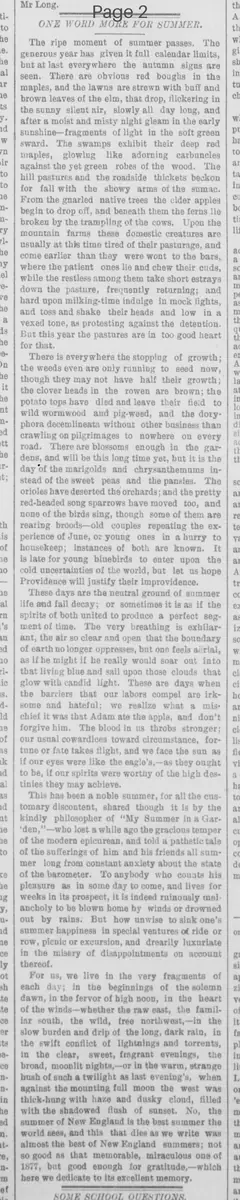
The ripe moment of summer passes. The generous year has given it full calendar limits, but at last everywhere the autumn signs are seen. There are obvious red boughs in the maples, and the lawns are strewn with buff and brown leaves of the elm, that drop, flickering in the sunny silent air, slowly all day long, and after a moist and misty night gleam in the early sunshine-fragments of light in the soft green sward. The swamps exhibit their deep red maples, glowing like adorning carbuncles against the yet green robes of the wood. The hill pastures and the roadside thickets beckon for fall with the showy arms of the sumac. From the gnarled native trees the cider apples begin to drop off, and beneath them the ferns lie broken by the trampling of the cows. Upon the mountain farms these domestic creatures are usually at this time tired of their pasturage, and come earlier than they were wont to the bars, where the patient ones lie and chew their cuds, while the restless among them take short estrays down the pasture, frequently returning; and hard upon milking-time indulge in mock fights, and toss and shake their heads and low in a vexed tone, as protesting against the detention. But this year the pastures are in too good heart for that.
There is everywhere the stopping of growth; the weeds even are only running to seed now, though they may not have half their growth: the clover heads in the rowen are brown: the potato tops have died and leave their field to wild wormwood and pig-weed, and the doryphora decemlineata without other business than crawling on pilgrimages to nowhere on every road. There are blossoms enough in the gardens, and will be this long time yet, but it is the day of the marigolds and chrysanthemums instead of the sweet peas and the pansies. The orioles have deserted the orchards; and the pretty red-headed song sparrows have moved too, and none of the birds sing, though some of them are rearing broods-old couples repeating the experience of June, or young ones in a hurry to housekeep; instances of both are known. It is late for young bluebirds to enter upon the cold uncertainties of the world, but let us hope Providence will justify their improvidence.
These days are the neutral ground of summer life and fall decay; or sometimes it is as if the spirits of both united to produce a perfect segment of time. The very breathing is exhilarating, the air so clear and open that the boundary of earth no longer oppresses, but one feels aerial, as if he might if he really would soar out into that living blue and sail upon those clouds that glow with candid light. These are days when the barriers that our labors compel are irksome and hateful; we realize what a mischief it was that Adam ate the apple, and don't forgive him. The blood in us throbs stronger: our usual cowardices toward circumstance, for tune or fate takes flight, and we face the sun as if our eyes were like the eagle's,-as they ought to be, if our spirits were worthy of the high destinies they may achieve.
This has been a noble summer, for all the customary discontent, shared though it is by the kindly philosopher of "My Summer in a Garden,"-who lost a while ago the gracious temper of the modern epicurean, and told a pathetic tale of the sufferings of him and his friends all summer long from constant anxiety about the state of the barometer. To anybody who counts his pleasure as in some day to come, and lives for weeks in its prospect, it is indeed ruinously melancholy to be blown home by winds or drowned out by rains. But how unwise to sink one's summer happiness in special ventures of ride or row, picnic or excursion, and drearily luxuriate in the misery of disappointments on account thereof.
For us, we live in the very fragments of each day; in the beginnings of the solemn dawn, in the fervor of high noon, in the heart of the winds-whether the raw east, the familiar south, the wild, free northwest, in the slow burden and drip of the long, dark rain, in the swift conflict of lightnings and torrents, in the clear, sweet, fragrant evenings, the broad, moonlit nights,-or in the warm, strange brush of such a twilight as last evening's, when against the mounting full moon the west was thick-hung with haze and dusky cloud, filled with the shadowed flush of sunset. No, the summer of New England is the best summer the world sees, and this that dies as we write was almost the best of New England summers: not so good as that memorable, miraculous one of 1877, but good enough for gratitude,-which here we dedicate to its excellent memory.
The ripe moment of summer passes. The generous year has given it full calendar limits, but at last everywhere the autumn signs are seen. There are obvious red boughs in the maples, and the lawns are strewn with buff and brown leaves of the elm, that drop, flickering in the sunny silent air, slowly all day long, and after a moist and misty night gleam in the early sunshine-fragments of light in the soft green sward. The swamps exhibit their deep red maples, glowing like adorning carbuncles against the yet green robes of the wood. The hill pastures and the roadside thickets beckon for fall with the showy arms of the sumac. From the gnarled native trees the cider apples begin to drop off, and beneath them the ferns lie broken by the trampling of the cows. Upon the mountain farms these domestic creatures are usually at this time tired of their pasturage, and come earlier than they were wont to the bars, where the patient ones lie and chew their cuds, while the restless among them take short estrays down the pasture, frequently returning; and hard upon milking-time indulge in mock fights, and toss and shake their heads and low in a vexed tone, as protesting against the detention. But this year the pastures are in too good heart for that.
There is everywhere the stopping of growth; the weeds even are only running to seed now, though they may not have half their growth: the clover heads in the rowen are brown: the potato tops have died and leave their field to wild wormwood and pig-weed, and the doryphora decemlineata without other business than crawling on pilgrimages to nowhere on every road. There are blossoms enough in the gardens, and will be this long time yet, but it is the day of the marigolds and chrysanthemums instead of the sweet peas and the pansies. The orioles have deserted the orchards; and the pretty red-headed song sparrows have moved too, and none of the birds sing, though some of them are rearing broods-old couples repeating the experience of June, or young ones in a hurry to housekeep; instances of both are known. It is late for young bluebirds to enter upon the cold uncertainties of the world, but let us hope Providence will justify their improvidence.
These days are the neutral ground of summer life and fall decay; or sometimes it is as if the spirits of both united to produce a perfect segment of time. The very breathing is exhilarating, the air so clear and open that the boundary of earth no longer oppresses, but one feels aerial, as if he might if he really would soar out into that living blue and sail upon those clouds that glow with candid light. These are days when the barriers that our labors compel are irksome and hateful; we realize what a mischief it was that Adam ate the apple, and don't forgive him. The blood in us throbs stronger: our usual cowardices toward circumstance, for tune or fate takes flight, and we face the sun as if our eyes were like the eagle's,-as they ought to be, if our spirits were worthy of the high destinies they may achieve.
This has been a noble summer, for all the customary discontent, shared though it is by the kindly philosopher of "My Summer in a Garden,"-who lost a while ago the gracious temper of the modern epicurean, and told a pathetic tale of the sufferings of him and his friends all summer long from constant anxiety about the state of the barometer. To anybody who counts his pleasure as in some day to come, and lives for weeks in its prospect, it is indeed ruinously melancholy to be blown home by winds or drowned out by rains. But how unwise to sink one's summer happiness in special ventures of ride or row, picnic or excursion, and drearily luxuriate in the misery of disappointments on account thereof.
For us, we live in the very fragments of each day; in the beginnings of the solemn dawn, in the fervor of high noon, in the heart of the winds-whether the raw east, the familiar south, the wild, free northwest, in the slow burden and drip of the long, dark rain, in the swift conflict of lightnings and torrents, in the clear, sweet, fragrant evenings, the broad, moonlit nights,-or in the warm, strange brush of such a twilight as last evening's, when against the mounting full moon the west was thick-hung with haze and dusky cloud, filled with the shadowed flush of sunset. No, the summer of New England is the best summer the world sees, and this that dies as we write was almost the best of New England summers: not so good as that memorable, miraculous one of 1877, but good enough for gratitude,-which here we dedicate to its excellent memory.
What sub-type of article is it?
Seasonal Reflection
Nature Description
What keywords are associated?
Summer End
Autumn Signs
New England
Nature Observation
Daily Appreciation
Seasonal Beauty
What entities or persons were involved?
New England
My Summer In A Garden Philosopher
Editorial Details
Primary Topic
Praise For New England Summer And Its Transition To Autumn
Stance / Tone
Nostalgic And Appreciative
Key Figures
New England
My Summer In A Garden Philosopher
Key Arguments
Summer's End Brings Visible Autumn Signs In Nature.
Late Summer Days Are Exhilarating And Liberating.
True Happiness Comes From Living In Daily Moments, Not Planned Events.
New England Summers Are The World's Best, This One Nearly As Good As 1877.