Thank you for visiting SNEWPapers!
Sign up free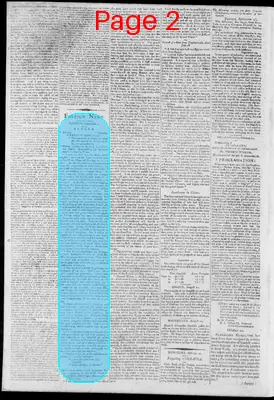
Virginia Argus
Richmond, Virginia
What is this article about?
Correspondence between French General Menou and British Commodore Sir Sidney Smith following the assassination of General Kleber in Cairo, discussing prisoner exchanges, the El-Arish convention, and negotiations for evacuating Egypt amid the ongoing war.
Clipping
OCR Quality
Full Text
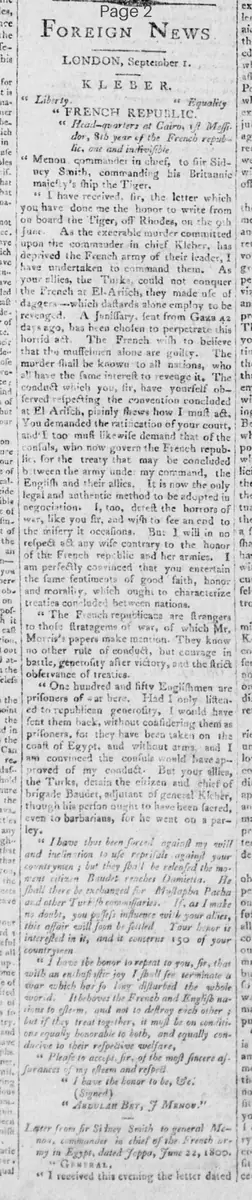
LONDON, September 1.
KLEBER.
"Liberty
"Equality
"FRENCH REPUBLIC.
"Head-quarters at Cairo, 1st Messidor, 8th year of the French Republic, one and indivisible.
"Menou, commander in chief, to Sir Sidney Smith, commanding his Britannic Majesty's ship the Tiger.
"I have received, sir, the letter which you have done me the honor to write from on board the Tiger, off Rhodes, on the 8th June. As the execrable murder committed upon the commander in chief Kleber, has deprived the French army of their leader, I have undertaken to command them. As your allies, the Turks, could not conquer the French at El-Arish, they made use of daggers--which dastards alone employ to be revenged. A Janissary, sent from Gaza a few days ago, has been chosen to perpetrate this horrid act. The French wish to believe that the Musselmen alone are guilty. The murder shall be known to all nations, who all have the same interest to revenge it. The conduct which you, sir, have yourself observed respecting the convention concluded at El Arish, plainly shows how I must act. You demanded the ratification of your court, and I too must likewise demand that of the consuls, who now govern the French Republic, for the treaty that may be concluded between the army under my command, the English and their allies. It is now the only legal and authentic method to be adopted in negotiation. I, too, detest the horrors of war, like you sir, and wish to see an end to the misery it occasions. But: I will in no respect act any wise contrary to the honor of the French Republic and her armies. I am perfectly convinced that you entertain the same sentiments of good faith, honor and morality, which ought to characterize treaties concluded between nations.
"The French republicans are strangers to those stratagems of war, of which Mr. Morrig's papers make mention. They know no other rule of conduct, but courage in battle, generosity after victory, and the strict observance of treaties.
"One hundred and fifty Englishmen are prisoners of war here. Had I only listened to republican generosity, I would have sent them back, without considering them as prisoners, for they have been taken on the coast of Egypt, and without arms, and I am convinced the consuls would have approved of my conduct. But your allies, the Turks, detain the citizen and chief of brigade Baudet, adjutant of general Kleber, though his person ought to have been sacred, even to barbarians, for he went on a parley.
"I have thus been freed against my will and inclination to use reprisals against your countrymen; but they shall be released the moment citizen Baudet reaches Damietta. He shall there be exchanged for Mustapha Pacha and other Turkish commissaries. If, as I make no doubt, you possess influence with your allies, this affair will soon be settled. Your honor is interested in it, and it concerns one of your countrymen.
"I have the honor to repeat to you, sir, that with an entire sincere joy I shall see terminate a war which has so long disturbed the whole world. It behooves the French and English nations to esteem, and not to destroy each other: but if they treat together, it must be on conditions equally honorable to both, and equally conducive to their respective welfare.
"Please to accept, sir, of the most sincere assurances of my esteem and respect.
"I have the honor to be, etc.
(Signed)
"ABDULAN BER, MENOU."
Later from Sir Sidney Smith to General Menou, commander in chief of the French army in Egypt, dated Joppa, June 22, 1800.
"GENERAL,
"I received this evening the letter dated the 20th June, which you have done me the honor to write me. At the moment at which I expected to see general Kleber under the most fortunate and favorable auspices, I learn with the highest chagrin, and with the greatest grief, his tragical death. I immediately communicated to the grand vizier and the Ottoman ministers, in the terms in which you communicated to me this melancholy event, and nothing but the certainty and the details with which you gave me this intelligence, could have induced their excellencies to believe it. The grand vizier formerly and officially declared to me, that he had not the least knowledge of those who committed this assassination, and I am very sure that his declaration is true and sincere, and without entering into the details of this melancholy event, which gives me inexpressible uneasiness, I shall content myself with replying to the articles of your letter which treat of our affairs.
"If the grand vizier has retained in his camp the aid de camp Baudot, who was sent to him at Jaffil il Harem, it is because his excellency did not think it right to suffer any person to depart from his camp at the moment when he saw himself surrounded by his enemies. Baudot was detained at Jaffil il Harem, as the Turkish officers, detained to serve as hostages reciprocally with him, were detained at Cairo.
"This aid de camp has been sent to the Ottoman fleet, to be exchanged as you desired, and in the mean time, his excellency the captain Pacha having arrived here, his absence from the fleet has caused the desired exchange to be put off. When his excellency shall have returned to his fleet, as the aid de camp Baudot is before Alexandria, the business of the exchange may be concluded if you think proper. But I do not see why you should make it to depend upon an affair which only concerns you and the Porte, the setting at liberty 150 English, who were ship wrecked at Cape Broulos. I expect from your good faith, and from your justice, that according to the regulations agreed upon between our nations, for the reciprocal exchange of our prisoners, which we are authorized to carry into effect, you will permit the return of captain Butal, his officers, and crew.
"The promises which you make me in the hope of reciprocal ones being made by me, cannot be applied to this circumstance and I think it superfluous to offer you in return the promise of my good offices in favor of a person who finds himself in a disagreeable situation which I myself have experienced. I am persuaded that the grand vizier will give the stamp of his generous and high approbation to all the honorable proceedings we may have one with another. The stratagems of war are unknown both to you and to us; and besides that, I shall continue to comport myself towards you with the same frankness, and the same good faith that I have hitherto done, I shall earnestly employ all my efforts to prevent any person with whom I have any influence, from holding a conduct contrary to these principles. Be persuaded that the hostile dispositions which have been announced by the first opposition to the execution of the treaty, and which has acquired both extent and publicity, may be done away by the means which the present circumstances will furnish to the two parties of corresponding and mutually understanding each other, and that in the end we shall be united by the bonds of a sincere friendship. In the mean time we shall carry on war with the means which we have hitherto employed against you, and with those farther ones which we can procure, and we shall endeavor to render ourselves worthy of the esteem of your brave troops.
'The hostilities which you have committed without waiting for the reply of lord Keith, who was not acquainted with the convention for the evacuation of Egypt, has served as the rule of our conduct. I had not asked of my court its ratification. I had only endeavored to obviate some unforeseen difficulties which opposed themselves to the return of the French into their country.
". General Kleber, in the last preliminaries which were stopped, not having made it understood that the treaty which was to follow would require the ratification of the consuls who now govern France; this condition which you put into your preliminaries, appears to be a refusal to evacuate Egypt, and the grand vizier has charged me to demand from you on this subject, a clear and precise answer. You desire as well as me the termination of the calamities of war which desolate the whole universe.
"It is in your power to remove one of the obstacles which oppose the conclusion of peace, by evacuating Egypt on the conditions agreed upon by gen. Kleber; if you refuse this, we will employ all our means, and all those of our allies, to oblige you to some conditions which may not be so advantageous for you. I cannot dissemble to you how much the discharge of this duty will cost me, but, the evacuation of Egypt being a point of interesting to the good of humanity, the way of conferences and correspondence for making the necessary dispositions for this purpose, is always open.
"As the admiral, under whose orders I act, is at a considerable distance from me, I am authorized to subscribe to such arrangements as circumstances may require, and though under the present circumstances I am not in the situation of making any new proposition, yet I am ready to listen to any which you may be disposed to make to me; and I can officially assure you that I will use every means in my power to oppose every inconsiderable step, and every vexatious opposition, from whatever quarter it may proceed.
I will strictly perform the precise instructions of my court: I know its principles are founded on the most exact equity and justice. My conduct shall strictly conform to these principles, and all my efforts shall be employed in performing my duty, and promoting its interests. As it is not yet certain to what part I am going, I must beg you to send your answer by two couriers, one to Alexandria, and the other to Jaffa, at the camp of the Grand Vizier."
What sub-type of article is it?
What keywords are associated?
What entities or persons were involved?
Where did it happen?
Foreign News Details
Primary Location
Egypt
Event Date
June 1800
Key Persons
Outcome
assassination of general kleber by a janissary; detention of 150 english prisoners and french aide-de-camp baudet; discussions on prisoner exchanges and ratification of el-arish convention for evacuating egypt.
Event Details
General Menou informs Sir Sidney Smith of Kleber's murder, accuses Turks, proposes prisoner exchanges conditional on Baudet's release, and insists on consular ratification for any new treaty. Smith expresses grief, denies Turkish involvement, explains Baudet's detention, urges release of shipwrecked Englishmen, and presses for Egyptian evacuation per Kleber's agreement without new ratification demands.