Thank you for visiting SNEWPapers!
Sign up free
The New Hampshire Gazette
Portsmouth, Rockingham County, New Hampshire
What is this article about?
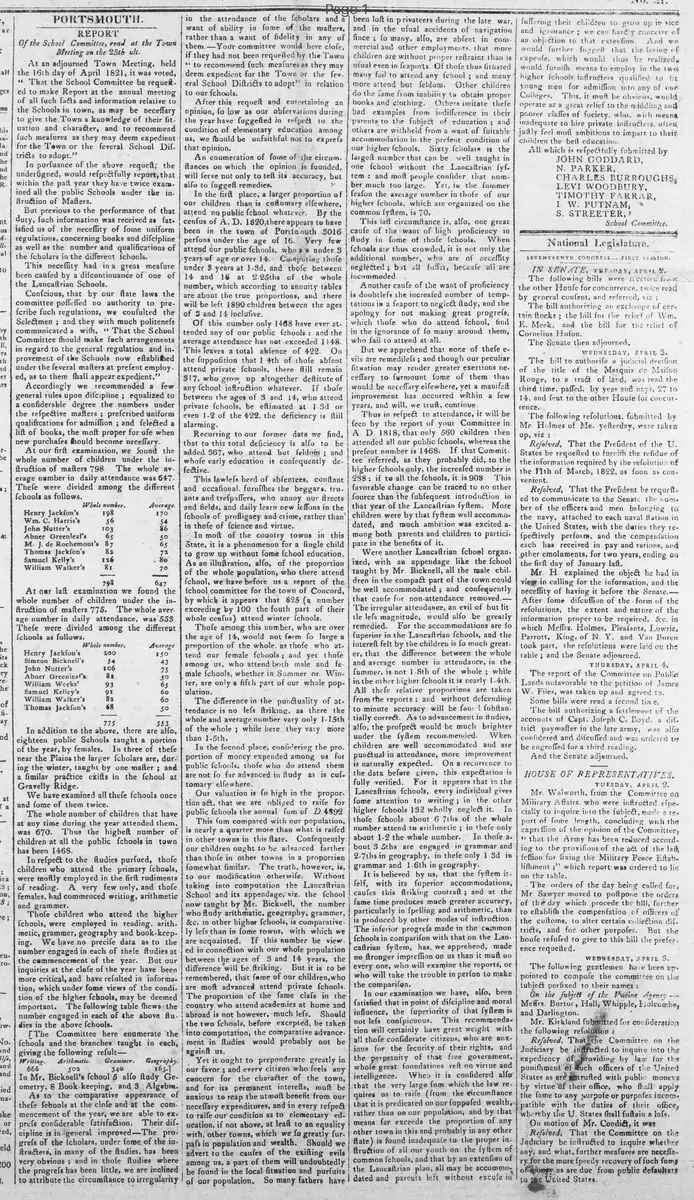
School Committee report to Portsmouth town meeting on April 25, 1821, detailing examinations of public schools, attendance statistics, studies pursued, and recommendations for improvements including reinstating a Lancastrian school to address low attendance and educational deficiencies.
Merged-components note: Merging the two tables into the school committee report as they contain the embedded attendance data referenced in the text of the report.
Clipping
OCR Quality
Full Text
| Whole number. | Average | |
| Henry Jackfon's | 198 | 170 |
| Wm. C. Harris's | 56 | 54 |
| John Nutter's | 103 | 86 |
| Abner Greenleaf's | 65 | 50 |
| M. J. de Rochemont's | 87 | 65 |
| Thomas Jackfon's | 82 | 72 |
| Samuel Kelly's | 126 | 80 |
| William Walker's | 81 | 70 |
PORTSMOUTH.
REPORT
Of the School Committee, read at the Town
Meeting on the 25th ult.
At an adjourned Town Meeting, held
the 16th day of April 1821, it was voted,
"That the School Committee be requested
to make Report at the annual meeting
of all such facts and information relative to
the Schools in town, as may be necessary
to give the Town a knowledge of their sit-
uation and character, and to recommend
such measures as they may deem expedient
for the Town or the several School Dis-
tricts to adopt."
In pursuance of the above request; the
undersigned, would respectfully report, that
within the past year they have twice exam-
ined all the public Schools under the in-
struction of Masters.
But previous to the performance of that
duty, such information was received as sat-
isfied us of the necessity of some uniform
regulations, concerning books and discipline
as well as the number and qualifications of
the scholars in the different schools.
This necessity had in a great measure
been caused by a discontinuance of one of
the Lancastrian Schools.
Conscious, that by our state laws the
committee possessed no authority to pre-
scribe such regulations, we consulted the
Selectmen; and they with much politeness
communicated a wish, "That the School
Committee should make such arrangements
in regard to the general regulation and in-
provement of the Schools now established
under the several masters at present employ-
ed, as to them shall appear expedient."
Accordingly we recommended a few
general rules upon discipline; equalized to
a considerable degree the numbers under
the respective masters; prescribed uniform
qualifications for admission; and selected a
list of books, the most proper for use when
new purchases should become necessary.
At our first examination, we found the
whole number of children under the in-
struction of masters 798. The whole av-
erage number in daily attendance was 647.
These were divided among the different
schools as follows.
798
647
At our last examination we found the
whole number of children under the in-
struction of masters 775. The whole aver-
age number in daily attendance, was 553.
These were divided among the different
schools as follows.
775
553
In addition to the above, there are also,
eighteen public Schools taught a portion
of the year, by females. In three of these
near the Plains the larger scholars are, dur-
ing the winter, taught by one master; and
a similar practice exists in the school at
Gravelly Ridge.
We have examined all these schools once
and some of them twice.
The whole number of children that have
at any time during the year attended them,
was 670. Thus the highest number of
children at all the public schools in town
has been 1468.
In respect to the studies pursued, those
children who attend the primary schools,
were mostly employed in the first rudiments
of reading. A very few only, and those
females, had commenced writing, arithmetic
and grammar.
Those children who attend the higher
schools, were employed in reading, arith-
metic, grammar, geography and book-keep-
ing. We have no precise data as to the
number engaged in each of these studies at
the commencement of the year. But our
inquiries at the close of the year have been
more critical, and have resulted in informa-
tion, which under some views of the condi-
tion of the higher schools, may be deemed
important. The following table shows the
number engaged in each of the above stu-
dies in the above schools.
The Committee here enumerate the
schools and the branches taught in each,
giving the following result—
Writing.
Arithmetic.
Grammar.
Geography.
666
502
340
163.
In Mr. Bicknell's school 5 also study Ge-
ometry, 8 Book keeping, and 3 Algebra.
As to the comparative appearance of
these schools at the close and at the com-
mencement of the year, we are able to ex-
press considerable satisfaction. Their dis-
cipline is in general improved—The pro-
gress of the scholars, under some of the in-
structors, in many of the studies, has been
very obvious: and in those studies where
the progress has been little, we are inclined
in the attendance of the Scholars and a
want of ability in some of the masters,
rather than a want of fidelity in any of
them.—Your committee would here close,
if they had not been requested by the Town
"to recommend such measures as they may
deem expedient for the Town or the sev-
eral School Districts to adopt" in relation
to our schools.
After this request and entertaining an
opinion, so low as our observations during
the year have suggested in respect to the
condition of elementary education among
us, we should be unfaithful not to express
that opinion.
An enumeration of some of the circum-
stances on which the opinion is founded,
will serve not only to test its accuracy, but
also to suggest remedies.
In the first place, a larger proportion of
our children than is customary elsewhere,
attend no public school whatever. By the
census of A. D, 1820, there appears to have
been in the town of Portsmouth 3016
persons under the age of 16. Very few
attend our public schools, who are under 3
years of age or over 14. Computing those
under 3 years at 1-3d, and those between
14 and 16 at 2.25ths of the whole
number, which according to annuity tables
are about the true proportions, and there
will be left 1890 children between the ages
of 3 and 14 inclusive.
Of this number only 1468 have ever at-
tended any of our public schools: and the
average attendance has not exceeded 1200.
This leaves a total absence of 422. On
the supposition that 1 4th of those absent
attend private schools, there still remain
317, who grow up altogether destitute of
any school instruction whatever. If those
between the ages of 3 and 14, who attend
private schools, be estimated at 1.3d or
even 1.2 of the 422, the deficiency is still
alarming.
Recurring to our former data we find,
that to this total deficiency is also to be
added 367, who attend but seldom; and
whose early education is consequently de-
fective.
This lawless herd of absentees, constant
and occasional, furnishes the beggars, tru-
ants and trespassers, who annoy our streets
and fields, and daily learn new lessons in the
schools of profligacy and crime, rather than
in those of science and virtue.
In most of the country towns in this
State. it is a phenomenon for a single child
to grow up without some school education.
As an illustration, also, of the proportion
of the whole population, who there attend
school, we have before us a report of the
school committee for the town of Concord,
by which it appears that 825 (a number
exceeding by 100 the fifth part of their
whole census) attend winter schools.
Those among this number, who are over
the age of 14, would not form so large a
proportion of the whole, as those who at-
tend our female schools: and yet those
among us, who attend both male and fe-
male schools, whether in Summer or Win-
ter, are only a fifth part of our whole pop
ulation.
The difference in the punctuality of at-
tendance is no less striking, as there the
whole and average number vary only 1-15th
of the whole; while here they vary more
than 1-5th.
In the second place, considering the pro-
portion of money expended among us for
public schools, those who do attend them
are not so far advanced in study as is cu-
tomary elsewhere.
Our valuation is so high in the propor-
tion act, that we are obliged to raise for
public schools the annual sum of $4892
This sum compared with our population,
is nearly a quarter more than what is raised
in other towns in this state. Consequently
our children ought to be advanced farther
than those in other towns in a proportion
somewhat similar. The truth, however, is,
to our mortification otherwise. Without
taking into computation the Lancastrian
School and its appendage, viz. the school
now taught by Mr. Bicknell, the number
who study arithmetic, geography, grammar,
&c. in other higher schools, is comparative-
ly less than in some towns, with which we
are acquainted. If this number be view-
ed in connection with our whole population
between the ages of 3 and 14 years, the
difference will be striking. But it is to be
remembered, that some of our children, who
are most advanced attend private schools.
The proportion of the same class in the
country who attend academies at home and
abroad is not however, much less. Should
the two schools, before excepted, be taken
into computation, the comparative advance-
ment in studies would probably not be
against us.
Yet it ought to preponderate greatly in
our favor; and every citizen who feels any
concern for the character of the town,
and for its permanent interests, must be
anxious to reap the utmost benefit from our
necessary expenditures, and in every respect
to raise our condition as to elementary ed-
ucation, if not above, at least to an equality
with, other towns, which we so greatly sur-
pass in population and wealth. Should we
advert to the causes of the existing evils
among us, a part of them will undoubtedly
been lost in privateers during the late war,
and in the usual accidents of navigation
since: so many, also, are absent in com-
mercial and other employments, that more
children are without proper restraint than is
usual even in seaports. Of those thus situated
many fail to attend any school; and many
more attend but seldom. Other children
do the same from inability to obtain proper
books and clothing. Others imitate these
bad examples from indifference in their
parents to the subject of education; and
others are withheld from a want of suitable
accommodation in the present condition of
our higher schools. Sixty scholars is the
largest number that can be well taught in
one school without the Lancastrian sys-
tem: and most people consider that num-
ber much too large. Yet, in the summer
season the average number in those of our
higher schools, which are organized on the
common system, is 70.
This last circumstance is, also, one great
cause of the want of high proficiency in
study in some of those schools. When
schools are thus crowded, it is not only the
additional number, who are of necessity
neglected; but all suffer, because all are
incommoded
Another cause of the want of proficiency
is doubtless the increased number of temp-
tations in a seaport to neglect study, and the
apology for not making great progress,
which those who do attend school, find
in the ignorance of so many around them,
who fail to attend at all.
But we apprehend that none of these e-
vils are remediless; and though our peculiar
situation may render greater exertions ne-
cessary to surmount some of them than
would be necessary elsewhere, yet a manifest
improvement has occurred within a few
years, and will, we trust, continue.
Thus in respect to attendance, it will be
seen by the report of your Committee in
A. D. 1818, that only 560 children then
attended all our public schools, whereas the
present number is 1468. If that Commit-
tee referred, as they probably did, to the
higher schools only, the increased number is
238: if to all the schools, it is 908 This
favorable change can be traced to no other
source than the subsequent introduction in
that year of the Lancastrian system. More
children were by that system well accommo-
dated, and much ambition was excited a-
mong both parents and children to partici-
pate in the benefits of it.
Were another Lancastrian school organ-
ized, with an appendage like the school
taught by Mr. Bicknell, all the male chil-
dren in the compact part of the town could
be well accommodated; and consequently
that cause for non-attendance removed.-
The irregular attendance, an evil of but lit-
tle less magnitude, would also be greatly
remedied. For the accommodations are so
superior in the Lancastrian schools, and the
interest felt by the children is so much great-
er, that the difference between the whole
and average number in attendance, in the
summer, is not 1.5th of the whole: while
in the other higher schools it is nearly 1.4th.
All these relative proportions are taken
from the reports: and without descending
to minute accuracy will be found substan-
tially correct. As to advancement in studies,
also, the prospect would be much brighter
under the system recommended. When
children are well accommodated and are
punctual in attendance, more improvement
is naturally expected, On a recurrence to
the data before given, this expectation is
fully verified. For it appears that in the
Lancastrian schools, every individual gives
some attention to writing; in the other
higher schools 132 wholly neglect it. In
those schools about 6 7ths of the whole
number attend to arithmetic; in these only
about 1.2 the whole number. In those a-
bout 3 5ths are engaged in grammar and
2.7ths in geography, in these only 1 3d in
grammar and 1.6th in geography.
It is believed by us, that the system it-
self, with its superior accommodations,
causes this striking contrast; and at the
same time produces much greater accuracy,
particularly in spelling and arithmetic, than
is produced by other modes or instruction.
The inferior progress made in the common
schools in comparison with that on the Lan-
castrian system, has, we apprehend, made
no stronger impression on us than it must on
every one, who will examine the reports, or
who will take the trouble in person to make
the comparison.
In our examination we have, also, been
satisfied that in point of discipline and moral
influence, the superiority of that system is
not less conspicuous. This recommenda-
tion will certainly have great weight with
all those considerate citizens, who are anx-
ious for the security of their rights, and
the perpetuity of that free government,
whose great foundations rest on virtue and
intelligence. When it is considered also
that the very large sum which the law re-
quires us to raise (from the circumstance
that it is predicated on our supposed wealth,
rather than on our population, and by that
means far exceeds the proportion of any
other town in this and probably in any other
state) is found inadequate to the proper in-
struction of all our youth on the system of
common schools, and that by an extension of
the Lancastrian plan, all may be accommo-
dated and parents left without excuse in
suffering their children to grow up in vice
and ignorance; we can hardly conceive of
an objection to that extension and we
would further suggest that the saving of
expense. which would thus be realized,
would furnish means to employ in the two
higher schools instructors qualified to fit
young men for admission into any of our
Colleges. This, it must be obvious, would
operate as a great relief to the middling and
poorer classes of society, who, with means
inadequate to hire private instructors, often
justly feel most ambitious to impart to their
children the best education.
All which is respectfully submitted by
JOHN GODDARD,
N. PARKER,
CHARLES BURROUGHS
LEVI WOODBURY,
TIMOTHY FARRAR,
I. W. PUTNAM.
S. STREETER,
School Committee.
| Whole number. | Average | |
| Henry Jackfon's | 200 | 150 |
| Simeon Bicknell's | 54 | 43 |
| John Nutter's | 106 | 75 |
| Abner Greenleaf's | 81 | 50 |
| William Weeks' | 93 | 65 |
| Samuel Kelley's | 91 | 60 |
| William Walker's | 82 | 60 |
| Thomas Jackfon's | 68 | 50 |
What sub-type of article is it?
What keywords are associated?
What entities or persons were involved?
Where did it happen?
Domestic News Details
Primary Location
Portsmouth
Event Date
25th Ult. 1821
Key Persons
Event Details
Report by School Committee on examinations of public schools, attendance figures, studies, and recommendations to reinstate Lancastrian school system for better accommodation and education.